

Animal cells get their structural integrity from their cytoskeleton, a shapeshifting mesh of filaments inside a cell that helps the cell organize its structure and communicate with its environment. A few years ago, scientists noticed that parts of the cytoskeleton would occasionally rearrange very rapidly, causing an earthquake-like disturbance in the part of the cell. They named these disturbances cytoquakes, but no one understood how or why they happened. 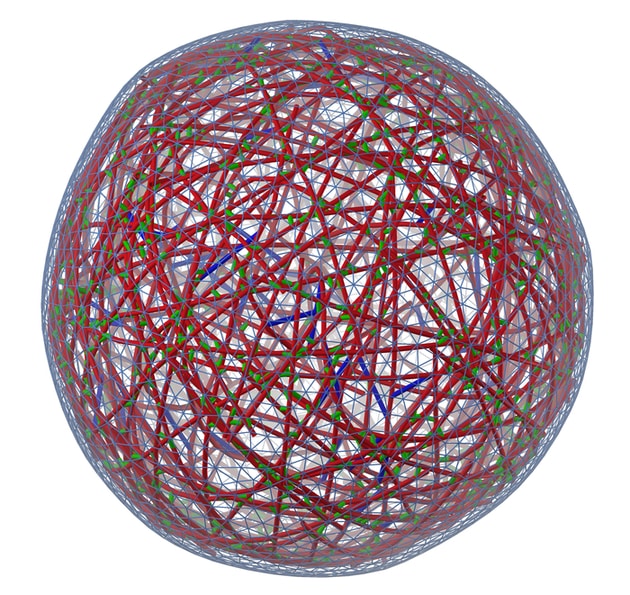
New supercomputer simulations developed by University of Maryland researchers reveal that these cytoquakes are caused by the slow buildup and sudden release of mechanical energy within the cell. The researchers believe the quakes may help the cell respond rapidly to signals from the outside environment, like chemicals produced by other cells or hormones in the bloodstream.
“Cytoquakes represent a sudden remodeling of a very important component of the cell, but the physics behind them really wasn’t known,” said Garegin Papoian, a co-author of the study who is the Monroe Martin Professor of Chemistry and Biochemistry with a joint appointment in the Institute for Physical Science and Technology at the University of Maryland. “We think these cytoquakes must be biologically important because the cytoskeleton is involved in so many functions within the cell. Understanding the physics behind them can provide insight into how cells work.”
The cytoskeleton is like an internal scaffolding within animal cells. It is made of a network of filaments that constantly grow, shrink, attach and detach from one another. In addition to providing structure to a cell, the filaments also serve as tracks for chemical signals to flow from one part of a cell to another.
Papoian and his colleagues hypothesized that the sudden rapid restructuring that happens in cytoquakes was the result of the cytoskeleton’s physical structure being particularly sensitive to its environment. He likens it to the sensitivity of a pile of sand compared with a brick. Both may be made of the same molecules, but the brick holds its structure, even under pressure, without collapsing. The pile of sand may hold its structure for a long while but then suddenly collapses into an avalanche of sliding sand.
To test the hypothesis, the team created a supercomputer simulation of a model cytoskeleton using a pioneering active matter simulation software that they developed called MEDYAN for “mechanochemical dynamics of active networks.” The software applies the laws of chemistry and physics to determine how the molecules within the cytoskeleton interact and behave.
The study revealed that the filaments in a cytoskeleton arrange themselves a bit like a shape-shifting tensegrity structure. In the macroscopic world, a tensegrity structure is a kind of geometric toy or sculpture made of cables and floating rods under tension and compression that appear to defy gravity. Analyzing these cellular tensegrity structures helped Papoian and his colleagues understand tension release within the cytoskeleton. They found that tension applied to one area of the structure can build and cause tension until it suddenly releases in another area. In other words, the cytoskeleton behaves more like a pile of sand than a brick.
The physical structure of the cytoskeleton allows tension to build between some of the filaments like the tension between grains of sand in a sand pile or between two tectonic plates along with a fault line. When some threshold is met, the tension suddenly releases, the pile of sand collapses, an earthquake rumbles or a cytoquake occurs.
“We postulate that the cytoquake mechanism poises the cell to react quickly to external signals from its environment compared to a system without this mechanism,” Papoian said.
For example, if a cell involved in repairing injuries must rush to the site of a wound, the cytoquake mechanism may respond to chemical signals from the injury site by jolting the cell into motion. When a cell migrates through the body, the leading edge may also use this mechanism to project or collapse protrusions as the cell probes its local neighborhood.
The team’s next step will be to expand on their simulation methods to include more parts of a cell such as a nucleus. They recently simulated the outer membrane of a cell and analyzed how the cytoskeleton pushes against this membrane to form finger-like protrusions.
“This work is showing us that we can use MEDYAN to model important components of a cell,” Papoian said. “Ideally, we would like to keep going and essentially build the fundamental model of a whole-cell at single-molecule resolution.”
Most stars including the sun generate magnetic activity that drives a fast-moving, ionized wind and also produces X-ray and ultraviolet emission (often referred to as XUV radiation). XUV radiation from a star can be absorbed in the upper atmosphere of an orbiting planet, where it is capable of heating the gas enough for it to escape from the planet's atmosphere. M-dwarf stars, the most common type of star by far, are smaller and cooler than the sun, and they can have very active magnetic fields. Their cool surface temperatures result in their habitable zones (HZ) being close to the star (the HZ is the range of distances within which an orbiting planet's surface water can remain liquid). Any rocky exoplanets that orbit an M-dwarf in its HZ, because they are close to the star, are especially vulnerable to the effects of photoevaporation which can result in partial or even total removal of the atmosphere. Some theorists argue that planets with substantial hydrogen or helium envelopes might become more habitable if photoevaporation removes enough of the gas blanket. 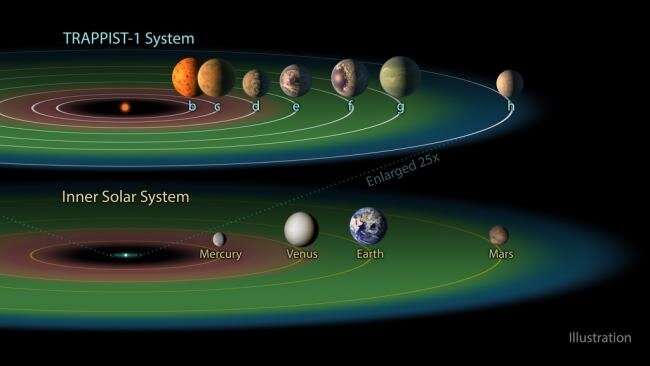
The effects of XUV radiation on exoplanet atmospheres have been studied for almost twenty years, but the effects of the stellar wind on exoplanet atmospheres are only poorly understood. Harvard-Smithsonian Center for Astrophysics (CfA) astronomers Laura Harbach, Sofia Moschou, Jeremy Drake, Julian Alvarado-Gomez, and Federico Frascetti and their colleagues have completed supercomputer simulations modeling the effects of stellar wind on an exoplanet with a hydrogen-rich atmosphere orbiting close to an M-dwarf star. As an example, they use the exoplanet configuration in TRAPPIST-1, a cool M-dwarf star with a system of seven planets, six of which are close enough to the star to be in its HZ.
The simulations show that, depending on the details, the stellar wind can generate outflows from a planet's atmosphere. The team finds that both the star's and the planet's magnetic fields play significant roles in defining many of the details of the outflow, which could be observed and studied via atomic hydrogen lines in the ultraviolet. The complex supercomputer simulation results indicate that planets around M-dwarf host stars are likely to display a diverse range of atmospheric properties, and some of the physical conditions can vary over short timescales making observational interpretations of sequential exoplanet transits more complex. The simulation results highlight the need to use 3D supercomputer simulations that include magnetic effects to interpret observational results for planets around M-dwarf stars.