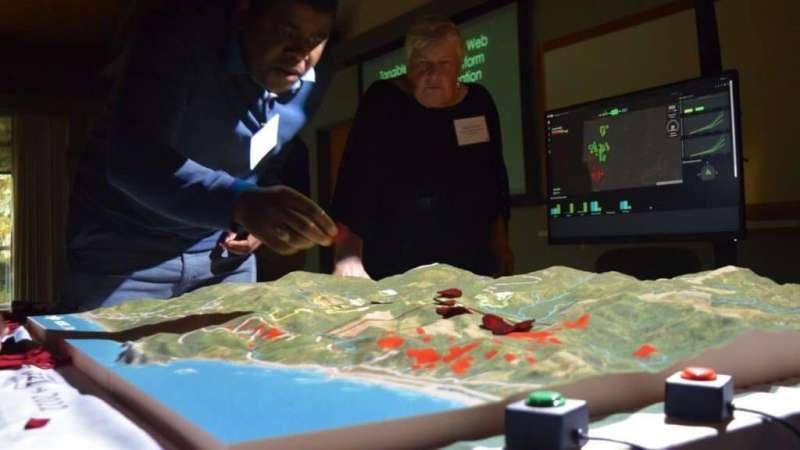
Lancaster researchers develop artificial intelligence systems that help to predict, warn of flooding

Professor Plamen Angelov leads a collaborative project with the European Space Agency's Φ-lab to develop a new AI system that will be able to efficiently analyze and interpret streams of satellite imagery and other data in real-time.

The new system would be able to improve flood alerts and rescue planning.

In previous work Professor Angelov, Chair in Intelligent Systems at Lancaster University's School of Computing and Communications has developed an 'explainable' approach to developing deep learning AI systems, called xDNN. This explainable approach helps to overcome a significant challenge in AI called the 'black box' problem - where humans cannot understand why an AI system makes a particular decision.

This three-year €180,000 research project, called 'Towards explainable AI for Earth Observation (AI4EO): a new frontier to gain trust into the AI', will build upon, develop further and apply Professor Angelov's xDNN system to images and other data captured by the European Space Agency's Sentinel satellite program.

The methods and algorithms developed within this project will process the images and other data faster and more efficiently than is currently achievable with added explainability and the ability to 'parallelize' - splitting and running the algorithm simultaneously on a cluster of multiple computers to get faster results.

Historically, automatic identification of water from satellite images involved a lot of manual steps and assumptions. It also often lacked robustness and accuracy in early flood detection.

More recent deep learning AI systems have achieved high accuracies and replaced the manual steps - however, they suffer from the black-box problem where their complex architecture makes them computational and energy demanding, opaque, and impossible to explain how decisions are made.

This research project into a new type of deep learning aims to develop more accurate and explainable predictions of flooding. The system should be faster to train, learn continuously and require less computational and electric power, which is very important especially for installations on satellites where the resources are scarce.

Professor Angelov, who is Director of the Lancaster Intelligent, Robotic and Autonomous Systems Centre, said: "All of us are aware that weather forecasting has improved over the years and that we are now able to receive updated weather alerts for rain on our phones. Flooding has huge economic and social impacts and often people only have short timeframes to react.

"By being able to more quickly, and accurately, detect floods in real-time from images and other data captured by satellites we can help improve alert systems and aid rescue planning, as well as the assessment of potential damage from floods. This has potential for significant societal benefit."

Japanese scientists use next-generation genome sequencer, supercomputer to show the arrangements of the genome's spool-like structures affecting gene expression

Scientists at Kyoto University's Institute for Integrated Cell-Material Sciences (iCeMS) in Japan have developed a technology that produces high-resolution simulations of one of the basic units of our genomes, called the nucleosome. Their findings should help improve understanding of how changes in nucleosome folding influence the inner workings of genes.

Nucleosomes are the basic structural units of DNA packaging inside the nucleus. They are formed of DNA wrapped around a small number of histone proteins. Nucleosomes move around inside the nucleus, folding and unfolding, changing their orientations, and moving closer together or further apart. These movements affect the accessibility of various molecules to DNA, determining when and how genes turn on and off. The research group has developed a new technology to analyze the 3D positions and orientations of nucleosomes using a next-generation genome sequencer and a supercomputer.  CREDIT Mindy Takamiya/Kyoto University iCeMS

"The 3D genome structure provides the physical molecular basis of gene expression processes in cells," explains iCeMS systems biologist Yuichi Taniguchi, who led the research.

To better visualize this structure, Taniguchi and colleagues developed Hi-CO, short for high-throughput chromosome conformation capture with nucleosome orientation. It builds on existing Hi-C technology by significantly improving resolution so that simulations show the 3D positions and orientations of every nucleosome analyzed in a sample.

"Being able to analyze this structure should help clarify the origins and control principles of many biological phenomena, including cell differentiation and immunity," says molecular biologist Masae Ohno, who conducted the experiments and analyses.

Hi-CO involves a month-long process in which enzymes and a variety of other molecules are used to treat an organism's genome, ultimately breaking down its DNA into millions of fragments that were close to each other due to nucleosome proximity. These fragments are then sequenced and the data is entered into a simulation program that shows the most likely orientations of each nucleosome.

Taniguchi and his team successfully tested Hi-CO on a yeast genome. They aim to next use it to analyze the genomes of other organisms while continuing to improve the technology. They also hope to use Hi-CO to study genome structures in various cell differentiation states and diseases.

Zhores supercomputer helps Russian researchers model new a method of generating gamma-ray combs

Skoltech researchers used the resources of the university's Zhores supercomputer to study a new method of generating gamma-ray combs for nuclear and X-ray photonics and spectroscopy of new materials. The paper was published in the journal Physical Review Letters.

A gamma-ray comb is a series of short bursts that, when plotted as intensity versus frequency, look as sharp and equally spaced teeth of a comb. Generating these combs at high brightness in the gamma-ray domain has been challenging because of something called ponderomotive spectral broadening - an effect that destroys the monochromaticity that allows gamma-ray sources to be used in nuclear spectroscopy, medicine, and other applications.

Sergey Rykovanov and Maksim Valialshchikov from the Skoltech High-Performance Computing and Big Data Laboratory as well as Vasily Kharin from Genity LLC offered a way to avoid this effect. To obtain the calculations needed to support this result, they used the Zhores supercomputing cluster at Skoltech.

"Our idea relies on a method that is very well known in the attosecond community--to use laser pulses with temporally varying polarization (with circular polarization in the wings and linear polarization only in the middle of the pulse) to gate emission of harmonics only to the part of the pulse where the polarization is linear," the authors write.

"Polarization gated pulses limit harmonics emission only to the region around the center of the pulse, where intensity gradients are smaller and harmonics emission efficiency is higher. Both of these lead to smaller ponderomotive broadening," Rykovanov says.

Maksim Valialshchikov adds that to run the tests necessary to confirm their results, the scientists needed a simulation with a large number of particles. "Zhores provides a large number of CPUs, and using part of them allows completing a single simulation order of magnitude faster than using a single laptop," he notes.

According to Rykovanov, the authors plan to conduct additional research regarding the impact of radiation friction and quantum effects on the visibility of gamma comb. "This will allow us to move towards the experimental observation of the proposed effect in the nearest future," he says.

The authors say their proposed method can be used in photonuclear experiments as well as nonlinear quantum electrodynamics experiments planned at DESY, the German particle accelerator research center, and SLAC National Accelerator Laboratory in the US.