

Magnetic liquid structure elucidated through hybrid reverse Monte Carlo simulation at Shinshu University

A research team lead by Ryusuke Futamura of Shinshu University investigated the response of magnetic ionic liquids (MIL) to magnetic fields from the microscopic viewpoints. Magnetic fluids, which can respond to magnetic fields, can be made by dispersing ferromagnetic nanoparticles in a solvent. Some pure liquids that are not mixtures also respond to magnetic fields. For example, oxygen is a liquid around -200°C and is attracted to magnets. In this study, pure magnetic ionic liquids Emim[FeCl4] and Bmim[FeCl4] were examined on the microscopic scale. These liquids are attracted to magnets at room temperature, but the former also undergo a change from paramagnetic to antiferromagnetic behavior at 3.8K.

Ferromagnetism is found in the objects which we think of as "magnets", such as refrigerator magnets. Magnetic atoms or ions have magnetic dipoles (north and south) in the molecular scale that interact with each other and show Ferro- or antiferromagnetism over a long distance in their crystal structures. Bmim[FeCl4] does not crystalize even at low temperatures and are amorphous, or formless. It was shown in this study that even in this amorphous state, there is structurality in the short-range and several magnetic ions form an aligned association structure. This is thought to be the reason for the negative Curie-Weiss temperature, which can be observed as a macroscopic physical property. CAPTION Magnetic ionic liquid structures were elucidated through hybrid reverse Monte Carlo simulation. The research results elucidated fundamental understanding of pure liquids with magnetic responses as well as lead to the development of MIL for a variety of practical applications.  CREDIT Ryusuke Futamura, Faculty of Science, Department of Chemistry, Shinshu University{module INSIDE STORY}
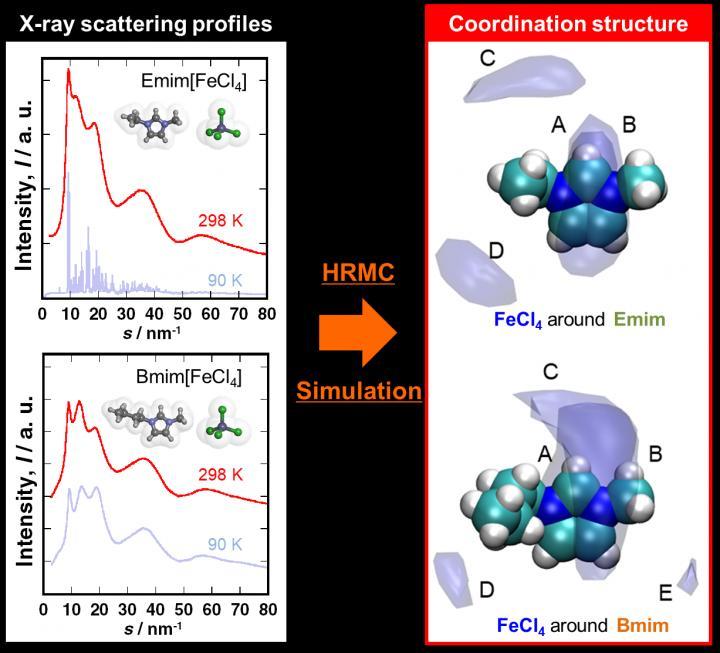
It was difficult to investigate and understand the formation of the liquid structure of Emim[FeCl4] and Bmim[FeCl4]. Liquids and amorphous objects do not have a long-range ordered structure, which means structural analysis of such materials is performed through X-ray scattering measurements followed by radial distribution analysis. However, MILs are binary systems consisting of cations and anions. This makes examination by ordinary radial distribution analysis difficult. This is where the hybrid reverse Monte Carlo (HRMC) method helped. It combined the X-ray scattering measurement with molecular simulation to clearly demonstrate the precise coordination structures of the two MIL. This has made it possible to discuss the cation-cation, anion-anion, and cation-anion of the liquid structure.

By the use of spatial distribution function analysis, it has become possible to visualize the ion coordination structure. The temperature dependence of the spatial distribution function showing the coordination structure of the anions around the cations in the MIL can be seen that the lower the temperature, the wider the coordination sphere and more blurred the site. The researchers were able to clarify the characteristics of substances that appear in macroscopic physical properties from a microscopic perspective.

First author Futamura specializes in the nano spaces of porous materials. He hopes to synthesize new composite materials by combining porous materials and ionic liquids. By confining MIL in the nano space of porous materials, he hopes to create new functional materials for various applications. These MIL are considered organic-inorganic hybrid functional materials that hold potential for outstanding chemical and physical uses.
Seven bridges collaborates on personalized treatment for kids with cancer

Seven Bridges has announced a collaborative partnership between The Gabriella Miller Kids First Data Resource Center (Kids First DRC), ZERO Childhood Cancer (ZERO), the Children's Brain Tumor Tissue Consortium (CBTTC), the Australian BioCommons and the Australian Research Data Commons (ARDC). The multinational genomic cancer research project aims to establish internationally federated computational infrastructure that will enable the harmonization of pediatric cancer data from ZERO Australia with the extensive genomic datasets from CBTTC and Kids First DRC. Through this collaboration, researchers hope to better understand rare pediatric brain cancer subtypes and improve interventions for patients and their families.

Large-scale cancer whole-genome sequencing (WGS), RNA-Seq and methylome analyses have made a substantial impact on our understanding of many cancers, including their etiology, identifying disease subtypes, novel pathways, and new drug targets. While there are a number of extensive genomic cancer research programs globally, most focus on adult cancer; however, as all high-risk pediatric cancer subtypes are rare diseases, statistically significant correlation between subtype and genomic variation is inherently dependent on large sample numbers.

"Childhood cancer kills more children than any other disease in Australia and every week three children and adolescents in Australia die because of cancer," said Mark Cowley, Ph.D., Associate Professor of the Children's Cancer Institute. "Every child is different, every cancer is unique, so treatment has to be tailored for each individual. Through an international data collaboration on pediatric cancer subtypes, we hope to better understand how to treat the cancers we find in Australia, based on information that was previously inaccessible."

The research will be done on the CAVATICA Platform, a cloud-based system for collaboratively accessing, sharing, and analyzing childhood cancer data. The CAVATICA Platform, powered by Seven Bridges, allows clinicians and scientists worldwide to rapidly access large amounts of genomic data and workflows within a computation and storage environment where they can share, process, integrate and analyze data. Complex and comparative analyses can be achieved using various open-source R and Python packages; and through the Data Cruncher feature, data can be shared through interactive Jupyter Notebooks.

"The CAVATICA Platform enables us to seamlessly collaborate, share, interoperate and connect with other researchers studying pediatric cancer, driving improved outcomes and novel research," said Adam Resnick, Ph.D., Kids First Data Resource Principal Investigator. "The platform has enabled us to harmonize and process over 15,000 whole genomes, whole becomes, and RNA-seq, including alignment, somatic variant calling, copy number calls, structural variants, RNA expression, and fusions. Additionally, integrations with the Kids First Data Resource Center portal allow users to create cohorts and manage their analysis in secure, cloud-based projects in CAVATICA."

To enable this multinational collaboration, the CAVATICA Platform is being expanded to enable harmonized analyses across geographically separated and jurisdictionally protected data datasets, in this case across Australia and the United States. The extended CAVATICA orchestration engine will allow ZERO and Kids First workflows and analysis tools to be used interchangeably and seamlessly across both datasets. From the researcher's perspective, the platform aggregates the separate datasets into a single virtual pan-continental dataset that is highly accessible through a global best practice analysis platform.

"By connecting pediatric researchers across international borders through the CAVATICA platform, we are also breaking down borders between data silos through the use of the global standard Common Workflow Language (CWL) and the ease of multi-cloud computing," said Brandi Davis-Dusenbery, Ph.D., Chief Scientific Officer of Seven Bridges. "This enables our researchers to focus on treatments for kids with rare cancers rather than data challenges."

Huge simulation finds new origin of supermassive black holes

Supercomputer simulations conducted by astrophysicists at Tohoku University in Japan have revealed a new theory for the origin of supermassive black holes. In this theory, the precursors of supermassive black holes grow by swallowing up not only interstellar gas but also smaller stars as well. This helps to explain the large number of supermassive black holes observed today.

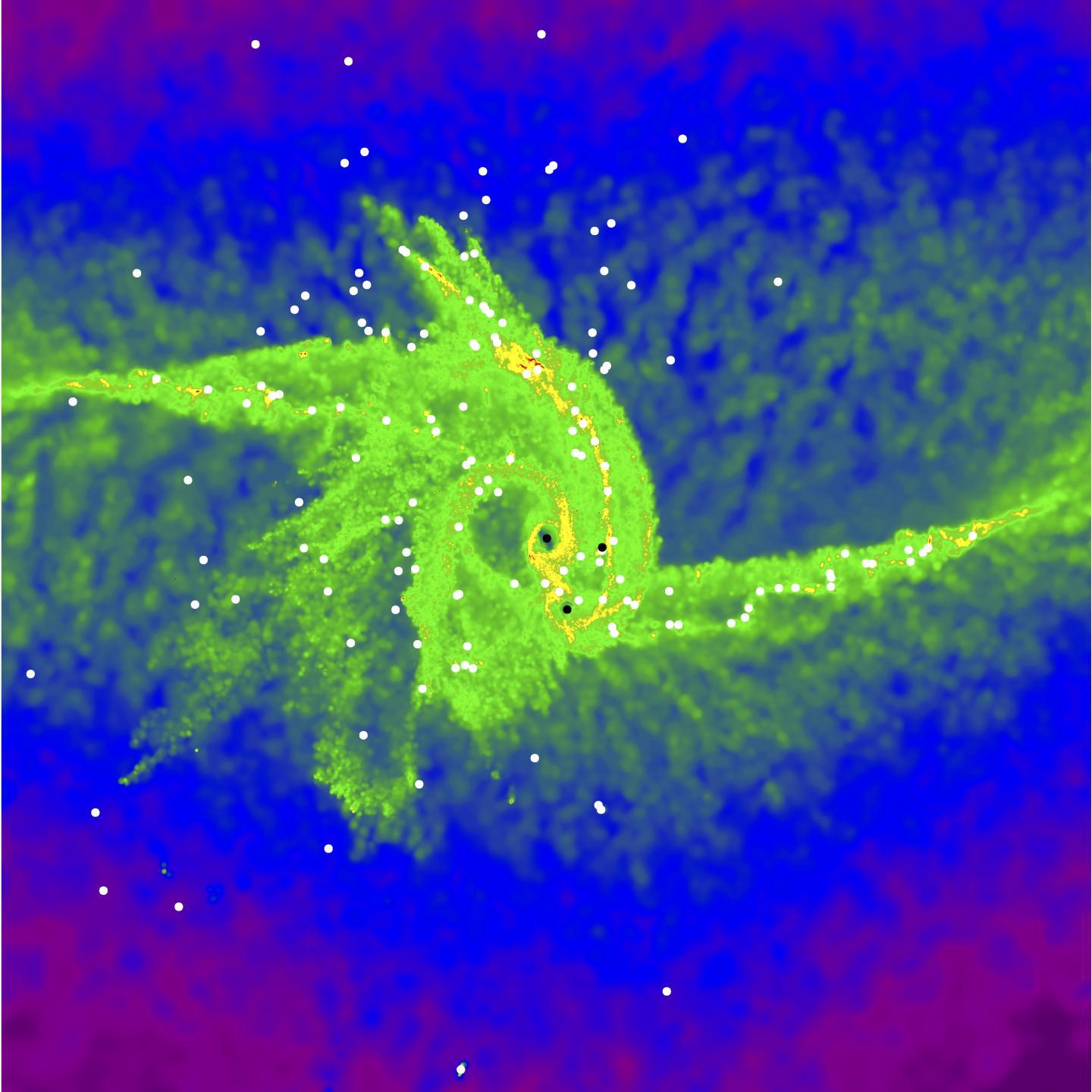
Almost every galaxy in the modern Universe has a supermassive black hole at its center. Their masses can sometimes reach up to 10 billion times the mass of the Sun. However, their origin is still one of the great mysteries of astronomy. A popular theory is the direct collapse model where primordial clouds of interstellar gas collapse under self-gravity to form supermassive stars which then evolve into supermassive black holes. But previous studies have shown that direct collapse only works with pristine gas consisting of only hydrogen and helium. Heavier elements such as carbon and oxygen change the gas dynamics, causing the collapsing gas to fragment into many smaller clouds which form small stars of their own, rather than a few supermassive stars. Direct collapse from pristine gas alone can't explain the large number of supermassive black holes seen today. CAPTION Snapshots of the simulations showing the distribution of matter in the Universe at the time of black hole formation (top) and the density distribution of black hole-producing gas clouds (bottom). In the bottom panel, the black dots near the center of the figure represent massive stars, which are thought to evolve into a black hole in time. The white dots represent stars that are smaller than 10 solar mass and were formed by the fragmentation of the gas cloud. Many of the smaller stars merge with the supermassive stars at the center, allowing the massive stars to grow efficiently.  CREDIT Sunmyon Chon{module INSIDE STORY}

Sunmyon Chon, a postdoctoral fellow at the Japan Society for the Promotion of Science and Tohoku University and his team used the National Astronomical Observatory of Japan's supercomputer "ATERUI II" to perform long-term 3D high-resolution simulations to test the possibility that supermassive stars could form even in heavy-element-enriched gas. Star formation in gas clouds including heavy elements has been difficult to simulate because of the computational cost of simulating the violent splitting of the gas, but advances in supercomputing power, specifically the high calculation speed of "ATERUI II" commissioned in 2018, allowed the team to overcome this challenge. These new simulations make it possible to study the formation of stars from gas clouds in more detail.

Contrary to previous predictions, the research team found that supermassive stars can still form from heavy-element enriched gas clouds. As expected, the gas cloud breaks up violently and many smaller stars form. However, there is a strong gas flow towards the center of the cloud; the smaller stars are dragged by this flow and are swallowed up by the massive stars in the center. The simulations resulted in the formation of a massive star 10,000 times more massive than the Sun. "This is the first time that we have shown the formation of such a large black hole precursor in clouds enriched in heavy-elements. We believe that the giant star thus formed will continue to grow and evolve into a giant black hole," says Chon.

This new model shows that not only primordial gas but also gas containing heavy elements can form giant stars, which are the seeds of black holes. "Our new model is able to explain the origin of more black holes than the previous studies, and this result leads to a unified understanding of the origin of supermassive black holes," says Kazuyuki Omukai, a professor at Tohoku University.