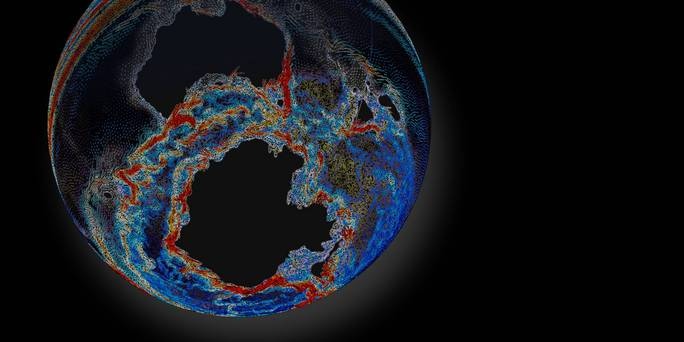
It is the mightiest river on Earth, yet no one has ever stood on its banks.
Encircling Antarctica in an unbroken loop, the Antarctic Circumpolar Current (ACC) moves more than 100 times the water of all the world’s rivers combined, shaping climate, isolating a continent, and quietly regulating the planet’s heat balance.
For decades, scientists believed they understood how it formed. But now, thanks to a new generation of supercomputer-driven simulations, that story is being rewritten, with profound implications for how we understand Earth’s past and future.
A climate engine born in chaos
Roughly 34 million years ago, Earth underwent one of its most dramatic transformations. The planet cooled from a greenhouse world, largely free of ice, into the “icehouse” climate we know today, with massive polar ice sheets taking hold.
At the same time, tectonic forces pulled continents apart. Ocean gateways opened between Antarctica, South America, and Australia. For years, it was thought that this was the key: once these passages widened, water could flow freely around Antarctica, forming the ACC and isolating the continent in cold waters.
Simple. Elegant. And, as it turns out, incomplete.
Supercomputers challenge a simple story
In a recent study, researchers used high-resolution climate and ocean simulations to revisit this long-standing assumption.
Their conclusion was that opening ocean gateways alone was not enough.
Instead, the birth of the ACC appears to have been a far more complex interplay of forces, one that only becomes visible when modeled at a massive computational scale.
Using supercomputers, scientists reconstructed ancient oceans in extraordinary detail, simulating currents, temperature gradients, atmospheric winds, and evolving ice sheets across millions of years. These models revealed that the current did not simply “switch on” when pathways opened. It required the right combination of circulation dynamics, wind patterns, and climate feedback to fully emerge.
In other words, the ACC was not just a consequence of geography.
It was a product of a system.
The power of simulation
Recreating Earth’s ancient oceans is not a task for ordinary computation.
These simulations must resolve interactions across vast scales, from swirling ocean eddies to global heat transport, while also accounting for atmospheric circulation, carbon dioxide levels, and ice sheet growth.
Each variable influences the others in a tightly coupled system.
Supercomputers make this possible.
They allow scientists to run “what-if” scenarios across geological time:
- What if the gateways opened earlier?
- What if CO₂ levels remained higher?
- What if winds shifted differently?
By iterating through these possibilities, researchers can isolate the conditions that gave rise to one of Earth’s most powerful climate engines.
It is less like solving a puzzle and more like replaying planetary history.
A current that shapes everything
Why does this matter?
Because the ACC is not just an ocean current, it is a global regulator.
Flowing uninterrupted around Antarctica, it acts as a barrier, preventing warmer waters from reaching the continent and helping maintain its vast ice sheets.
It connects the Atlantic, Pacific, and Indian Oceans, redistributing heat, carbon, and nutrients across the globe.
In many ways, it is the heartbeat of the Southern Ocean.
Understanding how it formed is key to understanding how it might change.
Looking back to see forward
One of the most striking insights from this research is how deeply the past informs the future.
Around the time the ACC formed, atmospheric CO₂ levels were roughly 600 parts per million, levels that modern climate scenarios suggest we could approach again.
By simulating that ancient world, scientists gain a rare opportunity: to observe how Earth’s systems behaved under conditions similar to those we may soon face.
But this is not a prediction in the traditional sense.
It is something more powerful.
It is understanding.
The age of computational Earth science
What makes this discovery truly inspiring is not just what it reveals about the ACC, but what it reveals about science itself.
We are entering an era where the most important frontiers are not only in space or in the field, but inside machines.
Supercomputers now allow us to:
- Reconstruct the climates that existed tens of millions of years ago
- Test planetary-scale hypotheses
- Explore systems too vast, too slow, or too complex to observe directly.
They have become time machines for Earth science.
A current, reimagined
The Antarctic Circumpolar Current was once thought to be a simple consequence of shifting continents.
Now, it emerges as something far more profound: a dynamic, evolving system born from the interplay of ocean, atmosphere, ice, and time.
And it took supercomputing to see it clearly.
As we confront a changing climate, this lesson resonates deeply. The systems that shape our planet are rarely simple. They are layered, interconnected, and often surprising.
But with enough computational power and enough curiosity, we can begin to understand them.
Even the ones that circle the Earth unseen.