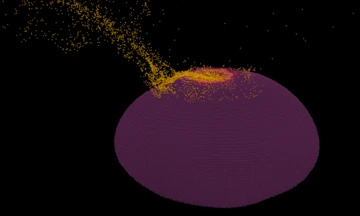
In the distant reaches of the asteroid belt between Mars and Jupiter, a metallic world named 16 Psyche preserves vital clues to planetary formation. Once thought to be the exposed core of an incomplete planet, Psyche is now at the center of groundbreaking research led by scientists from the University of Arizona. Using supercomputer simulations, they are re-examining the asteroid’s surface to unravel secrets about the early solar system.
Central to this research are the vast impact craters that pockmark Psyche’s exterior. These craters are not mere remnants of collisions; they hold essential information about the asteroid’s internal makeup, composition, and origins. Unlocking these secrets requires more than careful observation, it demands large-scale computational reconstruction.
From Telescope Data to Computational Models
Asteroid Psyche, roughly 220 kilometers in diameter, is one of the most massive metal-rich bodies in the asteroid belt.
Yet its composition remains debated. While once believed to be a solid iron-nickel core, more recent evidence suggests a mixed metal–silicate structure, complicating assumptions about its formation.
To resolve this uncertainty, researchers are turning to large-scale numerical impact simulations, using supercomputers to model how craters form under different material conditions. By comparing simulated crater morphologies with observational data, scientists can infer what lies beneath Psyche’s surface.
This approach effectively transforms crater analysis into an inverse problem, one where the observed geometry must be matched to a forward model of high-energy impacts governed by nonlinear physics.
HPC at the Core of Planetary Reconstruction
The study, published in Journal of Geophysical Research: Planets, leverages hydrocode simulations, a class of numerical methods used to model shock physics, material deformation, and high-velocity impacts. These simulations solve coupled partial differential equations describing:
- Momentum conservation under extreme pressures
- Energy transfer during hypervelocity collisions
- Phase transitions in metal and silicate materials
- Fragmentation and ejecta dynamics
Such models are computationally intensive. Each simulation must resolve fine spatial and temporal scales while exploring a large parameter space, including:
- Impactor size and velocity
- Target composition (metal-rich vs. mixed material)
- Porosity and internal layering
- Gravity regime of the asteroid
Running these scenarios across multiple configurations requires massively parallel HPC systems, often executing thousands of simulations to converge on statistically robust interpretations.
Craters as Probes of Internal Structure
One of the key insights from the study is that crater size alone is not sufficient to infer surface composition. Instead, the shape, depth, and ejecta distribution of craters vary significantly depending on whether the target material behaves like solid metal, fractured rock, or a porous composite.
Supercomputer simulations revealed that some of Psyche’s largest craters are more consistent with impacts into a lower-density or heterogeneous, rather than purely metallic, body. This finding aligns with recent observational and spectral data suggesting Psyche is not a simple exposed core, but a more complex, differentiated object.
In practical terms, this suggests the asteroid’s history likely includes a sequence of complex processes: partial differentiation followed by structural disruption, subsequent re-accumulation of mixed materials, and repeated high-energy impact events.
Each of these scenarios leaves distinct signatures in crater morphology, signatures that only become interpretable through computational modeling.
A Digital Twin Ahead of NASA’s Arrival
The timing of this work is particularly significant. NASA’s Psyche mission, launched in 2023, is expected to arrive at the asteroid in 2029.
By the time the spacecraft begins transmitting high-resolution imagery and gravity data, researchers aim to have a computational framework already in place, a kind of digital twin of Psyche that can rapidly assimilate new observations.
For HPC users, this represents a familiar paradigm:
- Build large ensembles of forward simulations.
- Precompute parameter sensitivities.
- Utilize observational data to constrain model space in real-time.
In planetary science, this workflow is becoming increasingly central as datasets grow and missions demand faster scientific interpretation.
"Large impact basins or craters excavate deep into the asteroid, which gives clues about what its interior is made of," said Namya Baijal, a doctoral candidate at the LPL and first author of the paper. "By simulating the formation of one of its largest craters, we were able to make testable predictions for Psyche's overall composition when the spacecraft arrives."
Inspiration for the Supercomputing Community
For supercomputing engineers, Psyche offers a compelling example of how HPC extends beyond traditional domains into planetary-scale inference problems.
The work illustrates a broader shift: modern space science is no longer limited by data collection, but by our ability to simulate, compare, and interpret complex physical systems.
Craters, once viewed as static geological features, are now dynamic datasets, decoded through parallel computation and advanced modeling.
And in those impact scars, billions of years old, supercomputers are helping scientists read a story that was once thought unreachable: the formation of worlds, written in metal and stone, reconstructed in code.