Astronomers at the McDonald Observatory, collaborating with the Hobby-Eberly Telescope Dark Energy Experiment, have created what they call the most detailed 3D map to date of faint hydrogen emissions from the early universe. This achievement is powered by massive data processing and supercomputing, highlighting both the opportunities and interpretive hurdles of computational cosmology.
This research seeks to map Lyman-alpha emission, the light given off when hydrogen atoms are energized by star formation, during a pivotal era about 9 to 11 billion years ago. The findings provide insight into how galaxies and intergalactic gas developed in this crucial period of cosmic history.
For HPC engineers and computational scientists, however, the project poses a key question: how much of the resulting map is based on direct observation, and how much is inferred through large-scale data processing?
Turning Half a Petabyte Into a Map
The raw data behind the project is formidable. Observations collected by the Hobby-Eberly Telescope produced more than 600 million spectra across a wide region of the sky. To process the data, researchers used supercomputing resources at the Texas Advanced Computing Center.
In total, roughly half a petabyte of observational data was sifted through using custom software pipelines designed to extract faint spectral signatures from the background noise.
This is a familiar workflow for HPC users: large-scale reduction pipelines, statistical signal extraction, and multi-stage modeling designed to convert massive observational datasets into structured scientific products.
But the map itself was not built by directly detecting every galaxy.
Instead, the team relied on a statistical technique known as line intensity mapping.
A Blurred Picture of the Cosmos
Traditional galaxy surveys attempt to catalog individual objects one by one. Intensity mapping takes a different approach: it measures the combined brightness of specific spectral lines across large regions of space, effectively capturing aggregate emission from both bright and faint sources simultaneously.
One scientist involved in the project compared the method to looking through a “smudged plane window,” the image is blurrier, but it reveals light from many otherwise invisible sources.
For HPC practitioners, this analogy should sound familiar. Intensity mapping is less about high-resolution object detection and more about statistical reconstruction from incomplete data, similar to techniques used in tomography, cosmological simulations, and signal processing.
In this case, the reconstruction relied on a computational assumption: regions near known bright galaxies are likely to host additional faint galaxies and intergalactic gas, due to the gravitational clustering of matter. The positions of bright galaxies were therefore used as anchors to infer the locations of surrounding faint structures.
This strategy dramatically increases the amount of usable information extracted from observational surveys, but it also introduces a layer of modeling.
When Data Analysis Becomes Astrophysics
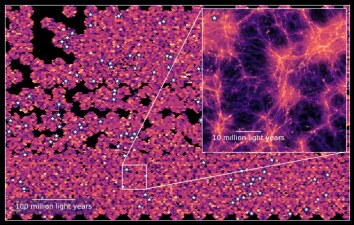
The resulting map reveals what researchers describe as a “sea of light” filling the spaces between previously cataloged galaxies. The signal suggests the presence of numerous faint galaxies and diffuse hydrogen gas that traditional surveys have missed.
From a computational standpoint, the achievement is significant. Processing hundreds of millions of spectra and reconstructing a three-dimensional cosmic structure from partial signals requires large-scale parallel workflows, sophisticated statistical filtering, and high-throughput data handling.
But the skeptical HPC user might ask an uncomfortable question:
If the map relies partly on statistical inference and clustering assumptions, how much of the detected structure is truly observed, and how much is model-dependent reconstruction?
The researchers themselves acknowledge this tension. The new map, they say, can now serve as a reference point for testing cosmological simulations of the same epoch.
In other words, the observational data may help validate or challenge theoretical models that attempt to describe the early universe.
HPC’s Expanding Role in Observational Cosmology
Regardless of interpretive debates, the project highlights a growing trend in astronomy: observational science is becoming increasingly computational.
Large surveys such as HETDEX collect far more data than traditional analysis pipelines can process manually. Instead, researchers rely on supercomputers to filter, correlate, and model enormous datasets.
In practice, this means that discoveries increasingly emerge not just from telescopes, but from the intersection of instrumentation, algorithms, and HPC infrastructure.
For supercomputing engineers, this evolution presents both opportunity and responsibility. As astronomical datasets continue to scale toward the exabyte era, the distinction between data analysis and theoretical modeling will become increasingly intertwined.
And sometimes, the most important question is not simply what the universe is telling us, but how much of that message is being interpreted through the lens of our algorithms.