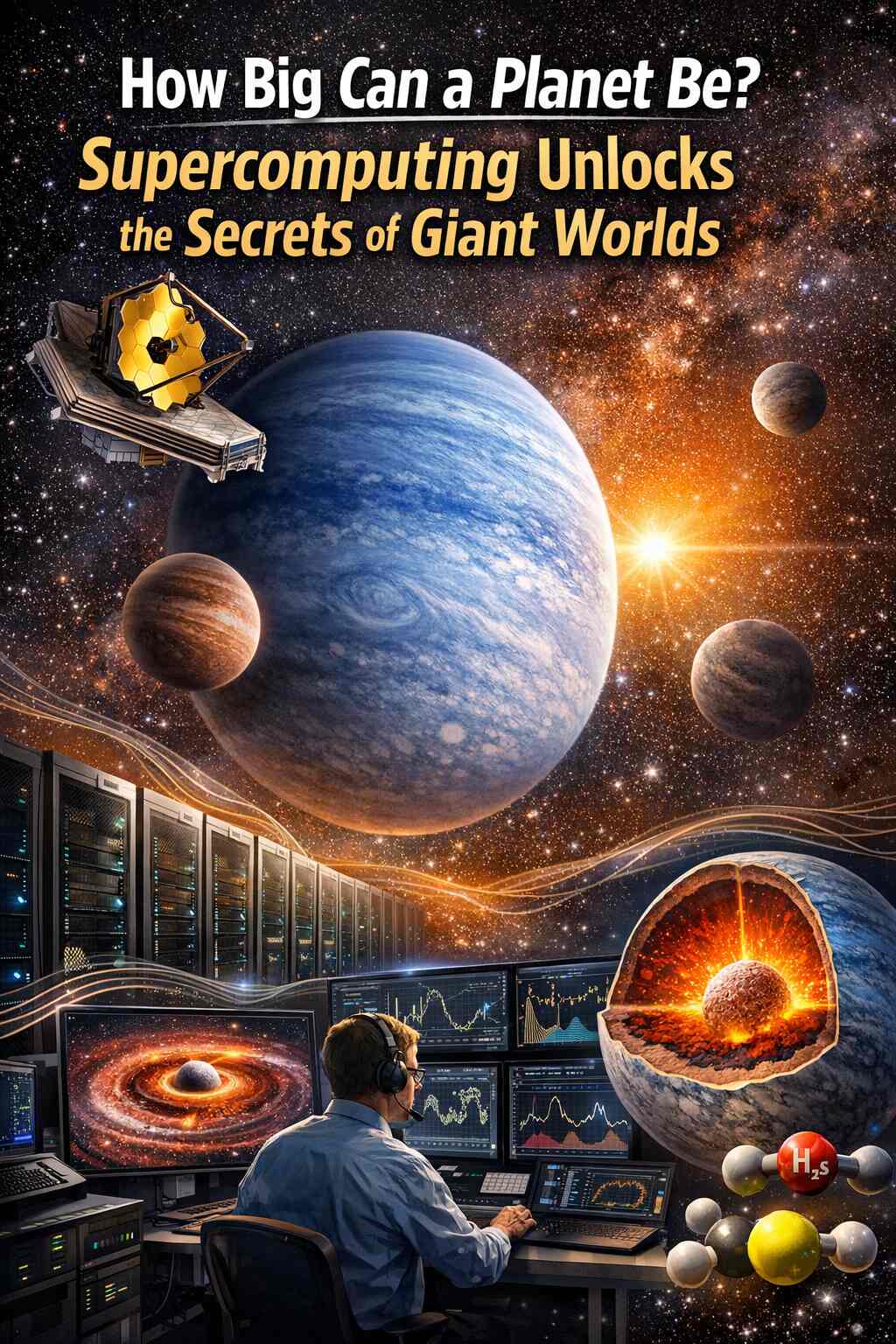
Planetary science is undergoing a remarkable transformation as astronomers revisit a core cosmic mystery: What are the true limits on how large a planet can grow? By combining the latest astronomical observations with the extraordinary capabilities of supercomputers, researchers are discovering that the boundary between massive planets and failed stars is less distinct than previously believed. This work highlights how crucial computational power has become in unraveling the complexities of the universe. Driving this scientific revolution is the HR 8799 star system, situated roughly 133 light-years from Earth in the constellation Pegasus. Here, four gigantic gas planets, each five to ten times the mass of Jupiter, are challenging traditional models of planet formation that are based on our own solar system.
From JWST’s Spectra to Computational Insights
The groundbreaking observations came from the James Webb Space Telescope (JWST), humanity's most powerful space observatory. JWST’s advanced spectrographs captured faint light from these distant giants, around 10,000 times fainter than their star, and revealed the spectral fingerprints of molecules previously hidden from view. Among these was hydrogen sulfide (H₂S), a refractory molecule that is a tell-tale marker of solid materials in the early planetary disk.
Identifying sulfur and other heavy elements in these far-off worlds was only possible thanks to supercomputing-driven atmospheric models and spectral extraction techniques. Researchers had to push simulations far beyond traditional grids, iteratively refining the physics and chemistry encoded in their models to match the rich JWST data. These computational efforts let scientists separate the faint planetary signals from the overwhelming glare of the host star, and decode what the spectral lines say about formation paths.
What they found is remarkable: the HR 8799 giants appear to have formed via core accretion, a process where planets grow gradually by accumulating solids into a dense core before capturing surrounding gas. This is the same fundamental mechanism thought to have shaped Jupiter and Saturn, but on a much grander scale and at far greater distances from their star.
Uniform Enrichment: A Shared Planetary Heritage
In the companion work, scientists reported that these massive exoplanets are uniformly enriched in heavy elements compared to their star across both volatile (like carbon and oxygen) and refractory species such as sulfur. This uniformity strongly points to efficient solid accretion during planet formation and suggests that the ingredients of planet-building are similar across a wide range of environments, even for giants many times Jupiter’s mass.
Crucially, interpreting these complex chemistry wouldn’t be possible without high-performance computing. Supercomputers are used to:
- Simulate protoplanetary disk conditions, exploring how cores form and accrete material over millions of years.
- Generate atmospheric models that predict how molecules absorb and emit light under varying temperatures and pressures.
- Fit these models to real spectral data from JWST, using optimization techniques only feasible at scale.
These tasks require petaflops of processing power and terabytes of memory, and they leverage algorithms developed by astrophysicists and computational scientists alike.
Beyond Our Solar System and Beyond Traditional Limits
Why does this matter for supercomputing? Answering today's big questions about planets, whether they are Earth-like, Neptune-like, or giants towering over Jupiter depends on the ability to compute the physics of formation and evolution under conditions we cannot recreate in the lab.
Where once planetary formation theories were built around our solar system’s modest giants, the HR 8799 results push us to ask even bolder questions: Can planets reach 15, 20, or even 30 times Jupiter's mass while still forming like planets, rather than stars? And, if so, what does that mean for how we define planets versus brown dwarfs?
With supercomputing as our engine, astronomers are not just cataloging distant worlds; they are rewriting the science of how those worlds came to be. As more data from JWST and future observatories pour in, this fusion of observation, theory, and computation promises to transform our understanding of planetary systems across the galaxy.
In that sense, the answer to "how big can a planet be?" isn’t just about mass, it’s about the growing scale of human curiosity and the computational tools we build to answer it.