JERA, Dell and RHAELM target $15 billion Chiba hyperscale AI facility as Japan experiments with a new model for building compute where electricity is already available
The next generation of AI supercomputing may not begin with a GPU.
It may begin with a power plant.
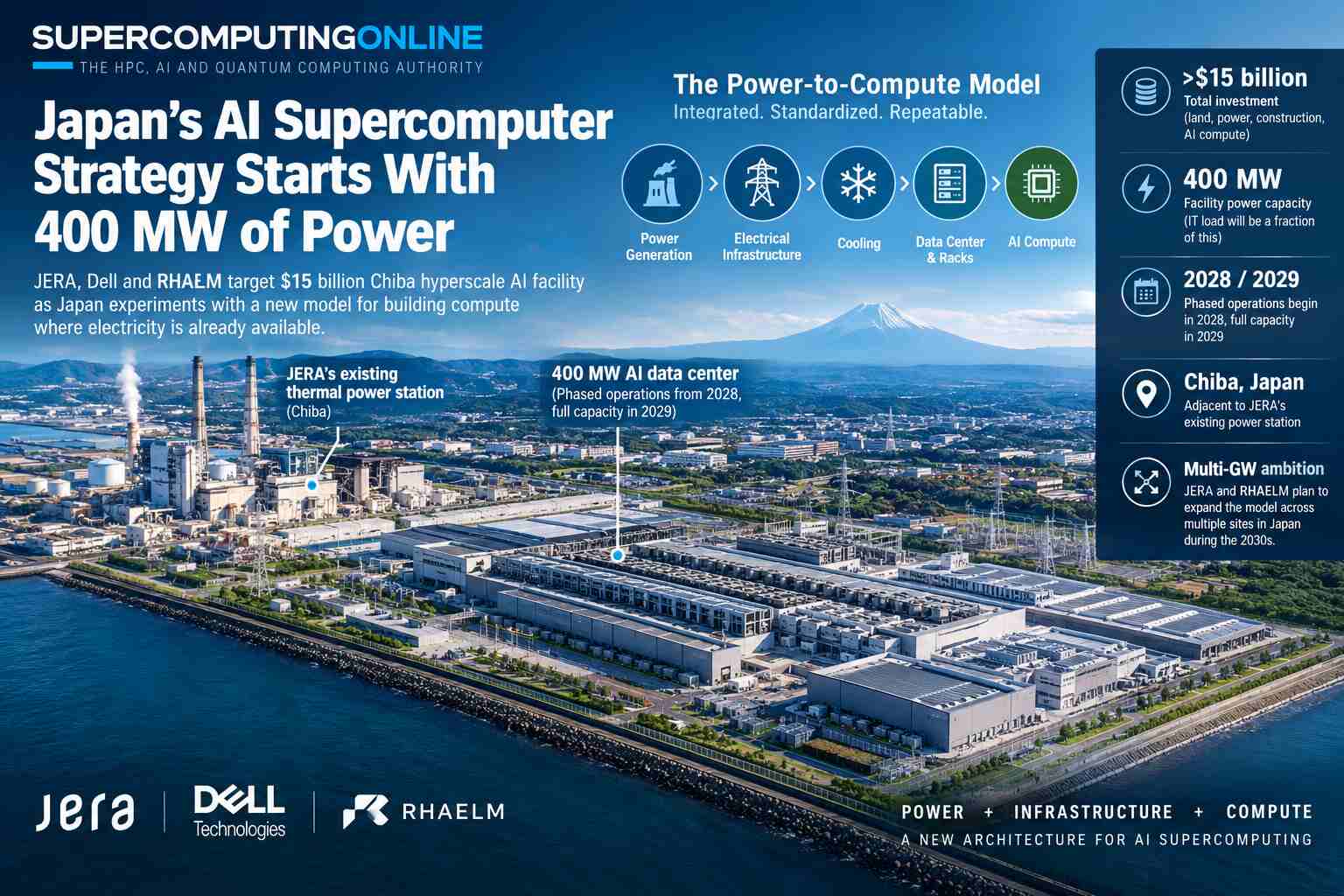
In a strategic collaboration, Japan’s primary power generator, JERA, has partnered with Dell Technologies and AI infrastructure developer RHAELM Holdings to pioneer a novel hyperscale computing model. This initiative integrates electricity generation, electrical infrastructure, advanced cooling, data center construction, and rack-scale AI computing into a single, cohesive deployment rather than treating them as fragmented projects.
The model’s inaugural implementation is a planned 400-megawatt AI data center in Chiba, situated adjacent to JERA’s existing thermal power station. This ambitious undertaking represents a total capital commitment exceeding $15 billion, covering land acquisition, power infrastructure, facility development, and AI compute capacity. According to JERA and Reuters, operations are projected to start in phases by 2028, with the facility achieving its full 400-MW capacity by 2029.
For the supercomputing industry, however, the financial scale and construction timeline are secondary to the underlying innovation. The partners are addressing one of the AI era's most critical challenges: rapidly converting raw electrical power into scalable, high-performance computing capacity.
The power bottleneck becomes the computing bottleneck
For decades, supercomputer deployments have generally been treated as technology projects. A facility is built, electrical capacity is secured, cooling systems are installed, networks are provisioned, and compute systems are eventually delivered and integrated.
AI is putting pressure on that sequence.
Modern AI clusters can require enormous amounts of power concentrated into relatively small physical footprints. Thousands of accelerators operating simultaneously create not only a power requirement but also a corresponding cooling, networking, storage and electrical-distribution problem.
As AI systems become larger, the availability of processors is therefore only one part of the equation.
There has to be somewhere to plug them in.
The Chiba project attacks that problem from the opposite direction. Rather than first developing a conventional grid-connected data center and then waiting for sufficient electrical capacity to become available, the partners plan to place the compute infrastructure alongside an existing generation asset.
JERA says the project will operate behind the meter, using power capacity from its operating generation asset. The company argues that this can allow AI computing capacity to come online years earlier than a conventional grid-connected development schedule.
That concept changes the starting point for hyperscale AI construction.
Instead of:
Data center → grid connection → wait for power → compute
the model becomes:
Generation → electrical infrastructure → cooling → compute
The distinction could become increasingly important as AI data-center developers encounter lengthy grid-interconnection queues and constrained transmission capacity.
400 MW is a supercomputing-scale number
The Chiba facility’s 400 MW power capacity provides a useful indication of the scale of infrastructure being contemplated.
It is important, however, to distinguish between facility power capacity and compute power.
A 400-MW data center does not mean 400 MW of GPUs or accelerators.
The site’s electrical envelope must support much more than processors. It encompasses power conversion and distribution, cooling infrastructure, networking, storage, CPUs, memory, accelerator systems, building systems, and other facility loads.
The actual IT load will depend on the final design and power-utilization characteristics of the facility.
Nevertheless, 400 MW represents an enormous potential computing envelope.
At high accelerator densities, the facility could support an extraordinary concentration of AI compute. The precise number of GPUs or other accelerators cannot be calculated from the 400-MW figure alone because it depends on the eventual rack architecture, accelerator selection, networking topology, storage requirements, and facility overhead.
That uncertainty is important.
400 MW is a statement about the infrastructure’s ability to deliver power, not a published specification for the number of processors inside it.
The rack becomes the building block
Dell’s role in the project points toward another important architectural change.
The company will provide standardized, rack-scale AI infrastructure, with JERA describing Dell’s AI Factory as the mechanism for standardizing the compute layer.
That is significant because the rack is becoming an increasingly important unit of AI infrastructure.
Traditional data-center architecture often treated servers as relatively interchangeable building blocks. AI clusters are different. Accelerator systems require carefully engineered relationships among:
- accelerators;
- host CPUs;
- high-bandwidth memory;
- local and parallel storage;
- high-speed fabric;
- power distribution;
- thermal management;
- software;
- orchestration; and
- cluster management.
The result is closer to a supercomputer node architecture multiplied across thousands of systems than to a conventional server farm.
At hyperscale, the physical rack itself becomes a systems-engineering object.
Power delivery, liquid cooling, network topology, and compute density must all be designed around the rack.
Dell’s standardized rack-scale approach is therefore intended to make the compute component repeatable.
RHAELM’s role is to integrate that compute infrastructure with the site, power and data-center construction.
JERA supplies the power and physical location.
The three pieces form the proposed deployment model.
Cooling becomes a first-class HPC problem
Power is only half of the physical equation.
Nearly every watt consumed by an accelerator eventually becomes heat that must be removed.
That means a 400-MW-class AI facility is also a massive thermal-management project.
As accelerator densities increase, traditional air cooling becomes increasingly difficult to apply economically at the highest rack densities. Liquid cooling, whether direct-to-chip, cold-plate or other advanced architectures, can provide substantially greater heat-transfer capability.
JERA’s announcement specifically identifies cooling infrastructure as one of the elements the partners intend to standardize alongside power generation, electrical infrastructure and AI computing.
That detail may ultimately prove more important than it first appears.
A future AI supercomputer is not simply a collection of processors connected by a network.
It is a coupled physical system:
electricity → voltage conversion → compute → heat → liquid cooling → heat rejection
Every stage affects the others.
A higher-density accelerator rack may deliver more AI performance per unit of floor space, but it simultaneously increases electrical and thermal engineering requirements.
The ability to standardize those systems could become one of the keys to shortening deployment times.
The network will determine whether 400 MW becomes useful compute
There is another critical layer between electricity and useful AI performance: interconnect.
Large AI models are increasingly distributed across thousands of accelerators. Training efficiency depends not simply on the raw compute capability of each accelerator but on how efficiently the cluster can exchange data.
That makes the network a component of the supercomputer.
High-bandwidth links connect accelerators within systems and racks, while larger-scale fabrics connect nodes across the cluster. Storage systems must simultaneously feed training pipelines with enormous quantities of data.
Consequently, a 400-MW facility cannot be evaluated simply by asking how many accelerators can fit inside it.
The more meaningful question is:
How much synchronized AI computation can the entire facility sustain?
That depends on the interaction among compute, memory, networking, storage, software and power.
The Chiba architecture is therefore better understood as a potential hyperscale AI supercomputing platform than simply a very large data center.
From one power station to a national AI infrastructure model
This is where the project becomes considerably more ambitious.
JERA, Dell and RHAELM are not presenting Chiba solely as a one-off campus.
The companies signed an MoU to develop a standardized framework for building AI infrastructure at national scale in Japan.
JERA and RHAELM intend to explore deploying the model at additional JERA sites, with an ambition of supporting multi-gigawatt-scale AI infrastructure across Japan during the 2030s.
That changes the significance of the 400-MW Chiba installation.
It becomes a prototype.
If the partners can establish a repeatable relationship between:
power station + site + electrical infrastructure + cooling + data center + rack-scale AI
then the next facility potentially does not have to begin as a blank-sheet engineering exercise.
The architecture can be repeated.
That is the industrialization opportunity.
Japan’s answer to the “speed to power” problem
The phrase emerging around the project is “speed to power.”
JERA’s CEO Yukio Kani has identified access to large-scale reliable energy as one of the critical constraints on AI infrastructure deployment. The company’s argument is straightforward: if the computing facility can be placed alongside existing generation, developers can potentially avoid some of the delays associated with conventional grid-connected development.
That is becoming a fundamental issue for the entire AI industry.
The global AI buildout is creating demand for data centers faster than traditional energy and transmission infrastructure can necessarily be developed.
The resulting problem is not simply a shortage of data-center buildings.
It is a synchronization problem.
Compute can be manufactured faster than power infrastructure can be connected.
AI developers therefore increasingly have to solve several schedules simultaneously:
- accelerator availability;
- data-center construction;
- grid interconnection;
- transmission capacity;
- power generation;
- cooling equipment;
- network equipment;
- storage;
- and capital deployment.
A delay in any one of those components can delay the entire AI cluster.
Chiba attempts to collapse several of those schedules into one integrated project.
The LNG connection
There is another unusual element to the Japanese approach.
JERA’s business spans much of the LNG value chain, including procurement, shipping, receiving and regasification infrastructure, and power generation.
The company’s announcement describes the initiative as an integrated model connecting LNG supply with AI computing.
That makes the project fundamentally different from a conventional hyperscaler simply purchasing electricity from the grid.
The proposed architecture links fuel supply, generation and compute infrastructure more tightly together.
The implication is significant for AI infrastructure planning: energy procurement itself can become part of the supercomputer architecture.
The processor may sit thousands of miles away from a natural-gas field, but the reliability of the resulting AI cluster ultimately depends on the physical energy chain that supplies its electricity.
$15 billion is the infrastructure, not a GPU purchase
The project’s financial headline deserves careful interpretation.
The announced investment exceeds $15 billion across all phases, but that amount encompasses the entire Chiba development, including land, power infrastructure, construction, and AI computing capacity. It is not a $15-billion Dell hardware order.
Apollo Global Management is expected to serve as a strategic investment and financing partner for RHAELM.
That financing structure reflects another reality of hyperscale AI:
The next generation of supercomputers is becoming an infrastructure-finance problem as much as a semiconductor problem.
A 400-MW facility requires enormous capital commitments before it can generate computing revenue.
Investors therefore have to underwrite not merely processors and servers but long-lived physical infrastructure, power contracts, cooling systems, buildings and operating capacity.
A potential template beyond Japan
The companies explicitly intend to explore applying the model beyond Japan over time.
That could make Chiba an interesting experiment for other electricity-constrained markets.
The underlying idea is not geographically complicated:
Find large, reliable generation.
Place compute beside it.
Standardize the electrical, cooling, and compute architecture.
Repeat.
That model could be attractive wherever conventional grid expansion is becoming the limiting factor for AI infrastructure.
It also potentially changes the geography of supercomputing.
Historically, compute clusters have often been located according to network connectivity, proximity to users, real-estate costs or access to established data-center markets.
The AI era may increasingly add another dominant variable:
Where is the power?
The supercomputer of the future may be built around the megawatt
For the HPC industry, perhaps the most important lesson from Chiba is that compute capacity is increasingly measured in two dimensions simultaneously.
One is familiar:
How much computation can the machine perform?
The other is becoming unavoidable:
How many megawatts can the site deliver continuously?
A cluster can have the world’s fastest accelerators and still fail to become a useful supercomputer if it cannot supply sufficient power, remove sufficient heat, move data fast enough, or maintain the system at high utilization.
That makes power, cooling, and interconnect first-class components of computational architecture.
The Chiba project puts that concept into physical form.
A power station becomes the foundation.
A data center becomes the computational shell.
Rack-scale AI systems become the building blocks.
High-speed networks connect them into a distributed machine.
And software turns the entire installation into a usable computational resource.
That is a supercomputer.
Just a very, very large one.
Chiba could be the beginning, not the destination
The proposed project is significant, representing a 400 MW capacity, a capital expenditure exceeding $15 billion, and a phased operational timeline commencing in 2028, with full functionality expected by 2029.
However, the broader implication of this initiative is the potential to establish the Chiba architecture as a repeatable model for infrastructure development. Should this effort succeed, Japan will not merely be constructing a hyperscale AI data center; it will have pioneered a standardized mechanism for repurposing existing power infrastructure into robust, large-scale sovereign AI computing capacity.
This represents a profound shift in the economics of supercomputing. While computation and semiconductor manufacturing capacity have historically served as the primary constraints, electricity has emerged as the critical scarce resource. Consequently, the competition to develop next-generation AI supercomputers will likely be determined not only within semiconductor fabrication plants or server assembly facilities but at the power stations themselves. In Chiba, Japan is asserting that the most efficient pathway to expanding AI compute capacity begins with a foundational asset: the power plant.