Mark Zuckerberg argues that the future of AI depends not on concentrating superintelligence in a handful of institutions, but on putting enormous computing power into the hands of billions. The harder question may be whether the world can build enough infrastructure to make it possible.
For decades, supercomputing was something most people could only experience indirectly. The machines lived inside government laboratories, universities and corporate research centers. They simulated nuclear reactions, modeled weather systems, designed aircraft, explored galaxies and helped scientists understand the molecular machinery of life.
The average person never touched a supercomputer. Now, that boundary is beginning to disappear.
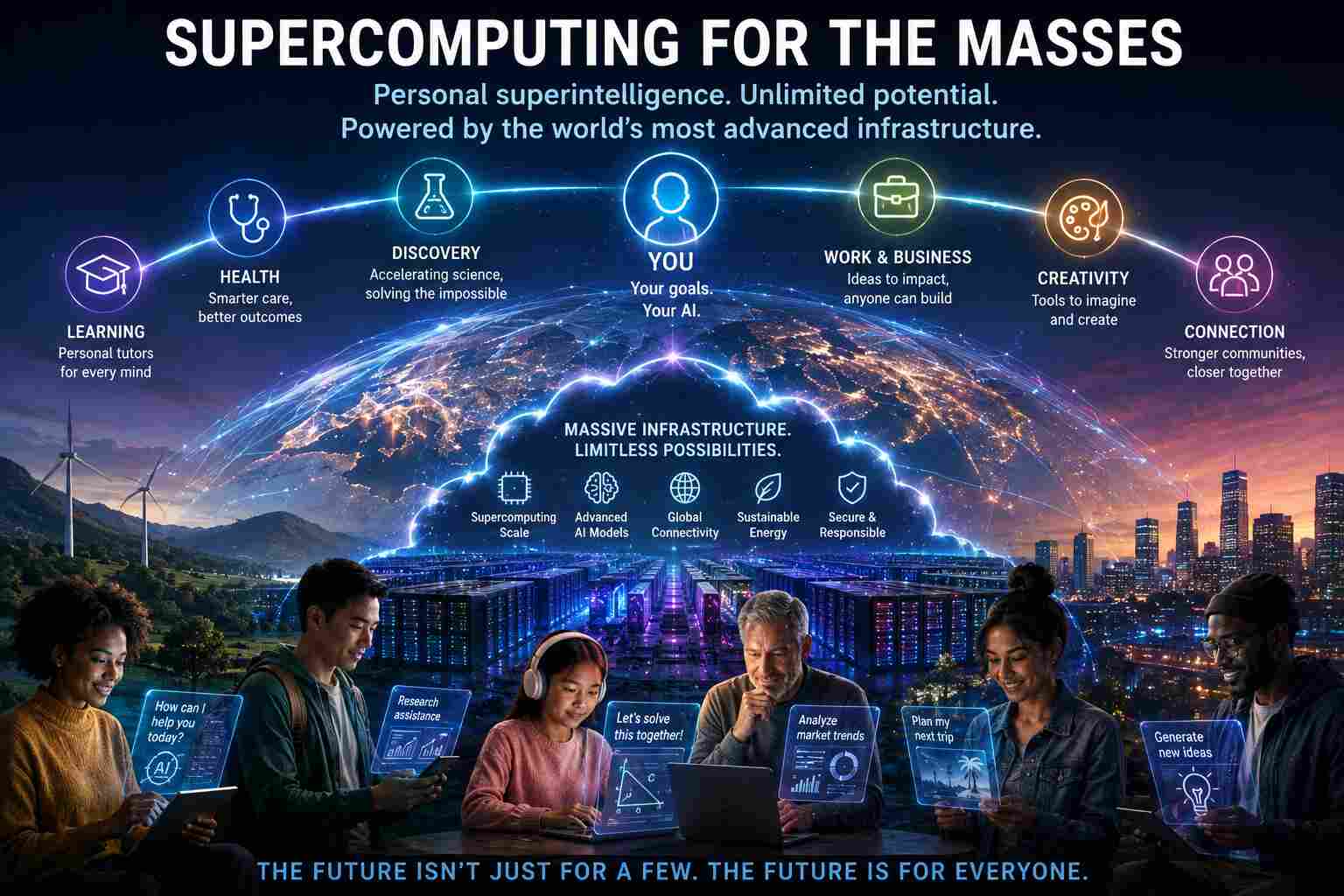
In a sweeping new vision for artificial intelligence, Meta CEO Mark Zuckerberg argues that the next stage of computing should put what he calls “superintelligence” directly into the hands of individuals, potentially giving billions of people access to AI systems capable of discovering, creating, teaching and reasoning at levels far beyond today's assistants.
Meta's argument is strikingly simple: if computing power transformed society when supercomputers moved onto desks and eventually into smartphones, why shouldn't the same thing happen with superintelligence? The company says the objective should not be to concentrate the most powerful AI systems inside a small number of corporations, governments or institutions. Instead, superintelligence should be distributed as widely as possible, with individuals able to direct it toward their own goals.
It is an ambitious proposition.
It is also, fundamentally, a supercomputing proposition.
From supercomputers to personal computing, and now personal intelligence
The history of computing is, in many ways, a history of decentralization. Computing began as an extraordinarily expensive resource available to governments, laboratories, and large organizations. Mainframes brought more people into the computing revolution. Personal computers moved computation onto desks. Smartphones put increasingly powerful processors into billions of pockets. Meta now argues that artificial intelligence could follow the same trajectory. Its vision is not simply to ensure everyone has access to a chatbot. The company describes a future in which each person could have an exceptionally capable personal agent that understands their goals, interests and preferences and works continuously on their behalf.
Such an agent, according to Meta’s vision, could help manage relationships, careers, finances, education, health, hobbies and household tasks. It could interact through multiple devices, including wearable technology.
The underlying idea is profound: Instead of people learning how to operate computers, computers increasingly learn how to help individual people achieve what they want.
That is a very different model of computing.
The supercomputer you never see
There is an important technical reality hiding behind the futuristic language. A personal superintelligence agent does not necessarily mean there will be a supercomputer sitting on someone’s desk. The enormous computational workload could remain in centralized data centers, while users access the resulting intelligence through networks and devices. That distinction matters. The smartphone revolution did not put a hyperscale data center in everyone’s pocket. It put an extremely capable interface in everyone’s pocket while connecting users to enormous networks of remote computing infrastructure. Personal superintelligence could follow the same pattern. The device becomes the interface. The cloud becomes the supercomputer. The AI becomes the computational layer connecting the two.
And suddenly, supercomputing becomes something billions of people can use without ever knowing which processor performed the calculation.
Meta’s most ambitious promise: Compute for billions
This is where Meta’s proposal becomes particularly interesting to the HPC community. Meta says everyone should have access to superintelligence, including free versions accessible to billions of people. For users who want more computing capacity, the company proposes a dynamic auction mechanism intended to allocate additional intelligence and compute while keeping prices as low as possible. That is essentially an argument for treating intelligence as a computational utility.
Need more?
Buy more compute.
Need less?
Use less.
And if the system works as envisioned, the underlying infrastructure would dynamically allocate enormous amounts of computational capacity among competing human demands.
It is an intriguing concept, but it also exposes the biggest problem with the entire proposition.
There is no infinite supply of compute.
Zuckerberg’s own essay acknowledges this limitation, arguing that there will always be finite compute and therefore an opportunity cost in deciding how that computing power is used.
That sentence may ultimately be more important than the promise of personal superintelligence itself.
The real bottleneck may be electricity.
The AI industry has spent years talking about models. But increasingly, the limiting factor may be infrastructure. Training increasingly capable models requires enormous computational resources. Serving those models to billions of people requires another enormous layer of inference capacity.
That means processors.
Memory.
Networking.
Data centers.
Cooling.
Power generation.
Transmission infrastructure.
And all the construction, manufacturing, and skilled labor required to build them.
Meta explicitly recognizes this problem.
The company argues that the United States needs to accelerate construction of both energy infrastructure and data centers if it wants to remain competitive in AI. Its essay points to the speed at which China is expanding energy capacity and argues that the United States faces a disadvantage in how quickly it can build physical infrastructure.
This is where the phrase “Supercomputing for the Masses” becomes more complicated.
Giving everyone access to superintelligence isn’t primarily a software problem.
It is an infrastructure problem.
The hidden supercomputer behind every AI prompt
Imagine billions of people interacting with personal AI agents throughout the day.
One person asks an agent to design a business.
Another asks it to analyze medical research.
A student uses an AI tutor for several hours.
A programmer asks an agent to build and test an application.
A small manufacturer uses AI to redesign a production process.
A scientist asks an agent to evaluate thousands of experimental hypotheses.
A filmmaker generates video.
An engineer runs simulations.
A researcher asks an AI system to design a new material.
None of these interactions may look like supercomputing to the user.
But behind them could be enormous clusters of accelerators executing billions or trillions of operations.
The abstraction is powerful.
The user sees an assistant.
The data center sees a workload.
The supercomputer sees another allocation of computational resources.
From automation to invention
Meta’s argument also contains an important philosophical distinction.
Zuckerberg says the greatest contribution of superintelligence should be invention rather than automation. The company’s vision is that AI will increasingly help people discover new knowledge, develop products, create businesses, and solve problems rather than simply eliminate existing human tasks.
That distinction matters enormously.
If AI is primarily an automation technology, its economic value may be measured by how many human tasks it can perform more cheaply.
If AI becomes an invention technology, the equation changes.
The potential output isn’t limited to today’s jobs.
It includes things that don’t exist yet.
New products.
New companies.
New scientific discoveries.
New medicines.
New forms of entertainment.
New engineering solutions.
New educational models.
New industries.
Meta argues that giving individuals more powerful tools could therefore increase individual capability rather than simply reducing the need for human workers.
Whether that prediction proves correct remains an open question.
But it is an important question to ask.
The one-person company
One of Meta’s more provocative predictions is that personal superintelligence could allow very small teams, or even individuals, to operate businesses at a scale that previously required much larger organizations.
The company argues that if individuals can access highly capable AI agents for research, programming, design, marketing, education, and operations, many ideas that were previously too expensive or complicated to pursue could become viable.
That could fundamentally alter the economics of computing.
Historically, access to sophisticated computing has often been an advantage enjoyed by large organizations.
The supercomputing-for-the-masses model reverses that relationship.
A small company could potentially rent computational intelligence rather than build an enormous technical organization.
A teenager could prototype an idea that once required a team of engineers.
A scientist could automate portions of a research workflow.
A designer could generate and evaluate thousands of concepts.
The scarce resource would no longer necessarily be access to sophisticated software.
It could become the ability to imagine what to do with it.
A Ph.D. in every subject?
Education could be another major beneficiary.
Meta envisions personalized tutors and coaches capable of helping people learn virtually any subject, with the patience to adapt continuously to individual needs.
The computational implication is enormous.
A traditional teacher has finite time.
A personal AI tutor could theoretically serve millions of students simultaneously.
And unlike a static textbook, an intelligent system could adapt explanations, generate examples, identify weaknesses, and change teaching strategies dynamically.
This doesn’t eliminate the importance of teachers.
It changes the computational economics of individualized education.
The same underlying infrastructure could potentially provide capabilities that were previously available only to students who could afford expensive tutoring or specialized instruction.
That is precisely the kind of democratization that makes the supercomputing-for-the-masses concept interesting.
Scientific discovery at machine speed
Perhaps the most exciting possibility is what happens when personal superintelligence reaches scientific research.
Meta says AI could increasingly work on scientific hypotheses over weeks or months, testing and refining ideas rather than simply responding to individual prompts.
That sounds less like today’s chatbot and more like an autonomous computational research assistant.
Consider what happens when that capability is connected to HPC resources.
An AI system could propose a material.
A supercomputer could simulate it.
The AI could analyze the result.
It could propose another composition.
The simulation could run again.
The process could repeat thousands or millions of times.
The result would be a feedback loop connecting artificial intelligence, scientific computing, and automated experimentation.
This is where supercomputing could move from being a tool used by scientists to becoming part of an increasingly autonomous scientific discovery system.
But who gets to control the supercomputer?
There is a darker side to the argument.
Meta’s central thesis is that concentrating superintelligence in a small number of organizations could create an unhealthy imbalance of power. The company argues that distributing advanced AI more broadly could create a system of checks and balances between individuals, businesses, and institutions.
This is one of the most consequential and controversial parts of the proposal.
Meta is effectively arguing that distributed intelligence can be a safety mechanism.
If everyone has powerful AI, no single organization possesses an overwhelming computational advantage.
That’s an appealing concept.
But it is also an assertion that deserves scrutiny.
More widely available intelligence could empower defenders.
It could also empower attackers.
More powerful cybersecurity tools could strengthen networks.
The same underlying capabilities could potentially be misused.
More capable scientific AI could accelerate drug discovery.
It could also accelerate dangerous research.
Meta itself acknowledges these tensions in its proposal, discussing cybersecurity, biological risks, government power, surveillance, job displacement and the possibility of AI systems becoming difficult to control.
The supercomputing community should therefore be interested not only in how much compute becomes available, but who controls it, how it is allocated and what safeguards surround it.
The data center comes home.
There is another dimension that deserves attention.
If superintelligence is to reach billions of people, enormous physical infrastructure must be built somewhere.
Meta recognizes that communities hosting AI data centers need to benefit from the development.
The company describes a “Community Compact” approach involving local jobs, investment in schools and public services, energy considerations and environmental commitments.
This could become one of the defining infrastructure debates of the AI era.
The public may interact with AI through a phone or pair of glasses.
But the computational machinery behind those interactions requires physical facilities occupying hundreds of acres, thousands of servers and enormous quantities of electricity.
The cloud may feel invisible.
Its infrastructure is not.
The economics of intelligence
Meta’s proposed dynamic pricing mechanism raises another fascinating possibility.
Traditional supercomputing centers typically allocate resources through queues, reservations, priority policies, and institutional access.
Cloud computing introduced a more flexible commercial model.
Meta’s proposal pushes that idea further: computational intelligence itself could become dynamically priced according to demand and available capacity.
In theory, users would pay for additional computational capability when they need it while free tiers maintain broad access.
If such a system works at planetary scale, computing could become increasingly similar to electricity or telecommunications: a resource that consumers don’t own but can draw upon when needed.
The critical difference is that the commodity being delivered is not merely computation.
It is intelligence generated by computation.
The supercomputing revolution may become invisible.
This may ultimately be the most important idea behind Meta’s proposal.
The next generation of supercomputing may not look like supercomputing.
There may be no terminal window.
No batch queue.
No job scheduler visible to the user.
No scientist waiting for a simulation to finish.
Instead, a person might simply say: “Design me a better battery.”
Or: “Help me understand this disease.”
Or: “Build a company around this idea.”
Behind the scenes, an AI agent could decompose the request, retrieve information, generate hypotheses, run simulations, evaluate results, and repeat the process.
The user experiences a conversation.
The infrastructure experiences a supercomputing workload.
The question Meta cannot answer yet.
Meta’s vision is compelling.
But a vision is not an infrastructure plan.
The difficult questions remain.
How much compute will billions of personal agents actually require?
How much electricity will that demand consume?
How quickly can new data centers be constructed?
Can power grids expand fast enough?
Can chip manufacturing scale?
Can memory and networking keep pace?
How much will high-end inference actually cost?
Can free access remain economically sustainable?
And perhaps most importantly: Who gets priority when everyone wants more compute than the planet can provide at the same moment?
Meta proposes market mechanisms and massive infrastructure expansion, but the ultimate answers will depend on technological advances that have not happened yet.
The company itself acknowledges the fundamental constraint: compute remains finite.
That may be the central economic fact of the coming AI era.
Supercomputing for the Masses
For Supercomputing News, Meta’s proposal represents something bigger than another corporate AI announcement.
It provides a useful opportunity to reconsider what the word supercomputing means.
For most of its history, supercomputing meant giving a relatively small number of researchers access to extraordinarily powerful machines.
The next phase could mean giving extraordinarily powerful computational capabilities to almost everyone.
The supercomputer doesn’t necessarily become smaller.
The audience becomes larger.
That distinction could define the next decade of computing.
If Meta and others succeed, the world’s most powerful computational systems could become invisible infrastructure supporting everyday human activity, from education and entrepreneurship to science, engineering and creative work.
And if they fail, the reasons may have little to do with the intelligence of the algorithms.
They may instead involve the far more mundane realities of electricity, chips, cooling, data centers, networks, economics and physical construction.
That is why Supercomputing for the Masses deserves to be more than a slogan.
It is a question about the future architecture of computing itself.
The supercomputer that once occupied an entire room eventually reached the desktop.
The desktop eventually became the smartphone.
The smartphone connected humanity to the cloud.
Now the cloud is being asked to become an intelligence engine for billions.
The next great computing revolution may therefore not be about building a supercomputer that is more powerful than anything that came before.
It may be about making supercomputing itself an everyday human capability.
And if that happens, the most important question may no longer be “How powerful is the world’s fastest computer?”
It may be: “What can billions of people accomplish when everyone gets access to one?”