An international research team led by Waseda University in Japan has used finite-temperature spin-dynamics simulations to show how nanoscale magnetic skyrmions can leverage topology, thermal noise, particle interactions, and engineered geometry to perform computation. This research, published in *npj Spintronics* under the title "Diffusion asymmetry of repulsive skyrmions in a structured environment," challenges the traditional computational paradigm of eliminating noise. Instead, the study suggests that thermal randomness can be harnessed as a functional component of a system. By designing physical structures, specifically, asymmetric nanoscale gates, that interact with the unique dynamics of skyrmions, researchers have shown that physical systems can be engineered to process information directly through their inherent material properties. This represents a significant shift toward unconventional computing architectures, where the physics of the system itself is designed to perform complex computational operations.
The Computational Experiment
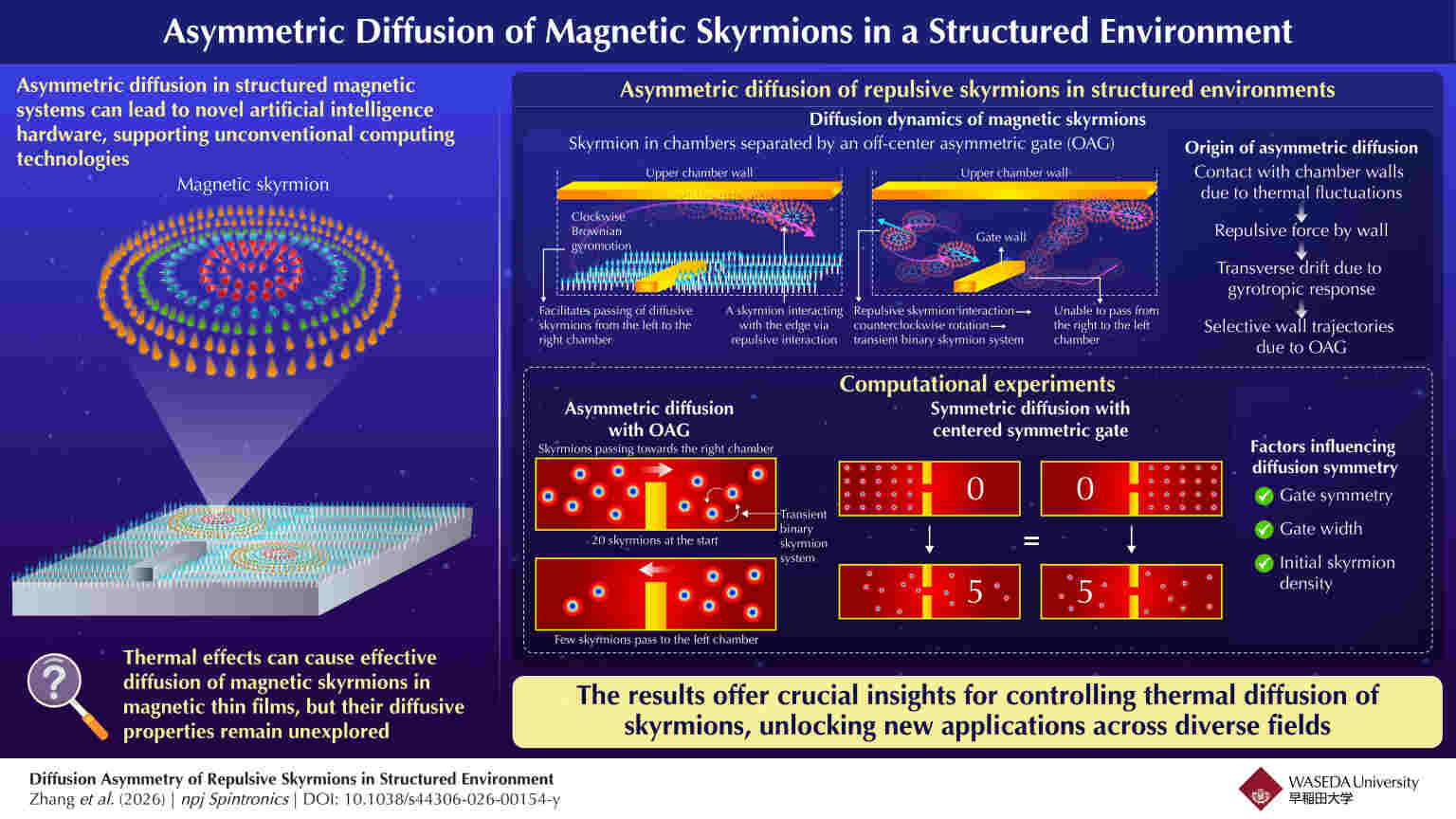
The researchers created a simulated nanoscale environment consisting of two chambers connected by an off-center asymmetric gate, or OAG.
The comparison is important.
In a conventional centered symmetric gate, a skyrmion approaching from either direction encounters essentially equivalent geometry.
In the asymmetric configuration, the gate is deliberately displaced from the center of the connecting region.
The simulations then ask a deceptively simple question:
Will thermally driven skyrmions move through the structure equally well in both directions?
The answer is no.
The computational model shows that skyrmions can preferentially diffuse from one chamber to the other. The effect emerges from the combined influence of skyrmion topology, gyrotropic motion, damping, boundary interactions and repulsive skyrmion-skyrmion forces.
This is not a simple mechanical ratchet.
The directional behavior emerges from the interaction of multiple physical effects.
Simulating Magnetic Objects as Computational Particles
Magnetic skyrmions are particularly interesting because their internal spin structure gives them unusual dynamics.
They are topological spin textures, meaning their behavior is governed in part by a topological charge rather than simply by their physical position.
The researchers model skyrmions with topological charge Q = −1.
Their motion includes a gyrotropic component that can cause a skyrmion undergoing thermal Brownian motion to follow curved rather than purely random trajectories.
That becomes critical when the skyrmion encounters a boundary.
Instead of simply bouncing away, the combination of gyrotropic motion and boundary interactions can guide the skyrmion along a wall.
With the gate positioned asymmetrically, the geometry can therefore make passage easier from one direction than the other.
The computer is effectively revealing a nanoscale transport mechanism that would be extraordinarily difficult to understand from geometry alone.
MuMax3 Turns the Physics Into a Numerical Experiment
To test their theoretical predictions, the researchers performed computational spin-dynamics experiments using MuMax3, a micromagnetic simulation package.
At finite temperature, the dynamics are governed by the stochastic Landau–Lifshitz–Gilbert equation, which describes the evolution of magnetization while incorporating thermal fluctuations.
This is a crucial part of the computational story.
The randomness is not an error term.
It is deliberately included in the model.
The simulation therefore attempts to reproduce the statistical behavior of real thermally fluctuating magnetic structures rather than calculating only an idealized deterministic trajectory.
In the primary simulation configuration, the researchers modeled:
- 20 skyrmions;
- topological charge Q = −1;
- temperature of 150 K;
- an asymmetric gate width of 36 nanometers; and
- stochastic thermal fluctuations controlled through random seeds.
The simulations followed the system for hundreds of nanoseconds and examined how many skyrmions crossed between the two chambers.
One Direction Works Better Than the Other
The computational results provide a striking demonstration.
Starting with 20 skyrmions in the left chamber and none in the right, the simulation produced six skyrmions in the right chamber after 500 nanoseconds and nine after 1,000 nanoseconds.
When the initial population was reversed, 20 skyrmions in the right chamber and none in the left, only two crossed to the left after 500 nanoseconds and three after 1,000 nanoseconds in the representative simulation.
The system therefore has a preferred diffusion direction.
That preference disappears when the gate is made symmetric.
The comparison between the asymmetric-gate and centered-symmetric-gate systems is what turns the result from an interesting trajectory into a computationally testable physical effect.
The Researchers Had to Prove It Wasn’t Just Random Luck
There is an obvious problem with a thermally driven system.
If the physics contains randomness, how can researchers be sure that an apparent directional effect isn’t simply a statistical accident?
The answer was to repeat the computational experiment.
The researchers performed 100 repetitions using different thermal random seeds while keeping the physical parameters fixed.
This is an important computational methodology.
The objective isn’t to find one simulation that produces an interesting result.
It is to determine whether the statistical behavior survives changes in the random realization of the thermal noise.
The repeated simulations support the persistence of the diffusion asymmetry.
Geometry Becomes a Computing Parameter
One of the most interesting findings is that the gate cannot simply be made arbitrarily narrow or wide.
The ratio between the gate opening and the skyrmion size is critical.
If the gate is too narrow, skyrmions cannot pass.
If it is too wide, the skyrmions pass through without sufficiently interacting with the surrounding geometry.
The simulations identify intermediate regimes where the asymmetric behavior emerges.
In particular, asymmetric diffusion was observed for gate widths of approximately 30–32 nm and 36–38 nm in the modeled system.
This is a fascinating computational result because it means geometry itself becomes a control parameter.
The shape of the device determines how thermal motion is transformed into directional information.
Twenty Skyrmions Are Different From One
The simulations also reveal something that would be absent from a single-particle model.
The skyrmions interact with one another.
Their interactions are predominantly repulsive, but those forces can produce surprisingly complex collective behavior.
Two diffusing skyrmions can temporarily form a kind of rotating bound configuration, producing emergent rotational dynamics even though their mutual interaction is repulsive.
This is important computationally.
The system cannot simply be modeled as 20 independent random walkers.
The motion of one skyrmion affects the environment experienced by another.
The resulting dynamics are therefore many-body and nonlinear.
Density Changes the Computation
The number of skyrmions inside the chambers also matters.
The simulations show that diffusion rates increase with the initial number of skyrmions for both asymmetric and symmetric geometries, although the geometry determines whether the resulting diffusion remains directionally asymmetric.
At very low density, there may be insufficient interaction to produce the effect.
At very high density, however, strong skyrmion-skyrmion repulsion can become so significant that skyrmions may be expelled from a chamber without interacting effectively with the gate.
The researchers found that 20 skyrmions provided a moderate density that maintained the desired asymmetric diffusion behavior in their modeled system.
This means the computational device has another parameter that could potentially be controlled:
information density.
The Simulation Is Time-Dependent
There is another subtle computational complication.
Skyrmions can be thermally annihilated.
Consequently, the total number of skyrmions decreases over time.
As the density changes, so do the skyrmion-skyrmion and skyrmion-wall interactions.
That means the effective diffusion rates are not necessarily constant.
The researchers therefore emphasize that their simulations should be interpreted as a dynamic, evolving system rather than a simple two-state process with fixed transition rates.
The simulations focus particularly on the early 0–500 ns interval, where changes in the effective diffusion rates are smaller and the directional effect can be analyzed more clearly.
This is an important example of why computational physics can become complicated very quickly.
The system is not just random.
It is evolving randomness.
The Thiele Model Helps Explain the Motion
The full spin-dynamics simulations reveal what happens.
The researchers then use the Thiele model to help explain why it happens.
Consider a skyrmion approaching the asymmetric gate from the left.
Its interaction with the gate and upper chamber wall produces a velocity field influenced by gyrotropic and dissipative responses.
In the simulation, the skyrmion can accelerate along the upper wall and eventually enter the opposite chamber.
The reverse trajectory behaves differently.
A skyrmion approaching from the right can be redirected away from the gate and remain trapped in its original chamber.
The numerical experiment and reduced theoretical model therefore complement each other.
The detailed simulation establishes the behavior.
The analytical model helps explain the mechanism.
Damping Turns Out to Matter
The researchers also investigate what happens if the dissipative contribution is removed.
Their Thiele-model analysis shows that when the damping-related term is effectively set to zero, asymmetric diffusion becomes much harder to produce.
The skyrmions can pass through the gate more symmetrically from either side.
This indicates that nonzero damping is an important component of the directional effect.
The result highlights another characteristic of computational physics.
A phenomenon that appears to be caused by geometry alone actually depends on the interaction of:
geometry + topology + thermal noise + gyrotropic motion + damping + boundary forces.
Remove one component and the behavior can change dramatically.
Randomness Becomes a Resource
This is where the work becomes particularly interesting for computing.
Traditional computer engineering generally attempts to suppress randomness.
Digital logic depends on reproducible states.
Noise is usually treated as something that must be minimized.
The skyrmion system suggests another possibility.
A carefully engineered physical structure can transform thermal fluctuations into a statistically useful directional process.
The researchers point out that asymmetric diffusion in physical systems could provide a route toward nonlinear, noise-assisted and geometry-controlled information processing.
That connects directly to the broader field of unconventional computing.
From Spintronics to Neuromorphic Computing
Neuromorphic computing attempts to emulate some characteristics of biological information processing using physical systems that can naturally represent complex, dynamic states.
Skyrmions are attractive candidates because they can move, interact, fluctuate and respond to their environment.
The new work suggests that their behavior could potentially be manipulated statistically rather than forcing every skyrmion into a perfectly deterministic trajectory.
That is conceptually important.
A future computational device might not ask:
Did the skyrmion move left or right?
It might ask:
What information is encoded in the probability distribution of where the skyrmions move?
That is a very different computational paradigm.
Reservoir Computing Without Conventional Digital Logic
The paper’s references point to previous demonstrations of Brownian reservoir computing using geometrically confined skyrmion dynamics, as well as gesture-recognition experiments using skyrmion-based Brownian reservoir computing.
Reservoir computing is particularly interesting because the physical system itself performs a nonlinear transformation of input signals.
Instead of explicitly programming every internal operation, the dynamics of the physical reservoir provide a complex computational state space.
The new asymmetric-diffusion mechanism could potentially add another useful ingredient:
controlled directional transport generated by stochastic physical dynamics.
The researchers are not claiming that this study has produced a complete computer.
Rather, it identifies a physical mechanism that could contribute to future unconventional architectures.
That distinction is important.
A Computational Device Built From Probability
The deeper idea is almost philosophical.
Conventional computing asks engineers to create predictable operations from predictable states.
This research explores whether engineers can instead create predictable statistics from unpredictable microscopic events.
That distinction could be valuable for specialized computing workloads.
Thermal fluctuations are unavoidable at nanoscale dimensions.
Instead of treating them entirely as a liability, future devices might exploit them.
The geometry acts as the algorithm.
The skyrmion dynamics provide the nonlinear transformation.
Thermal noise supplies stochasticity.
And the resulting probability distribution becomes the computational output.
Why This Matters for Future AI Hardware
Artificial intelligence increasingly requires computing systems that can perform enormous numbers of operations under tight energy constraints.
Conventional transistor scaling alone may not provide the efficiency improvements required indefinitely.
That has driven research into alternative approaches including analog computing, in-memory computing, neuromorphic architectures, photonic processors and spintronic systems.
Skyrmion-based computing belongs to this broader search for architectures that use physical processes more directly.
The Waseda-led study is particularly interesting because it demonstrates that device geometry can shape stochastic information flow.
Instead of designing a circuit entirely from deterministic gates, one could potentially design physical landscapes in which particles naturally perform useful transformations.
The Supercomputing Connection
There is an important nuance for the HPC community.
The paper does not present a conventional “supercomputer achieved X petaflops” breakthrough.
The significance is different.
Computational modeling is being used to discover and engineer new computing physics.
The researchers use numerical spin dynamics to explore a parameter space involving temperature, skyrmion density, gate geometry, interactions and stochastic fluctuations.
They then use statistical repetition and reduced theoretical modeling to identify robust physical behavior.
This is exactly the kind of computational workflow increasingly important across modern science:
simulate → observe → vary parameters → repeat statistically → identify mechanism → design new experiment or technology.
When the Algorithm Is the Physics
The most exciting possibility is that the eventual computational device may look very different from today’s processors.
Instead of billions of transistors executing precisely defined Boolean operations, a future unconventional processor could contain physical structures whose collective dynamics naturally transform information.
The software could encode an input into the physical system.
The skyrmions could evolve.
Thermal fluctuations could provide controlled stochasticity.
Geometry could bias the resulting trajectories.
Sensors could measure the distribution of final states.
And machine-learning algorithms could interpret those states.
In such a system, the physics becomes part of the algorithm.
A Tiny Magnetic System With a Big Computational Idea
The physical structures in this study are nanoscale.
The gate widths producing the strongest asymmetric diffusion are measured in tens of nanometers.
Yet the computational implications are much larger.
The research demonstrates that carefully engineered nanoscale environments can convert a fundamental physical process—Brownian diffusion—into a directional and potentially information-bearing phenomenon.
It is a reminder that the future of computing may not necessarily be found by making conventional processors ever larger.
It may be found by making computation increasingly physical, parallel, stochastic and specialized.
The Road to Practical Hardware Is Still Long
The researchers themselves identify important limitations and areas for future work.
The diffusion rate depends on skyrmion density and can change as skyrmions are thermally annihilated.
The gate geometry cannot easily be changed after fabrication.
Skyrmion size and density, however, can respond to thermal conditions and external magnetic fields.
The study also suggests future investigations of other skyrmion types and interaction regimes.
Therefore, this is not a finished computing technology.
It is a computationally demonstrated physical mechanism.
And that may be precisely why it is interesting.
The Future May Compute With Noise
For decades, computing has been a story about controlling physics.
Control the electron.
Control the transistor.
Control the voltage.
Control the bit.
But as computing moves into the nanoscale and researchers search for new architectures beyond conventional CMOS, another philosophy is emerging:
Don’t necessarily control every microscopic event. Control the statistical behavior of the system.
The skyrmion simulations from Waseda and its collaborators provide a compelling example.
Twenty nanoscale magnetic structures are allowed to move under thermal fluctuations.
Their topology bends their trajectories.
Their mutual interactions alter their motion.
A carefully positioned gate biases their diffusion.
And a computational experiment reveals that the resulting randomness can become directional information.
From Random Motion to Useful Computation
The broader significance of this research can be encapsulated in a single principle: geometry serves as a mechanism to transform noise into computation. The study demonstrates that asymmetric diffusion emerges only when specific conditions regarding skyrmion size, gate dimensions, boundary geometry, damping, thermal fluctuations, and particle density are met. Because this effect is negated by restrictive, overly open, or symmetric configurations, the physical environment itself functions as a critical computational design parameter, a development with promising implications for the future of spintronics and unconventional AI hardware. While the researchers have not developed a direct replacement for current GPUs, they have established a fundamental insight through detailed computational modeling: nanoscale physical systems can effectively harness randomness to generate structured information. As the demand for computational power rises alongside the need for greater energy efficiency, this approach may redefine the architecture of future processors, shifting from traditional logic gate operations to systems that leverage fundamental physical processes for computation.