Russian scientists discover new physical effects important for the ITER reactor operation

Researchers discovered new effects, which affect the energy flow in the reactor

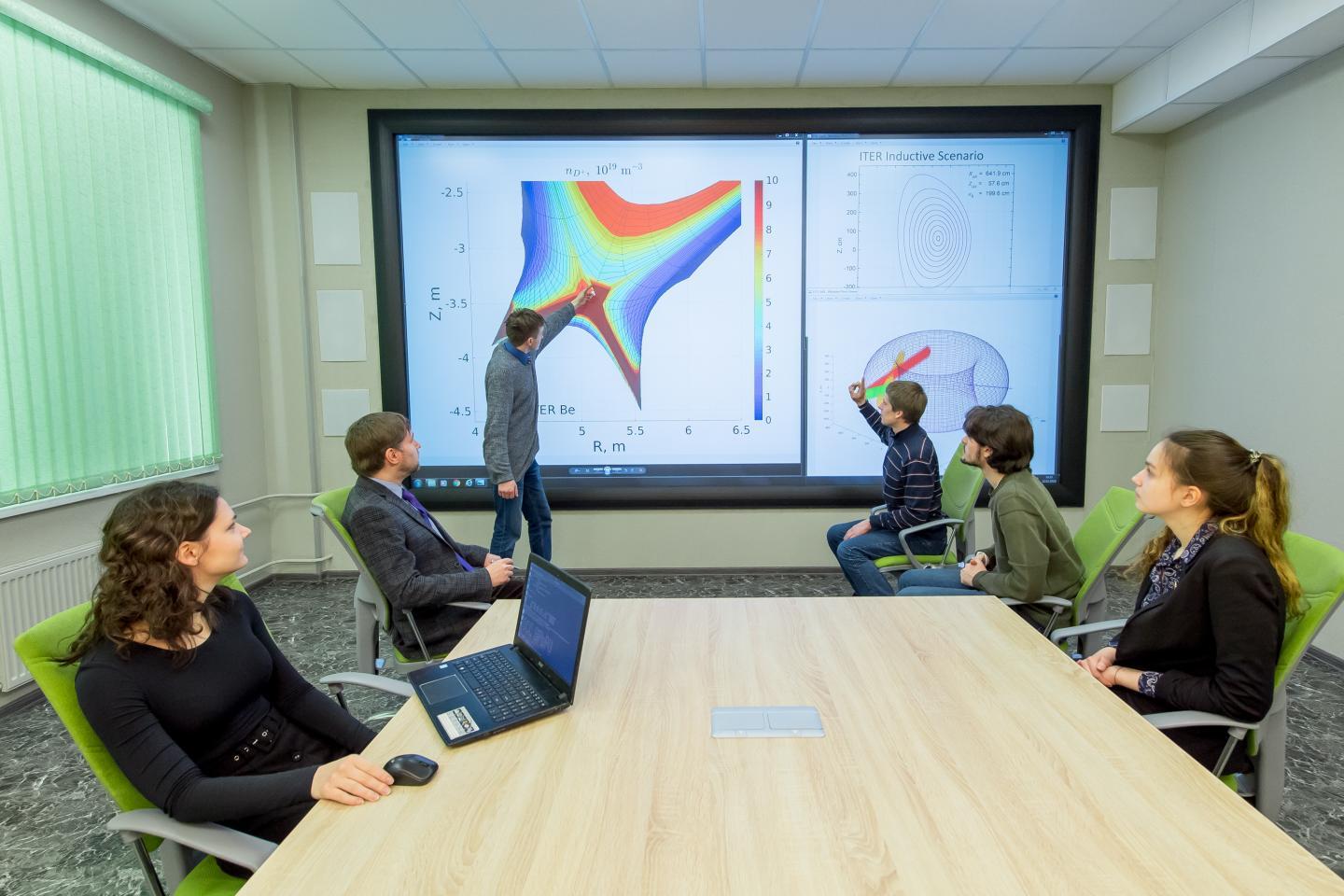
The energy of the future lies in the area of the controlled thermonuclear fusion. The scientific group from Peter the Great St.Petersburg Polytechnic University (SPbPU), headed by Professor Vladimir Rozhansky, is directly involved in the establishment of the world's largest experimental thermonuclear reactor ITER. Researchers discovered new effects, which affect the energy flow in the reactor. The theoretical predictions were confirmed by the experiments on two tokamaks. The research results were published in the scientific journal "Plasma Physics and Controlled Fusion.Researchers discovered new effects, which affect the energy flow in the reactor.{module INSIDE STORY}

The scientific group of Polytechnic University is engaged in modeling of the edge plasma. The researchers aim to identify how and what types of impurities to enter the reactor, and how the power coming from the central zone to be redistributed, and so on. Scientists of SPbPU developed SOLPS-ITER transport code. Currently it is announced as the official code for calculating the parameters of the edge plasma not only for ITER, but also for all existing installations.

"One of the main issues of thermonuclear fusion is associated with the edge plasma, or rather with the thin scrape-off layer. Understanding how this layer is arranged, knowledge of the physical processes helps to predict the energy flux density on the material surfaces. Generally, it influences the possibility to carry out the controlled thermonuclear fusion, because the reactor divertor plates should withstand huge energy flows , "notes Vladimir Rozhansky, professor at the Higher School of Physics and Engineering at SPbPU.

The researchers investigated the electric currents which flow in the scrape-off layer of the edge plasma. They carried out theoretical calculations, and performed numerical simulations. The calculated data was verified experimentally on two tokamaks. On the tokamak at the Max Planck Institute for Plasma Physics in Germany, and also on the Russian tokamak "Globus-M", which is located at the Ioffe Institute. In the course of studying a new type of current was discovered.

"Due to the simulations and experiments on existing tokamaks, we were able to confirm the theory of the mechanisms of the scrape-off layer formation in the reactor. Experiments on both tokamaks fully confirmed our theoretical calculations. Therefore, we can make predictions and extrapolate these data to the larger object , the ITER reactor, "says Professor Rozhansky.

The scientific group is currently working on modeling the world's largest JET tokamak, with plasma parameters close to ITER.

Dattner's modeling shows kids half as susceptible to COVID-19 as adults

New findings could deepen understanding of spread and inform public health policies

A new computational analysis suggests that people under the age of 20 are about half as susceptible to COVID-19 infection as adults, and they are less likely to infect others. Itai Dattner of the University of Haifa, Israel, and colleagues present these findings in the open-access journal PLOS Computational Biology https://journals.plos.org/ploscompbiol/article?id=10.1371/journal.pcbi.1008559 . A little girl in a medical mask stands on the street during the COVID 19 Coronavirus pandemic. She is holding a toy teddy bear, who is also wearing a medical mask.  CREDIT Nik Anderson, www.vperemen.com{module INSIDE STORY}

Earlier studies have found differences in symptoms and the clinical course of COVID-19 in children compared to adults. Others have reported that a lower proportion of children are diagnosed compared to older age groups. However, only a few studies have compared transmission patterns between age groups, and their conclusions are not definitive.

To better understand susceptibility and infectivity of children, Dattner and colleagues fitted mathematical and statistical models of transmission within households to a dataset of COVID-19 testing results from the dense city of Bnei Brak, Israel. The dataset covered 637 households whose members all underwent PCR testing for active infection in spring of 2020. Some individuals also received serology testing for SARS-CoV-2 antibodies.

By adjusting model parameters to fit the data, the researchers found that people under 20 are 43 percent as susceptible as people over 20. With an infectivity estimated at 63 percent of that of adults, children are also less likely to spread COVID-19 to others. The researchers also found that children are more likely than adults to receive a negative PCR result despite actually being infected.

These findings could explain worldwide reports that a lower proportion of children are diagnosed compared to adults. They could help inform mathematical modeling of COVID-19 dynamics, public health policy, and control measures. Future computational research could explore transmission dynamics in other settings, such as nursing homes and schools.

"When we began this research, understanding children's role in transmission was a top priority, in connection with the question of reopening schools," Dattner says. "It was exciting to work in a large, multidisciplinary team, which was assembled by the Israeli Ministry of Health to address this topic rapidly."

Institute of Industrial Science at The University of Tokyo researchers discover new law of phase separation

Researchers from Institute of Industrial Science at The University of Tokyo investigated the mechanism of phase separation into the two phases with very different particle mobilities using supercomputer simulations. They found that slow dynamics of complex connected networks control the rate of demixing, which can assist in the design of new functional porous materials, like lithium-ion batteries.

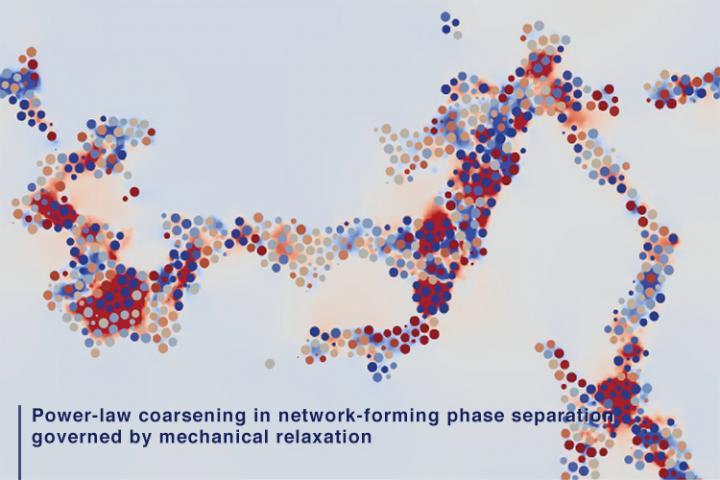
According to the old adage, oil and water don't mix. If you try to do it anyway, you will see the fascinating process of phase separation, in which the two immiscible liquids spontaneously "demix." In this case, the minority phase always forms droplets. Contrary to this, the researchers found that if one phase has much slower dynamics than the other phase, even the minority phase form complex networks instead of droplets. For example, in phase separation of colloidal suspensions (or protein solutions), the colloid-rich (or protein-rich) phase with slow dynamics forms a space-spanning network structure. The network structure thickens and coarsens with time while having the remarkable property of looking similar over a range of length scales, so the individual parts resemble the whole. Researchers at The University of Tokyo discover a new law about how the complex network of phase-separated structures grows with time, which may lead to more efficient batteries and industrial catalysts{module INSIDE STORY}

In the case of spontaneous demixing, the self-similar property causes the typical size of the domains to increase as a function of the elapsed time while obeying a power law. Classical theories predict that the growth exponent of the domains should be 1/3 and 1 for droplet or bicontinuous structures, respectively. However, for network-forming phase separation, it has not been explored how the structure grows or if there is such a law.

Now, using large-scale supercomputer simulations, researchers at The University of Tokyo studied how the typical size of phase domains grows over time when a system is deeply quenched. "In such a situation, the particle mobility can be significantly different between the two phases, and then, the classical theory does not necessarily apply, " first author Michio Tateno says. The team studied the phase separation of a fluid into a gas and liquid and the demixing of a colloidal suspension consisting of insoluble particles and a liquid, using molecular dynamics simulations and hydrodynamic calculations, respectively. They found that the minority phase of slow dynamics universally forms a network structure that grows with a growth exponent of 1/2, and provided a theoretical explanation for the mechanism.

"Significant differences in the particle mobility between the two phases plays a critical role in controlling the speed of the demixing process," senior author Hajime Tanaka says. Because many devices, like rechargeable batteries and catalysts, rely on the creation of intricate porous networks, this research may lead to advances in these areas. In addition, it may shed light on certain cellular functions that have been hypothesized to be controlled by internal biological phase separations.