BGN Technologies demos first all-optical, stealth encryption technology at the Cybertech Global Tel Aviv conference

BGN Technologies, the technology-transfer company of Ben-Gurion University of the Negev (BGU), Israel, has introduced the first all-optical "stealth" encryption technology that will be significantly more secure and private for highly sensitive cloud-supercomputing network transmission. The new all-optical encryption innovation will be introduced at the Cybertech Global Tel Aviv conference taking place on January 28-30, 2020 in Tel Aviv, Israel.

"Today, information is still encrypted using digital techniques, although most data is transmitted over distance using light spectrum on fiber-optic networks," says Prof. Dan Sadot, Director of the Optical Communications Research Laboratory, who heads the team that developed the groundbreaking technology.

"Time is running out on security and privacy of digital encryption technology, which can be read offline if recorded and code-broken using intensive computing power. We've developed an end-to-end solution providing encryption, transmission, decryption, and detection optically instead of digitally." {module INSIDE STORY}

Using standard optical equipment, the research team essentially renders the fiber-optic light transmission invisible or stealthy. Instead of using one color of the light spectrum to send one large data stream, this method spreads the transmission across many colors in the optical spectrum bandwidth (1,000 x wider than digital) and intentionally creates multiple weaker data streams that are hidden under noise and elude detection.

Every transmission -- electronic, digital or fiber -- has a certain amount of "noise." The researchers demonstrated that they can transmit weaker encrypted data under a stronger inherent noise level that cannot be detected.

The solution also employs a commercially available phase mask, which changes the phase of each wavelength (color). That process also appears as noise, which destroys the "coherence" or ability to recompile the data without the correct encryption key. The optical phase mask cannot be recorded offline, so the data is destroyed if a hacker tries to decode it.

"Basically, the innovative breakthrough is that if you can't detect it, you can't steal it," Prof. Sadot says. "Because an eavesdropper can neither read the data nor even detect the existence of the transmitted signal, our optical stealth transmission provides the highest level of privacy and security for sensitive data applications."

Zafrir Levy, senior vice president for exact sciences and engineering at BGN, says, "The novel, patented method invented by Prof. Sadot and his team is highly useful for multiple applications, such as high-speed communication, sensitive transmission of financial, medical or social media-related information without the risk of eavesdropping or jamming data flow. In fact, with this method, an eavesdropper will require years to break the encryption key. BGN is now seeking an industry partner to implement and commercialize this game-changing technology."

"Every data center has 100G and 400G lines, and part of those lines are encrypted end-to-end," Prof. Sadot adds. "There is a need for non-digital encryption for customers who require the most advanced security possible."

This all-optical technology is an extension of the digital optical encryption method originally invented by Prof. Sadot and his team in collaboration with Prof. Zalevsky at Bar Ilan University.
MARVEL researchers generalize Fourier's heat equation; explaining hydrodynamic heat propagation

The theory is in striking agreement with pioneering experimental results in graphite published last year

Fourier's well-known heat equation, introduced in 1822, describes how temperature changes in space and time when heat flows through a material. In general, this formulation works well to describe heat conduction in objects that are macroscopic (typically, a millimeter or larger), and at high temperatures. It fails, however, in describing so-called "hydrodynamic heat phenomena."

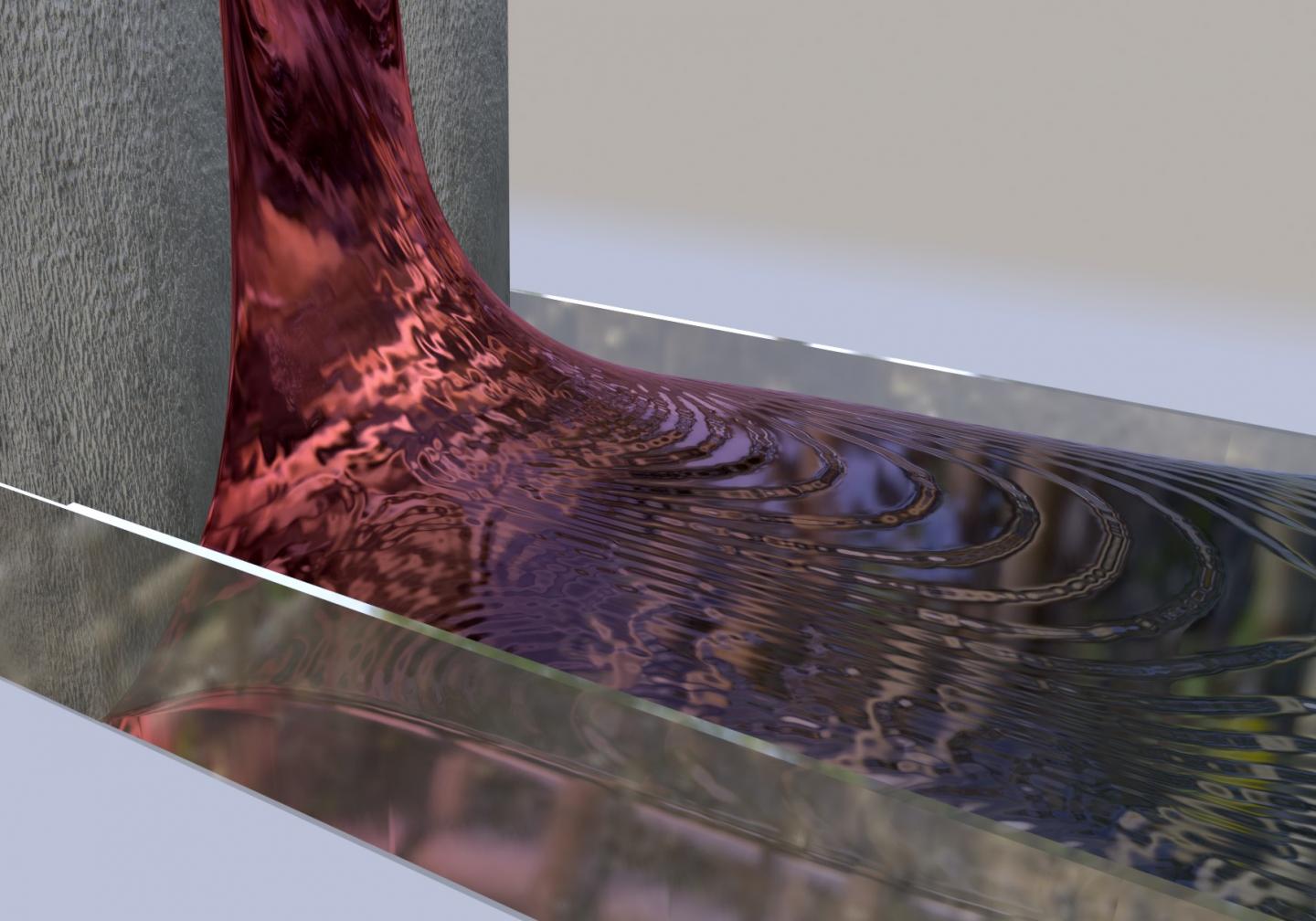
One such phenomenon is Poiseuille heat flow, where the heat flux becomes similar to the flow of a fluid in a pipe: it has a maximum in the center and minima at the boundaries, suggesting that heat propagates as a viscous-fluid flow. Another, called "second sound" takes place when heat propagation in a crystal is akin to that of sound in air: given portions of the crystal oscillates quickly between being hot and cold, instead of following the gentle temperature variation observed in the usual (diffusive) propagation.

Neither of these phenomena is described by Fourier's equation. Until now, researchers have only been able to analyze these phenomena using microscopic models, whose complexity and high computational cost have hindered both understanding and application to anything but the simplest geometries. In contrast, in developing the novel viscous heat equations, MARVEL researchers have condensed all the relevant physics underlying heat conduction into accurate and easily-solvable equations. This introduces a novel basic research tool for the design of electronic devices, especially those integrating diamond, graphene or other low-dimensional or layered materials where hydrodynamic phenomena are now understood to be prevalent. CAPTION The new equations explain why and under which conditions heat propagation can become fluid-like, rather than diffusive.  CREDIT @Michele Simoncelli, EPFL{module INSIDE STORY}

The work is particularly timely. While these heat hydrodynamic phenomena have been observed since the 1960s, they were only seen at cryogenic temperatures (around -260 degrees C) and therefore thought to be irrelevant for everyday applications. These beliefs suddenly changed last March with the publication in Science of pioneering experiments that found second-sound (or wavelike) heat propagation in graphite employed in several engineering devices and promising material for next-generation electronics at the record temperature of -170 degrees C.

The novel formulation presented in the paper Generalization of Fourier's law into viscous heat equations yields results for graphite that are in striking agreement with these experiments and also predicts that this hydrodynamic heat propagation can be observed in diamond even at room temperature. This prediction is awaiting experimental confirmation, which would establish a new record for the maximum temperature at which hydrodynamic heat transfer is observed.

The work is very relevant for applications since such hydrodynamic heat propagation can emerge in materials for next-generation electronic devices, where overheating is the main limiting factor for miniaturization and efficiency. Knowing how to handle the heat generated in these devices is critical to understanding how to maximize their efficiency, or even predict if they will work or just melt because of overheating. The paper provides new and original insights into transport theories and also paves the way towards the understanding of shape and size effects, e.g., new-generation electronic devices and so-called "phononic" devices that control cooling and heating. Finally, this novel formulation can be adapted to describe viscous phenomena involving electricity, discovered by Philip Moll in 2017, now a professor at the Institute of Materials at EPFL.

For the mathematically inclined

In this work, MARVEL researchers have coarse-grained the microscopic integrodifferential phonon Boltzmann transport equation into mesoscopic (simpler) differential equations, which they have called "viscous heat equations". These viscous heat equations capture the regime where the atomic vibrations in a solid ("phonons") assume a collective ("drift") velocity akin to that of a fluid. They have shown how thermal conductivity and viscosity can be determined exactly and in closed-form as a sum over the eigenvectors of the scattering matrix (the "relaxons", a concept introduced in 2016 by Cepellotti, for which he was awarded the IBM Research Prize and the Metropolis Prize of the American Physical Society). Relaxons have well-defined parities, with even relaxons determining the thermal viscosity and odd relaxons determining the thermal conductivity, and thermal conductivity and viscosity govern the evolution of the temperature and drift-velocity fields in these two coupled viscous heat equations.

In the paper, the scientists also introduced a Fourier deviation number (FDN), a dimensionless parameter that quantifies the deviation from Fourier's law due to hydrodynamic effects. The FDN is a scalar descriptor that captures the deviations from Fourier's law due to viscous effects, playing a role analogous to the Reynolds number for fluids, which is a parameter that engineers use to distinguish the different possible behaviors of the solutions to the Navier-Stokes equations.

Scientists use DICE model to show that Paris Climate Agreement passes the cost-benefit test

Climate costs are likely smallest if global warming is limited to 2 degrees Celsius; the politically negotiated Paris Agreement is thus also the economically sensible one, Potsdam researchers find in a new study

"To secure economic welfare for all people in these times of global warming, we need to balance the costs of climate change damages and those of climate change mitigation. Now our team found what we should aim for," says Anders Levermann from the Potsdam Institute for Climate Impact Research (PIK) and Columbia University's LDEO, New York, head of the team conducting the study. "We did a lot of thorough testing with our computers. And we have been amazed to find that limiting the global temperature increase to 2°C, as agreed in the science-based but the highly political process leading towards the 2015 Paris Agreement, indeed emerges as economically optimal."

Striving for economic growth

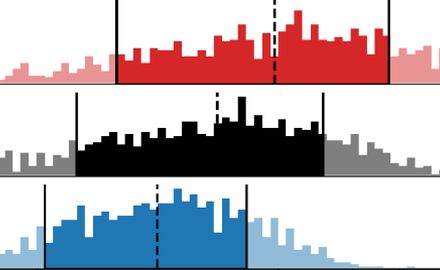
Climate policies such as for instance the replacement of coal-fired power plants by windmills and solar energy, or the introduction of CO2 pricing, have some economic costs. The same is true for climate damages. Cutting greenhouse gas emissions clearly reduces the damages, but so far observed temperature-induced losses in economic production have not really been accounted for in computations of economically optimal policy pathways. The researchers now did just that. They fed up-to-date research on economic damages driven by climate change effects into one of the most renowned supercomputer simulation systems, the Dynamic Integrated Climate-Economy model developed by the Nobel Laureate of Economics, William Nordhaus, and used in the past for US policy advice. The supercomputer simulation is trained to strive for economic growth. Cumulative gross domestic product losses under different scenarios of climate sensitivity. Image: Glanemann et al 2020

"It is remarkable how robustly reasonable the temperature limit of more or less 2°C is, standing out in almost all the cost-curves we've produced," says Sven Willner, also from PIK and an author of the study. The researchers tested a number of uncertainties in their study. For instance, they accounted for people's preference for consumption today instead of consumption tomorrow versus the notion that tomorrow's generations should not have fewer consumption means. The result that the 2°C limit is the economically most cost-efficient one was also true for the full range of possible climate sensitivities, hence the amount of warming that results from a doubling of CO2 in the atmosphere.

"The world is running out of excuses for doing nothing"

"Since we have already increased the temperature of the planet by more than one degree, 2°C requires fast and fundamental global action," says Levermann. "Our analysis is based on the observed relationship between temperature and economic growth, but there could be other effects that we cannot anticipate yet." Changes in the response of societies to climate stress - especially a violent flare-up of smoldering conflicts -, or the crossing of tipping points for critical elements in the Earth system could shift the cost-benefit analysis towards even more urgent action. {module INSIDE STORY}

"The world is running out of excuses to justify sitting back and doing nothing - all those who have been saying that climate stabilization would be nice but is too costly can see now that it is really unmitigated global warming that is too expensive," Levermann concludes. "Business, as usual, is clearly not a viable economic option anymore. We either decarbonize our economies or we let global warming fire up costs for businesses and societies worldwide."