H2O.ai empowers MarketAxess to innovate, inform trading strategies

H2O.ai has announced that its open-source platform, H2O, provides critical machine learning capabilities to MarketAxess, the operator of a leading electronic trading platform for fixed-income securities and the provider of market data and post-trade services for the global fixed-income markets. MarketAxess’ Composite+, powered by H2O open source, delivers greater insight and price discovery in real-time, globally, for over 24,000 corporate bonds. Composite+ has won several awards for its use of AI including the Risk Markets Technology Award for Electronic Trading Support Product of the Year and the Waters Technology American Financial Technology Award for Best Artificial Intelligence Technology Initiative.

“H2O is an integral part of Composite+ and provides some of the fundamental machine learning tools and support that make our algorithms run as well as they do,” said David Krein, Global Head of Research at MarketAxess. “The Composite+ pricing engine is helping fulfill our clients’ critical liquidity needs with more accurate and timely pricing data, which we make available within the MarketAxess electronic trading workflow. H2O.ai has been a great partner which has contributed to our recent success.” {module INSIDE STORY}

“Congratulations to David and the research team at MarketAxess for creating the industry-leading algorithmic pricing engine with H2O AI. With H2O’s machine learning algorithms in Composite+, MarketAxess has fully automated corporate bond pricing with better predictions and features,” said Sri Ambati, CEO and founder at H2O.ai. “Fixed-income markets are ripe for AI transformation and MarketAxess is leading the change bringing speed and transparency to the marketplace. We are thrilled to be a partner in their amazing success and look forward to accelerating the age of AI in Capital markets with faster, cheaper and open platforms.”

MarketAxess Composite+

Composite+ is a leading algorithmic pricing engine for corporate bonds that leverages a range of proprietary and industry data sources, with updates up to every 15 seconds. It combines public data from the FINRA Trade Reporting and Compliance Engine (TRACE) with proprietary data from the MarketAxess trading platform and Trax. The solution applies artificial intelligence and machine learning to predict accurate two-way reference prices for more than 24,000 bonds globally. When the most proximate signals are missing, the Composite+ algorithm can still learn to triangulate less predictive features successively.

Composite+ is designed to support a variety of trading functions such as pre-trade price discovery, liquidity provision, transaction cost analysis, auto-execution, and crossing. The pricing engine is seamlessly incorporated into all aspects of MarketAxess’ trading workflow, including within its all-to-all Open Trading marketplace and request for quote (RFQ) inquiry screens. It is also integrated into the company’s BondTicker and Axess All web-based data platforms.

H2O: Open Source AI

H2O is the leading open-source, scalable and distributed in-memory AI and machine learning platform. H2O supports the most widely used statistical & machine learning algorithms including gradient boosted machines, generalized linear models, deep learning and more. H2O also has an industry-leading AutoML functionality that automatically runs through all the algorithms and their hyperparameters to produce a leaderboard of the best models. The H2O platform is extensively used in industries such as financial services that require machine learning at scale.

UKCEH evaluates risk of chemicals to wildlife; huge challenge that requires new approach

Supercomputer modeling and long-term environmental monitoring will be essential, says review paper in Science

Supercomputer modeling and long-term ecological monitoring will be essential to assess the environmental risks of the rapidly growing number of chemicals across the world, according to a new review paper in the journal Science.

The analysis, led by the UK Centre for Ecology & Hydrology (UKCEH), says the sheer number of chemicals and substances is making it increasingly challenging to carry out the risk assessments required to check all products are completely safe for wildlife.

The EU's REACH (Registration, Evaluation, Authorisation, and Restriction of Chemicals) regulation 2006 set an important precedent - that the onus to demonstrate a chemical was safe for humans and the environment should lie with the manufacturer. CAPTION Yellow hazardous chemicals sign  CREDIT Pixabay{module INSIDE STORY}

However, out of more than 100,000 chemicals on the market in Europe, only a small fraction have been thoroughly evaluated for their potential harmful impacts on humans and the environment.

Professor Andrew Johnson of UKCEH, lead author of the paper, explains that, for example, there has been a lot of evaluation of the effects of pesticides on the environment but not washing detergents, despite their widespread use. He adds pharmaceuticals do not need an environmental risk assessment, and there has been little research into the potential impacts of several key classes of drugs on wildlife.

Meanwhile, weak regulations or inconsistent local enforcement have contributed to the creation of severe pollution hotspots in some parts of the world, particularly Asia where chemical sales are more than 60% higher than the US and EU combined, according to Professor Johnson and his co-authors.

He says: "Given the many chemicals that entered the market before REACH came into force, a retrospective authorization process is trying to catch up.

"An ever-growing number of chemicals and uses for them means the challenge is enormous, and regulators are struggling to keep up. But it isn't necessarily a lost cause. We've learned from the past and chemicals are generally safer."

Along with the progress in the regulation and management of chemicals, Professor Johnson and his co-authors say another reason for optimism is the improvement in analytical techniques in recent years. Supercomputer modeling enables scientists to predict the effects of chemicals without animal testing but regulators are reluctant to rely entirely on these theoretical models.

The paper's authors - from UKCEH, the China National Environmental Monitoring Centre, Kyoto University and Brunel University - also recommend a more consistent retrospective risk assessment. This would involve long-term ecological monitoring to establish the trends in wildlife populations that are exposed to chemicals, and then carrying out forensic scientific analysis to establish if these are linked to chemical pollutants.

The paper's authors say this approach requires greater co-operation between scientists across different disciplines, and are calling on ecotoxicologists and environmental chemists to collaborate with ecologists.

One example of best practice of retrospective risk assessment and multidisciplinary collaboration, cited in the paper, is the investigative research carried out after declines were noted in bee populations. Several global studies, including UKCEH's pan-European field trial in 2014/15, showed that exposure to certain neonicotinoids had a negative impact on bees, resulting in EU bans on those pesticides.

Professor Johnson explains: "Our current system of chemical risk assessment is based on prospective rather than both prospective and retrospective analysis. Long-term environmental monitoring is not normally at the front of the queue for receiving funding, but it's cost-effective and can provide the most compelling evidence of whether our use of chemicals is sustainable."

New SwRI models reveal inner complexity of Saturn moon

Enceladus' subsurface ocean composition hints at habitable conditions

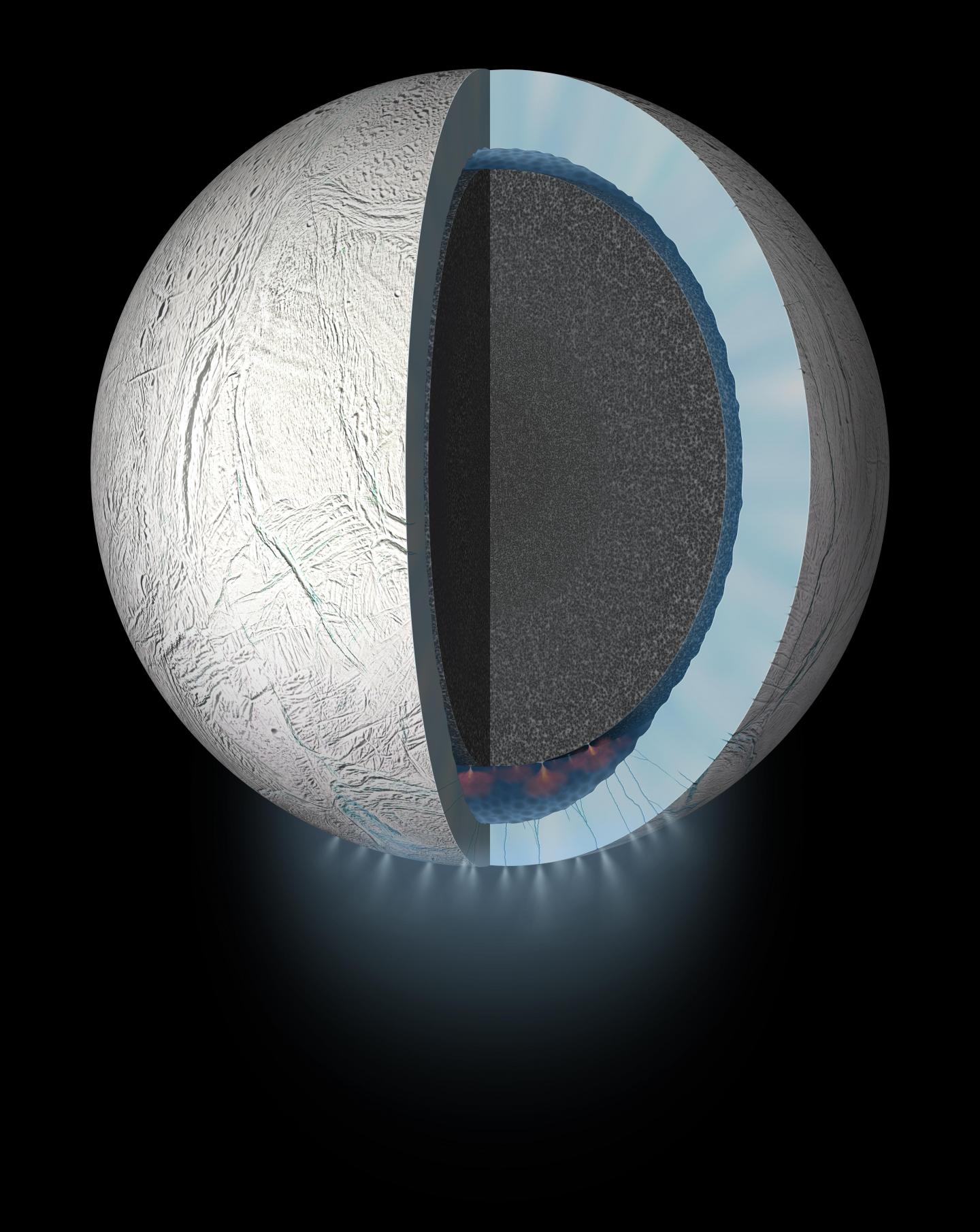
A Southwest Research Institute team developed a new geochemical model that reveals that carbon dioxide (CO2) from within Enceladus, an ocean-harboring moon of Saturn, may be controlled by chemical reactions at its seafloor. Studying the plume of gases and frozen sea spray released through cracks in the moon's icy surface suggests an interior more complex than previously thought.

"By understanding the composition of the plume, we can learn about what the ocean is like, how it got to be this way and whether it provides environments where life as we know it could survive," said SwRI's Dr. Christopher Glein, lead author of a paper in Geophysical Research Letters outlining the research. "We came up with a new technique for analyzing the plume composition to estimate the concentration of dissolved CO2 in the ocean. This enabled modeling to probe deeper interior processes." Using new geochemical models, SwRI scientists found that CO2 in Enceladus' ocean may be controlled by chemical reactions at the seafloor. Integrating this finding with previous discoveries of H2 and silica suggests geochemically diverse environments in the rocky core. This diversity has the potential to create energy sources that could support life.{module INSIDE STORY}

Analysis of mass spectrometry data from NASA's Cassini spacecraft indicates that the abundance of CO2 is best explained by geochemical reactions between the moon's rocky core and liquid water from its subsurface ocean. Integrating this information with previous discoveries of silica and molecular hydrogen (H2) points to a more complex, geochemically diverse core.

"Based on our findings, Enceladus appears to demonstrate a massive carbon sequestration experiment," Glein said. "On Earth, climate scientists are exploring whether a similar process can be utilized to mitigate industrial emissions of CO2. Using two different data sets, we derived CO2 concentration ranges that are intriguingly similar to what would be expected from the dissolution and formation of certain mixtures of silicon- and carbon-bearing minerals at the seafloor."

Another phenomenon that contributes to this complexity is the likely presence of hydrothermal vents inside Enceladus. At Earth's ocean floor, hydrothermal vents emit hot, energy-rich, mineral-laden fluids that allow unique ecosystems teeming with unusual creatures to thrive.

"The dynamic interface of a complex core and seawater could potentially create energy sources that might support life," said SwRI's Dr. Hunter Waite, principal investigator of Cassini's Ion Neutral Mass Spectrometer (INMS). "While we have not found evidence of the presence of microbial life in the ocean of Enceladus, the growing evidence for chemical disequilibrium offers a tantalizing hint that habitable conditions could exist beneath the moon's icy crust."

The scientific community continues reaping the benefits of Cassini's close flyby of Enceladus on Oct. 28, 2015, prior to the end of the mission. INMS detected H2 as the spacecraft flew through the plume, and a different instrument had earlier detected tiny particles of silica, two chemicals that are considered to be markers for hydrothermal processes.

"Distinct sources of observed CO2, silica and H2 imply mineralogically and thermally diverse environments in a heterogeneous rocky core," Glein said. "We suggest that the core is composed of a carbonated upper layer and a serpentinized interior." Carbonates commonly occur as sedimentary rocks such as limestone on Earth, while serpentine minerals are formed from igneous seafloor rocks that are rich in magnesium and iron.

It is proposed that hydrothermal oxidation of reduced iron deep in the core creates H2, while hydrothermal activity intersecting quartz-bearing carbonated rocks produces silica-rich fluids. Such rocks also have the potential to influence the CO2 chemistry of the ocean via low-temperature reactions involving silicates and carbonates at the seafloor.

"The implications for possible life enabled by a heterogeneous core structure are intriguing," said Glein. "This model could explain how planetary differentiation and alteration processes create chemical (energy) gradients needed by subsurface life."