

UMaine, UNH researchers to study how foraging adaptations affect Arctic charr resilience or vulnerability to climate change

The University of Maine and University of New Hampshire researchers will investigate how the diversity and evolution of feeding habits among Arctic charr populations in Maine affect their resilience or vulnerability to climate change.

The National Science Foundation’s Organismal Responses to Climate Change Program awarded almost $1.5 million for the study, spearheaded by Nathan Furey, an assistant professor of biological sciences at UNH, in collaboration with Michael Kinnison, a UMaine professor of evolutionary applications, and Christina Murphy, an assistant professor with the UMaine Department of Wildlife, Fisheries and Conservation Biology, and assistant unit leader of Maine’s U.S. Geological Survey Cooperative Fish and Wildlife Research Unit. Photo of former University of Maine graduate student Mitch Paisker releasing a female Arctic charr that was captured, tagged and measured back into Floods Pond in 2018.
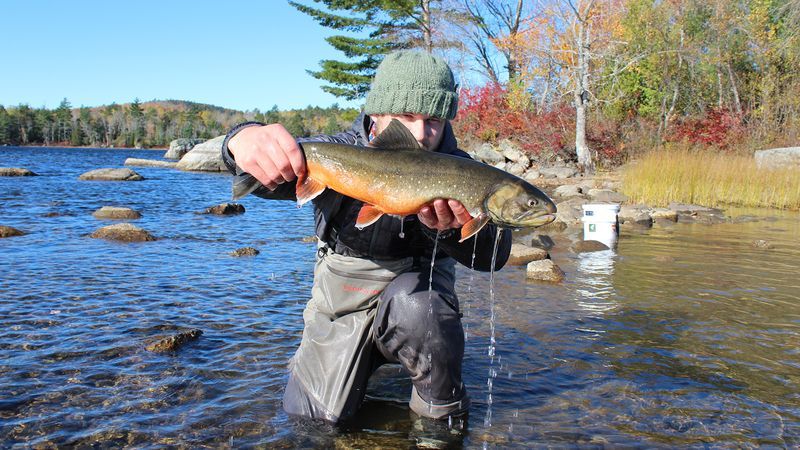
Kinnison’s lab has collected more than 20 years of Arctic charr genetic samples, trait data, and mark-recapture population size estimates from Floods Pond in Otis, Maine, all of which will support the new study. 

Arctic charr colonized some lakes in Maine, New Hampshire, and Vermont after glaciers receded more than 10,000 years ago. Populations in New Hampshire and Vermont went extinct in the last century and the Maine Department of Inland Fisheries and Wildlife (MDIFW) reports that Maine is home to the only living native population of Arctic charr in the United States, outside of Alaska. This unique natural resource, sometimes called “blueback” or “Sunapee” trout, is highly valued among anglers and conservationists, but Maine’s remnant populations also represent the most-southern populations of this Arctic species, putting them at particular risk from climate change.

Prior research by Kinnison’s team has found that these populations currently differ in what and where they eat, how large they get when they reproduce, and in which habitats. The UMaine and UNH researchers suggest these differences are associated with lake differences in food resource availability. They also say that there is evidence from an introduced population that Arctic charr feeding habits and traits can change over the years to decades when food and other resource availability changes.

Climate change threatens food webs worldwide. Yet many predictive models for species responses fail to account for the differentiation and evolution of feeding habits among populations of certain animals that are at the edge of their ecological ranges, like Arctic charr in Maine, according to the researchers. To address the gap, the UMaine and UNH scientists say they will develop a framework that links the genetic and malleable components of feeding trait diversity among Arctic charr in Maine to “population demography, habitat, community contexts and ultimately the eco-evolutionary potential for persistence” against climate change. 

Their work could help scientists better predict the viability of Maine Arctic charr and other species with populations that are at the edge of their ecological ranges based on the combined factors of climate change, inter- and intraspecies interactions like competition, and different phenotypes like eating habits. 

“Maine’s woods and waters are the front lines for climate change. Many of Maine’s iconic species, from moose to loons, to salmon and Arctic charr are literally living on the edge — their warm range edge,” says Kinnison, who directs the Maine Center for Genetics in the Environment. “We think the winners and losers will often come down to which populations can adapt or otherwise match climate-related resource changes. Maine’s Arctic charr is a good system to study this theory and a possibly unique one given our 20-year dataset of fish captures, traits, and genetic samples.” 

To conduct their study, researchers plan to collect non-lethal tissue samples from Arctic charr and other fishes from Floods Pond, and a few Maine lakes to analyze genetically and for naturally occurring isotopes that trace food webs. They also will conduct high-resolution fish tracking to understand the minute-to-minute behavior of fish in Floods Pond and these new data will be analyzed alongside more than two decades of fish abundance and trait data from the pond obtained by Kinnison’s students in collaboration with the Bangor Water District and MDIFW. They will use their data to develop models that will simulate Arctic charr with a variety of feeding habits, eating, growing, and enduring through various changing temperatures, communities, and ecosystems.

A postdoctoral researcher, two graduate students, multiple undergraduate students, and technical staff will work with Furey, Kinnison, and Murphy on the project. The team also will partner with Laura Wilson, a University of Maine Cooperative Extension 4-H science youth development professional, to create science tool kits based on their Arctic charr research that will teach grade school students about how aquatic species endure or perish from, different effects of climate change. 

“We are really excited about this project because of the multifaceted expertise of the group,” Furey says. “Our interdisciplinary approach will not only advance the science but also be a benefit to the involved students and early career researchers who will gain skills and experience across a breadth of biological disciplines. Combining our unique team with engaged collaborators outside of academia, our work will not only aid the conservation and management of the iconic Arctic charr but also provide frameworks for identifying resilient populations of other coldwater fishes at their warm range edge as we continue to experience climate change.”  
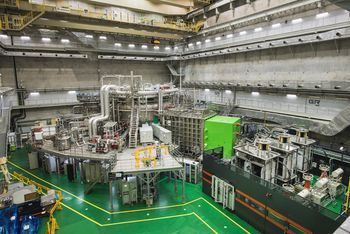
Korea Institute of Fusion Energy builds simulations to predict fusion instabilities in TAE

Today, the Korea Institute of Fusion Energy (KFE) announced that a new fusion simulation code was developed to project and analyze the Toroidal-Alfvén-Eigenmode (TAE). In TAE, instabilities occur in the course of interactions between fast ions and the perturbed magnetic fields surrounding them. It disturbs a tokamak’s plasma confinement by disengaging fast ions from the plasma core. KSTAR

Because fast ions have much more kinetic energy than normal ones, they play a significant role in facilitating fusion reactions by increasing plasma temperatures and performance. Stably confining them in the plasma core is therefore considered one of the most important tasks for sustaining fusion reactions.

Several studies were conducted to understand the relationship between fast ions and the TAE to prevent TAE instabilities and increase fast ion confinement. At KFE, Dr. Youngwoo Cho has improved the Gyro Kinetic Plasma Simulation Program (gKPSP) to calculate and project the changes in TAE following fast ion movements.

The gKPSP, a domestically developed fusion simulation code, was mainly used for analyzing plasma transport phenomena until Dr. Cho added a feature to enable electromagnetic analysis. With the amendment, it is now capable of analyzing the TAE instabilities and has passed cross-validation with other existing codes.

The new code will be utilized for analyzing the confinement performance of fast ions generated by different methods, including various heating devices and fusion reactions. It is expected to contribute to developing plasma performance enhancement technologies by optimizing fast ions’ confinement performance. 

Spanish geoscientists analyze sediments to investigate global warming occurring 56 million years ago; used it to predict climate change

The alluvial and hydro-climatic changes on the boundary between Huesca and Lleida during the Palaeocene-Eocene global warming are analyzed

The Department of Geology of the University of the Basque Country UPV/EHU has examined sediments dating back 56 million years in the Tremp-Graus basin (on the border between Lleida and Huesca). It can be deduced from the study that the global warming episode at that time consisted of three phases in which the distribution of precipitation was different. The data from the study can be used to adjust mathematical models used to predict the effects of the current climate change. Palaeo-climate study may be of use in making predictions (Aitor Payros / UPV/EHU)

Major carbon emissions into the atmosphere and oceans took place 56 million years ago; that led to intense global warming known as the Palaeocene-Eocene Thermal Maximum and is regarded as an ancient analog of today's anthropogenic warming. “Although the origin or cause of the warming at that time was different, the process was very similar to today’s warming, so it is considered to be similar to today's global warming. The climate is known to have warmed, but other alterations besides warming may occur with climate change. In particular, we wanted to analyze how the hydro-climatic conditions in terms of rainfall changed at that time,” said Aitor Payros, who gained a Ph.D. in Geology at the UPV/EHU.

The UPV/EHU’s Department of Geology has investigated the mid-latitude alluvial and hydro-climatic changes recorded in the Tremp-Graus basin (on the border between Lleida and Huesca) during the Palaeocene-Eocene Thermal Maximum and has concluded that what happened then could in some way be similar to what is already happening today in the southeast of the Iberian Peninsula. To do this, they collected historical data from the region and discovered geographical as well as hydro-climatic similarities.

According to Aitor Payros, “we saw that global warming altered the seasonal distribution of precipitation and that it also altered across several phases. At first, rainfall was concentrated in a few months around autumn; later, it became more evenly distributed throughout the year. The last phase, however, tended to be drier. According to Payros, "we can't simply say that global warming is causing temperatures to rise or making rainfall heavier. Things are not that straightforward. Changes do occur, but they are not sustained over the entire period of global warming. Within global warming, there may be several phases".

Looking to the past to predict the future

"We observed that at the onset of that global warming episode there was an increase in seasonal contrasts with respect to precipitation. In other words, precipitation was concentrated around the autumn (with frequent storms and major floods) and during the remaining months, there were periods of drought. And that is precisely what has been happening over the last few decades, and during the last century, in the southeast of the Iberian Peninsula: heavy rainfall is becoming more frequent around autumn and late summer, which was not the case 100 or 200 years ago," said Payros.

The researcher pointed out that it is not possible to predict what will happen in the future in the southeast of the Iberian Peninsula, "but if we assume that the Earth responds in a similar way to the same or similar phenomena, we could surmise that the future annual distribution of precipitation may be more homogeneous in the southeast of the peninsula or other regions with a similar climate".

Payros stresses the potential value of studying palaeo-climates: "We can see what happened millions of years ago. And if what happened is repeated over and over again, in other words, if the Earth always responds in the same way to certain phenomena, we can assume that it will continue to function in the same way in the future.” This type of research can be used to make future predictions: "When the computer or mathematical models used to predict climate are able to reproduce the phenomena that took place during past global warming periods, then they will be able to predict the changes that will occur in the future. Such computer and mathematical models may tally with our data."