

Geoscientist King's modeling reveals how dwarf planet Ceres powers unexpected geologic activity

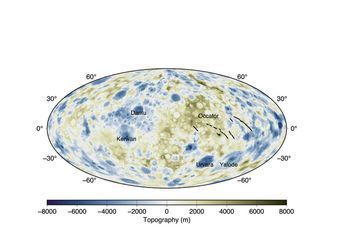
For a long time, our view of Ceres was fuzzy, said Scott King, a geoscientist at the Virginia Tech College of Science. A dwarf planet and the largest body found in the asteroid belt — the region between Jupiter and Mars speckled with hundreds of thousands of asteroids — Ceres had no distinguishable surface features in existing telescopic observations from Earth. This illustration models the topography (in meters) of Ceres from NASA’s Dawn project, with green and blue colors. Some of the dwarf planet’s major craters are labeled. A ruler is below the image of Ceres showing, in meters, negative 8,000 to positive 8,000.
Then, in 2015, the hazy orb that was Ceres came into view. That view was stunning to scientists such as King. Data and images collected by NASA’s Dawn mission gave a clearer picture of the surface, including its composition and structures, which revealed unexpected geologic activity.

Scientists had seen the general size of Ceres in earlier observations. It was so small it was assumed to be inactive. Instead, Dawn discovered a large plateau on one side of Ceres that covered a fraction of the dwarf planet, similar to what a continent might take up on Earth. Surrounding it were fractures in rocks clustered in one location. And there were visible traces of an ocean world: deposits all over the surface where minerals had condensed as the water evaporated — the mark of a freezing ocean.

A professor in the Department of Geosciences, King, who mostly studies larger bodies such as planets, wanted to know how a body as small as Ceres could generate the heat needed to power that kind of geological activity and account for the surface features picked up by Dawn.

Through modeling, he and a team of scientists from multiple universities as well as the United States Geological Survey and the Planetary Science Institute found that the decay of radioactive elements within Ceres’s interior could keep it active. Their findings were recently published in American Geophysical Union Advances.

King’s study of big planets such as Earth, Venus, and Mars had always shown him that planets start hot. The collision between objects that form a planet creates that initial heat. Ceres, by contrast, never got big enough to become a planet and generate heat the same way, King said. To learn how it could still generate enough heat to power geologic activity, he used theories and computational tools previously applied to bigger planets to study Ceres’s interior, and he looked for evidence that could support his models in data returned by the Dawn mission.

The team’s model of the dwarf planet’s interior showed a unique sequence: Ceres started cold and heated up because of the decay of radioactive elements such as uranium and thorium — which was alone enough to power its activity — until the interior became unstable.

“What I would see in the model is, all of a sudden, one part of the interior would start heating up and would be moving upward and then the other part would be moving downward,” King said.

That instability could explain some of the surface features that had formed on Ceres, as revealed by the Dawn mission. The large plateau had formed on only one side of Ceres with nothing on the other side, and the fractures were clustered in a single location around it. The concentration of features in one hemisphere signaled to King that instability had occurred and had left a visible impact.

“It turned out that you could show in the model that where one hemisphere had this instability that was rising up, it would cause extension at the surface, and it was consistent with these patterns of fractures,” King said.

Based on the team’s model, Ceres didn’t follow a planet’s typical pattern of the hot first and cool second, with its own pattern of cool, hot, and cool again. “What we’ve shown in this paper is that radiogenic heating all on its own is enough to create interesting geology,” King said.

He sees similarities to Ceres in the moons of Uranus, a study commissioned by NASA and the National Science Foundation recently deemed a high priority for a significant robotic mission. With additional improvements to the model, he looks forward to exploring their interiors as well.

“Some of these moons are not too different in size from Ceres,” King said. “I think applying the model would be really exciting.”
ADVA increases sales in Q2

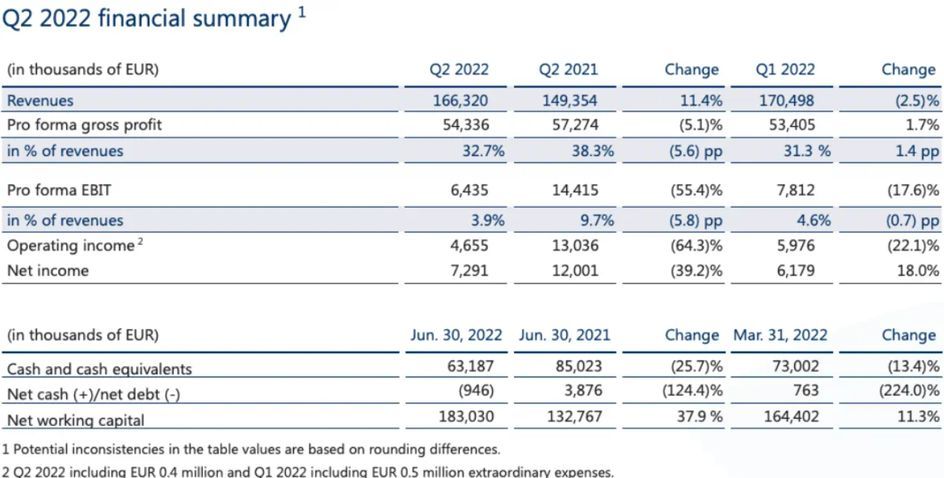
ADVA has reported revenues in Q2 2022 reached EUR 166.3 million, down by 2.5% from EUR 170.5 million in Q1 2022 and up by 11.4% compared to EUR 149.4 million in Q2 2021. The increase in revenues for Q2 2022 is predominantly driven by a growth in demand from network operators and internet content providers (ICPs). In addition, the stronger US dollar led to higher revenues in North America.

Pro forma gross profit in Q2 2022 increased by 1.7%, reaching EUR 54.3 million (32.7% of revenues) compared to EUR 53.4 million (31.3% of revenues) in Q1 2022 and decreased by 5.1% compared to EUR 57.3 million (38.3% of revenues) reported in Q2 2021. Gross profit was impacted by increased purchasing costs caused by the semiconductor crisis and a stronger US Dollar. 

Pro forma EBIT for Q2 2022 was EUR 6.4 million (3.9% of revenues) and decreased by 17.6% compared to EUR 7.8 million (4.6% of revenues) reported in Q1 2022 and substantially declined by 55.4% from EUR 14.4 million (9.7% of revenues) in Q2 2021.

Operating income for Q2 2022 of EUR 4.7 million decreased by 22.1% from EUR 6.0 million reported for Q1 2022 and significantly decreased by 64.3% from EUR 13.0 million in Q2 2021. Operating income for Q2 2022 was impacted by extraordinary expenses in connection with the announced merger with Adtran amounting to EUR 0.4 million (Q1 2022 EUR 0.5 million and Q2 2021 EUR 0).

Net income reached EUR 7.3 million in Q2 2022, increased by 18.0% from EUR 6.2 million in Q1 2022, and considerably decreased by 39.2% from EUR 12.0 million in Q2 2021.  

The company’s cash and cash equivalents totaled EUR 63.2 million, representing a decrease of EUR 9.8 million compared to EUR 73.0 million at the end of Q1 2022. Year-over-year cash and cash equivalents decreased by EUR 21.8 million from EUR 85.0 million at the end of Q2 2021. The company invested non-operating cash in measures to secure delivery.

Net debt at the end of Q2 2022 stood at EUR 0.9 million compared to a net cash position of EUR 0.8 million at the end of Q1 2022 and a net cash position of EUR 3.9 million at the end of Q2 2021. 

At quarter-end, net working capital totaled EUR 183.0 million and increased by EUR 18.6 million compared to EUR 164.4 million at the end of Q1 2022 and increased significantly by EUR 50.3 million compared to EUR 132.8 million at the end of Q2 2021. The higher net working capital compared to the year-ago quarter is mainly attributable to increased inventory levels to secure the supply chain.

Screenshot 2022 07 29 16.33.48 ccda1

“The recent months were very exciting for us as a company,” said Brian Protiva, CEO of ADVA. “We reached several important milestones on our journey of joining forces with Adtran and advanced our operational business. Our revenues in the first half of 2022 were at a record level, and our order books are nicely filled. We still see strong customer demand paired with a high level of complexity and costs in the areas of procurement, production, and logistics. This environment will continue for the foreseeable future. Our teams work tirelessly on solutions to meet market demand, and we work closely with our customers every day to provide the best possible support for their network development. So far, we’ve mastered the challenges very well and look positively towards the remainder of the year.” 

“In the past quarter, we again grew compared to the year-ago quarter. This underlines the positive market environment and the tailwind we are experiencing on the demand side,” said Uli Dopfer, CFO of ADVA. “However, in the second half of the year, we will also have to deal with the challenges resulting from increased procurement costs and stressed supply chains. Despite increased inventories, our liquidity is at a satisfying EUR 63 million. Against the background of a continued strong order intake and a strengthening dollar in combination with persistently higher costs in the supply chains, we have decided to adjust the outlook for the fiscal year accordingly, which we announced in an ad-hoc notification on July 15th. We are raising our revenue guidance to between EUR 680 and 730 million and reducing our pro forma EBIT margin guidance by one percentage point to between 5% and 9%.”

2022 financial outlook

For the fiscal year 2022, ADVA expects revenues to be in the range of EUR 680 million and 730 million and a pro forma EBIT of between 5.0% and 9.0% of revenues. 

Intel's sales took a nosedive in Q2

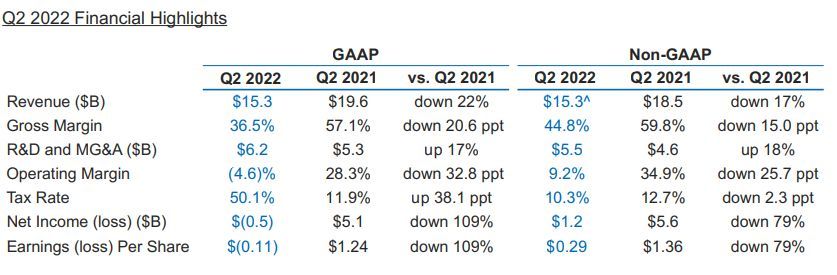
In the second quarter, Intel's revenue was $15.3 billion, down 22% year over year (YoY). The company’s data center group was impacted by continued falling sales, down 16%; Network and Edge Group and Mobileye achieved record quarterly revenue.

It was its biggest sales drop in more than a decade. The company blamed a rapid decline in economic activity for its sagging sales.

Intel's revenue missed consensus on the street by 14%, the company’s largest disappointment since 1999. It ended the quarter with a $454 million net loss, compared with a net income of $5 billion in the year-ago quarter. The gross margin narrowed to 36.5% from 50.4% in the previous quarter.

“This quarter’s results were below the standards we have set for the company and our shareholders. We must and will do better. The sudden and rapid decline in economic activity was the largest driver, but the shortfall also reflects our own execution issues,” said Pat Gelsinger, Intel CEO. “We are being responsive to changing business conditions, working closely with our customers while remaining laser-focused on our strategy and long-term opportunities. We are embracing this challenging environment to accelerate our transformation.”

Screenshot 2022 07 29 13.50.00 48a3c

"We are taking necessary actions to manage through the current environment, including accelerating the deployment of our smart capital strategy, while reiterating our prior full-year adjusted free cash flow guidance and returning gross margins to our target range by the fourth quarter," said David Zinsner, Intel CFO. "We remain fully committed to our business strategy, the long-term financial model communicated at our investor meeting, and a strong and growing dividend."