Oxford researchers develop new AI system using light to learn associatively

Researchers at Oxford University’s Department of Materials, working in collaboration with colleagues from Exeter and Munster have developed an on-chip optical processor capable of detecting similarities in datasets up to 1,000 times faster than conventional machine learning algorithms running on electronic processors.  An illustration of Pavlov's experiment on associated learning and a computer chip  CREDIT Zengguang Cheng

The new research published in Optica took its inspiration from Nobel Prize laureate Ivan Pavlov’s discovery of classical conditioning. In his experiments, Pavlov found that by providing another stimulus during feedings, such as the sound of a bell or metronome, his dogs began to link the two experiences and would salivate at the sound alone. The repeated associations of two unrelated events paired together could produce a learned response – a conditional reflex.

Co-first author Dr. James Tan You Sian, who did this work as part of his DPhil in the Department of Materials, University of Oxford said: ‘Pavlovian associative learning is regarded as a basic form of learning that shapes the behavior of humans and animals – but adoption in AI systems is largely unheard of. Our research on Pavlovian learning in tandem with optical parallel processing demonstrates the exciting potential for a variety of AI tasks.’

The neural networks used in most AI systems often require a substantial number of data examples during a learning process – training a model to reliably recognize a cat could use up to 10,000 cat/non-cat images – at a computational and processing cost.

Rather than relying on backpropagation favored by neural networks to ‘fine-tune’ results, the Associative Monadic Learning Element (AMLE) uses a memory material that learns patterns to associate together similar features in datasets – mimicking the conditional reflex observed by Pavlov in the case of a ‘match’.   

The AMLE inputs are paired with the correct outputs to supervise the learning process, and the memory material can be reset using light signals. In testing, the AMLE could correctly identify cat/non-cat images after being trained with just five pairs of images.  

The considerable performance capabilities of the new optical chip over a conventional electronic chip are down to two key differences in design:

  • a unique network architecture incorporating associative learning as a building block rather than using neurons and a neural network
  • the use of ‘wavelength-division multiplexing’ to send multiple optical signals on different wavelengths on a single channel to increase computational speed.

The chip hardware uses light to send and retrieve data to maximize information density – several signals on different wavelengths are sent simultaneously for parallel processing which increases the detection speed of recognition tasks. Each wavelength increases the computational speed.

Professor Wolfram Pernice, co-author from Münster University explained: "The device naturally captures similarities in datasets while doing so in parallel using light to increase the overall computation speed – which can far exceed the capabilities of conventional electronic chips."

An associative learning approach could complement neural networks rather than replace them clarified co-first author Professor Zengguang Cheng, now at Fudan University.

"It is more efficient for problems that don’t need substantial analysis of highly complex features in the datasets’ said Professor Cheng. ‘Many learning tasks are volume based and don’t have that level of complexity – in these cases, associative learning can complete the tasks more quickly and at a lower computational cost."

"It is increasingly evident that AI will be at the center of many innovations we will witness in the coming phase of human history. This work paves the way toward realizing fast optical processors that capture data associations for particular types of AI computations, although there are still many exciting challenges ahead," said Professor Harish Bhaskaran, who led the study.

The full paper, ‘Monadic Pavlovian associative learning in a backpropagation-free photonic network,’ is available in the journal Optica.
Chinese researchers find human activities increase likelihood of more extreme heatwaves

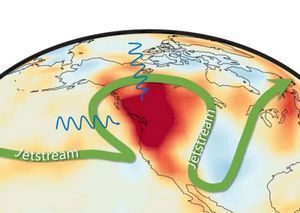
July 19 was the hottest day ever recorded in the United Kingdom, with temperatures surpassing 40 degrees Celsius (about 104 degrees Fahrenheit). The heatwave serves as an early preview of what climate forecasters theorized will be typical summer weather in the U.K. in 2050. The heat continues across Europe today, as well as in the United States, where more than a third of the country is under heat warnings. Shading represents surface air temperature anomalies, and the green vector denotes jetstream (a narrow band of very strong westerly air currents near the altitude of the tropopause). Two blue vectors indicate that the heatwave is related to anomalous circulations in the North Pacific and the Arctic.

The temperatures harken back to just over a year ago when nearly 1,500 people died during a late June heatwave that more than doubled average temperatures in the United States and Canada.

Will temperatures continue to rise, leading to more frequent extreme heat events?

Yes, according to the latest analysis of the atmospheric circulation patterns and human-caused emissions that led to the 2021 heatwave in North America. The findings, published on July 22 in Advances in Atmospheric Sciences, may also explain the U.K.'s current heatwave.

The research team found that greenhouse gases are the primary reason for increased temperatures in the past and will likely continue to be the main contributing factor, with simulations showing that extreme heatwave events will increase by more than 30 percentage points in the coming years. Most of that increased probability is the result of greenhouse gases, according to their results.

“An extraordinary and unprecedented heatwave swept western North America in late June of 2021, resulting in hundreds of deaths and a massive die-off of sea creatures off the coast as well as horrific wildfires,” said lead author Chunzai Wang, a researcher in the Southern Marine Science and Engineering Guangdong Laboratory and head of the State Key Laboratory of Tropical Oceanography at the South China Sea Institute of Oceanology, Chinese Academy of Sciences (CAS).

“In this paper, we studied the physical processes of internal variability, such as atmospheric circulation patterns, and external forcing, such as anthropogenic greenhouse gases.”

Atmospheric circulation patterns describe how air flows and influences surface air temperatures around the planet, both of which can change based on natural warming from the Sun and atmospheric internal variability, as well as Earth’s rotation. These configurations are responsible for daily weather, as well as the long-term patterns comprising climate.  Using observational data, the researchers identified that three atmospheric circulation patterns co-occurred during the 2021 heatwave: the North Pacific pattern, the Arctic-Pacific Canada pattern, and the North American pattern.

“The North Pacific pattern and the Arctic-Pacific Canada pattern co-occurred with the development and mature phases of the heatwave, whereas the North America pattern coincided with the decaying and eastward movements of the heatwave,” Wang said. “This suggests the heatwave originated from the North Pacific and the Arctic, while the North America pattern ushered the heatwave out.”

But atmospheric circulation patterns can co-occur — and have before — without triggering an extreme heatwave, so how much was the 2021 event influenced by human activities? Wang and the team used the internationally curated, tested and assessed models from the World Climate Research Programme, specifically the Detection Attribution Model Comparison models of the Coupled Model Intercomparison Project Phase 6 (CMIP6).

“From the CMIP6 models, we found that it is likely that global warming associated with greenhouse gases influences these three atmospheric circulation pattern variabilities, which, in turn, led to a more extreme heatwave event,” Wang said. “If appropriate measures are not taken, the occurrence probability of extreme heatwaves will increase and further impact the ecological balance, as well as sustainable social and economic development.”

Other contributors include co-corresponding author Jiayu Zheng and two students from the University of CAS: Wei Lin and Yuqing Wang.

HKU physicists discover signatures of highly entangled quantum matter

A research team from the Department of Physics, The University of Hong Kong (HKU), discovered clear evidence to characterize a highly entangled quantum matter—the quantum spin liquid (QSL) (a phase of matter that remains disordered even at shallow temperatures) from large-scale simulations on supercomputers. This pivotal research work has recently been published in one of the leading journals in quantum materials—npj quantum materialsA photo of part of the research team. From the left: Dr Zheng Yan, Mr Jiarui Zhao, and Dr Bin-Bin Chen.

QSLs were proposed by P. W. Anderson—the Nobel Physics Laureate of 1977—in 1973, which had the potential to be used in topological quantum computing to bring the computing power of computers to a new stage and to help understand the mechanism of high-temperature superconductors, that could greatly reduce the energy cost during electricity transport owing to the absence of electrical resistance in superconductors.  

The QSL is termed a liquid due to its lack of conventional order in the matter. QSLs have a topological order that originates from long-range and strong quantum entanglement, while the detection of this topological order is a very tough task due to the lack of materials that can perfectly achieve the many model systems that scientists propose to find a topological order of QSL and prove its existence. Thus, there has not been concrete evidence that QSLs exist in nature.

Under this context, Mr. Jiarui ZHAO, Dr. Bin-Bin CHEN, Dr. Zheng YAN, and Dr. Zi Yang MENG from HKU Department of Physics, successfully probed this topological order in a phase of the Kagome lattice quantum spin model, which is a two-dimensional lattice model with intrinsic quantum entanglement and proposed by scientists that have Z2 (a cyclic group of order 2) topological order, via a carefully designed numerical experiment on supercomputers. Their unambiguous results of topological entanglement entropy strongly suggest the existence of QSLs in highly entanglement quantum models from a numerical perspective.

‘Our work takes advantage of the superior computing power of modern supercomputers, and we use them to simulate a very complicated model which is thought to possess topological order. With our findings, physicists are more confident that QSLs should exist in nature,’ said Mr. Jiarui Zhao, the first author of the journal paper and a Ph.D. student at the Department of Physics.

"Numerical simulations have been an important trend in scientific research of quantum materials. Our algorithms and computations could find more interesting and novel quantum matter and such efforts will surely contribute to the development of both practical quantum technology and the new paradigm in fundamental research." Dr. Zi Yang Meng, Associate Professor in the Department of Physics remarked.

The research
The team designed a numerical experiment on the Kagome spin model (Kagome is a two-dimensional lattice structure that shows a similar pattern to a  traditional Japanese woven bamboo pattern in the shape of hexagonal latticework) in the proposed QSL phase, and the schematic plot of the experiment is illustrated in Figure 2. The entanglement entropy (S) of a system can be obtained by measuring the change of the free energy of the model during a carefully designed nonequilibrium process. The topological entropy (γ), which characterizes long-range topological order, can be extracted by subtracting the short-range contribution, which is proportional to the length of the entanglement boundary (l) from the total entanglement entropy(S), by fitting the data of entanglement entropy of different entanglement boundary length to a straight line (S=al-γ).

The team experimented on two kinds of lattices with different ratios of length and width to ensure the reliability of the results. We use a straight line to fit the relation between the entanglement entropy with the length of the entanglement boundary so that the topological entropy should equal the intercept of the straight line. Our results give the value of topological entropy to be 1.4(2), which is consistent with the predicted value of topological entropy of a Z2 quantum spin liquid, which is 2ln (2). Our findings confirm the existence of QSLs from a numerical perspective.