SUPERCOMPUTING NEWS SUPERCOMPUTING NEWS
    • MEDIA KIT
    • MOST READ
    • RSS FEED
    • ACADEMIA
    • AEROSPACE
    • APPLICATIONS
    • ASTRONOMY
    • AUTOMOTIVE
    • BIG DATA
    • BIOLOGY
    • CHEMISTRY
    • CLIENTS
    • CLOUD
    • DEFENSE
    • DEVELOPER TOOLS
    • EARTH SCIENCES
    • ECONOMICS
    • ENGINEERING
    • ENTERTAINMENT
    • GAMING
    • GOVERNMENT
    • HEALTH
    • OIL & GAS
    • INDUSTRY
    • INTERCONNECTS
    • MANUFACTURING
    • MIDDLEWARE
    • MOVIES
    • NETWORKS
    • PHYSICS
    • PROCESSORS
    • RETAIL
    • SCIENCE
    • STORAGE
    • SYSTEMS
    • VISUALIZATION
    • AcyMailing subscription form

    • ADD YOUR VIDEOS
    • MANAGE VIDEOS
    • CONVERSATION INBOX
    • SOCIAL ADVERTISER
    • SOCIAL NETWORK VIDEOS
    • SURVEYS
    • GROUPS
    • PAGES
    • MARKETPLACE LISTINGS
    • APPLICATIONS BROWSER
    • PRIVACY CONFIRM REQUEST
    • PRIVACY CREATE REQUEST
    • LEADERBOARD
    • POINTS LISTING
      • BADGES
    • TRADE SHOWS
Sign In
Tyler O'Neal, Staff Editor ENGINEERING November 15, 2021, 8:01 am

NetApp powers Ducati into the next MotoGP World Championship

NetApp extends its collaboration to accelerate Ducati Corse’s digital transformation and deliver fast, reliable access to real-time data from anywhere in the world

NetApp has announced the extension of its partnership with the Ducati Corse motorcycle racing team after the 2021 MotoGP World Championship race in Valencia, Spain. For the next two years, NetApp will continue to help advance Ducati’s performance in the MotoGP World Championship, the world’s most prestigious motorcycle racing competition.

The collaboration between Ducati (part of the Volkswagen Group), through its Ducati Corse division, and NetApp began in 2018 in a bid to maximize the use of data to improve performance within the world of racing. NetApp and Ducati are expanding their work together to accelerate digital transformation by:

  • Optimizing 3D product design in complex development projects by implementing a new virtual desktop environment, allowing engineers to collaborate efficiently all over the world. As part of this improvement, engineers and developers can securely leverage and archive any project data, using the rich functionalities of NetApp StorageGRID object storage.
  • Automating the racing team’s data workflow before, during, and after the race. Engineers can support their team’s success, both remotely and on-site to maximize the power of information for the win.
  • Supporting the overall evolution of the information technology strategy through collaboration between Ducati and the Professional Services teams at NetApp.

{module title="INSIDE STORY"}

“We are delighted to build on the collaboration with NetApp, which has developed well over the past four years,” said Luigi Dall'Igna, General Manager at Ducati Corse. “We look forward to working together to continue to optimize our performance with the limitless possibilities that the power of data can bring to the motorbike racing world.”

“Leading a winning team requires exploring new ways to succeed and finding any edge to beat the competition,” said Cesar Cernuda, President at NetApp. “Our partnership and momentum with Ducati Corse are thriving and the team secured three of the top five placements in world standings this year. We are proud to support the ongoing digital transformation of Ducati into a winning, data-driven company.”

British universities consider the ethical implications of using Artificial Intelligence in the food sector

Tyler O'Neal, Staff Editor ENGINEERING November 12, 2021, 11:05 am

Imagine a world in which smart packaging for supermarket-ready meals updates you in real-time to tell you about carbon footprints, gives live warnings on product recalls, and instant safety alerts because allergens were detected unexpectedly in the factory.
But how much extra energy would be used to power such a system? And what if an accidental alert meant you were told to throw away your food for no reason?

These are some of the questions asked by a team of researchers in Lancaster, Lancashire, England, including a Lancaster University Lecturer in Design Policy and Futures Thinking, who by creating objects from a ‘smart’ imaginary new world are looking at the ethical implications of using Artificial Intelligence in the food sector.

Their article, Considering the ethical implications of digital collaboration in the Food Sector, is published today in the November issue of the data science solutions journal ‘Patterns’. {module title="INSIDE STORY"} 

Food production is the largest sector in the UK manufacturing industry. Complex food production and distribution processes and systems, involving millions of people and organizations, produce huge amounts of data every day.

But, says the article, for opportunities to be fully realized, there is a need to be able to securely work together, share and access a wide variety of data sources across the entire food sector. Sharing data and using it more effectively, such as with AI and other new technological innovations, can potentially reduce waste, increase sustainability and protect health.

Meeting this need requires a trusted mechanism to enable the different parties throughout the supply chain to support each party to make informed decisions about the credibility of the separate data sources. But organizations can be wary of sharing data that may be commercially sensitive, so new systems are being developed that can be trusted to protect privacy while allowing wider use to be made of the collected data.

The article warns that new technology may also introduce ethical issues and unexpected, harmful consequences.

“To create such a data collaboration would require the integration of both cutting-edge technologies and surrounding social, institutional, and policy elements to ensure that the system works equally well and equitably for all parties involved,” adds the article.
“For example, if AI is to be implemented, we need to address ethical challenges that are well known in this area, such as bias and accountability, to create systems that are responsible in their implementation and prioritize human well-being.”

The project brought people together with different types of expertise and used a method called ‘design fiction’ to help explore the ethical implications of sharing data about food and evaluate technologies that don’t yet exist.

Lead author Dr. Naomi Jacobs from the Imagination Laboratory at Lancaster University said: “Rather than ask general questions about what might go wrong, or have to wait until something is fully built - when it is probably too late to change things without huge costs or starting all over again - we imagined what the world might look like if ‘data trusts’ (designed to protect private data while allowing others to make use of it) already existed.”

As part of a wider project established by the Internet of Food Things Network+ (led by the University of Lincoln) to explore data trusts related to the food sector, the research team created objects that acted as ‘props’ from that fictional world such as a documentary film about a supermarket recalls, and the real-time supermarket ready meal packaging. These props were used with a set of cards designed to enable engagement with the ethics of technology, called the Moral-IT Deck. Using these, they worked with experts in food and technology to evaluate the potential ethical benefits, risks, and challenges they posed.

“Through this process, we learned about important issues,” added Dr. Jacobs. “For example, it is key to consider where power lies in these systems, how large companies, small companies, and individual consumers might be positively or negatively impacted, and how different ethical aspects such as sustainability and wellbeing, privacy and transparency, might need to be balanced. These need to be considered when developing these types of data trusts in the future.”

The article sets out an approach by which the ethical implications of technological progress can be considered, specifically here in the context of digital collaboration in the food sector and with a particular focus on the use of AI in shared data management and usage and the importance of responsible innovation.


Japanese supercomputing produces the clue to the missing planets mystery

Tyler O'Neal, Staff Editor ENGINEERING November 12, 2021, 11:00 am

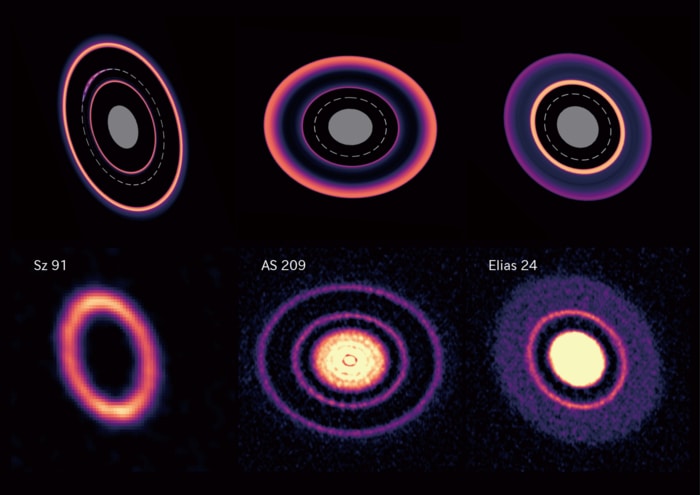
Forming planets are one possible explanation for the rings and gaps observed in disks of gas and dust around young stars. But this theory has trouble explaining why it is rare to find planets associated with rings. New supercomputer simulations show that after creating a ring, a planet can move away and leave the ring behind. Not only does this bolster the planet theory for ring formation, but the supercomputing also shows that a migrating planet can produce a variety of patterns matching those actually observed in disks. A comparison of the three phases of ring formation and deformation found in these simulations by ATERUI II (top) with real examples observed by ALMA (bottom). The dotted lines in the simulation represent the orbits of the planets, and the gray areas indicate regions not covered by the computational domain of the simulation. In the upper row, the simulated protoplanetary disks are shown from left to right at the start of planetary migration (Phase I), during planetary migration (Phase II), and at the end of planetary migration (Phase III).  CREDIT Kazuhiro Kanagawa, ALMA(ESO/NAOJ/NRAO)

Young stars are encircled by protoplanetary disks of gas and dust. One of the world’s most powerful radio telescope arrays, ALMA (Atacama Large Millimeter/submillimeter Array), has observed a variety of patterns of denser and less dense rings and gaps in these protoplanetary disks. Gravitational effects from planets forming in the disk are one theory to explain these structures, but follow-up observations looking for planets near the rings have largely been unsuccessful.

In this research a team from Ibaraki University, Kogakuin University, and Tohoku University in Japan used a supercomputer dedicated to astronomy, ATERUI II at the National Astronomical Observatory of Japan, to simulate the case of a planet moving away from its initial formation site. Their results showed that in a low viscosity disk, a ring formed at the initial location of a planet doesn’t move as the planet migrates inwards. The team identified three distinct phases. In Phase I, the initial ring remains intact as the planet moves inwards. In Phase II, the initial ring begins to deform and a second ring starts forming at the new location of the planet. In Phase III, the initial ring disappears and only the latter ring remains.

These results help explain why planets are rarely observed near the outer rings, and the three phases identified in the simulations match well with the patterns observed in actual rings. Higher resolution observations from next-generation telescopes, which will be better able to search for planets close to the central star, will help determine how well these simulations match reality.

These results appeared as K.D. Kanagawa et al. “Dust rings as a footprint of planet formation in a protoplanetary disk” in The Astrophysical Journal on November 12, 2021.

  1. Salk prof Michael shines a light into black holes in the Arabidopsis genome
  2. NSF renews funding for Two-Dimensional Crystal Consortium

Page 68 of 78

  • 63
  • 64
  • 65
  • 66
  • 67
  • 68
  • 69
  • 70
  • 71
  • 72
POPULAR RIGHT NOW
  • Supercomputers replace ‘bathtub’ flood maps with physics-based digital twins of Britain’s coastline
    Supercomputers replace ‘bathtub’ flood maps with physics-based digital twins of Britain’s coastline
  • Supercomputers push neural quantum simulation beyond previous limits
    Supercomputers push neural quantum simulation beyond previous limits
  • Intel’s AI supercomputing revival: Q2 financial surge signals new era for CPU-powered HPC infrastructure
    Intel’s AI supercomputing revival: Q2 financial surge signals new era for CPU-powered HPC infrastructure
  • AWS supercomputing investment reaches historic scale as Amazon’s AI strategy powers record financial results
    AWS supercomputing investment reaches historic scale as Amazon’s AI strategy powers record financial results
  • AI infrastructure financing fears shake semiconductor sector
    AI infrastructure financing fears shake semiconductor sector
  • Catching the wave of the future: Supercomputers unlock the hidden dynamics of Venus
    Catching the wave of the future: Supercomputers unlock the hidden dynamics of Venus
  • NCAR supercomputers run planet scale climate experiments impossible in the real world
    NCAR supercomputers run planet scale climate experiments impossible in the real world
  • AI hunts the cosmos: Machine learning helps astronomers discover the first ‘Wandering’ supermassive black hole caught destroying a star
    AI hunts the cosmos: Machine learning helps astronomers discover the first ‘Wandering’ supermassive black hole caught destroying a star
  • Supercomputing for the masses: Meta's vision of a personal superintelligence for everyone
    Supercomputing for the masses: Meta's vision of a personal superintelligence for everyone
  • NVIDIA helps turn AI compute into a new asset class as Wall Street mobilizes $500 billion
    NVIDIA helps turn AI compute into a new asset class as Wall Street mobilizes $500 billion
THIS YEAR'S MOST READ
  • Wall Street wants to trade supercomputing power like oil
    Wall Street wants to trade supercomputing power like oil
  • Beamforming the future: BeammWave's 6G push signals the rise of orbital-terrestrial wireless networks
    Joakim Axmon
    Joakim Axmon
  • Cosmic ambition at scale: UK’s supercomputer unlocks a 2.5 petabytes universe
    Cosmic ambition at scale: UK’s supercomputer unlocks a 2.5 petabytes universe
  • Hidden order, revealed at scale: Supercomputing, electron ptychography uncover the inner workings of relaxor ferroelectrics
    Hidden order, revealed at scale: Supercomputing, electron ptychography uncover the inner workings of relaxor ferroelectrics
  • Intel's Q1 results signal supercomputing surge driving Xeon momentum
    Intel's Q1 results signal supercomputing surge driving Xeon momentum
  • When stars fall apart: Supercomputing reveals the hidden physics of black holes
    When stars fall apart: Supercomputing reveals the hidden physics of black holes
  • MIT develops computational framework to probe dark matter via gravitational waves
    MIT develops computational framework to probe dark matter via gravitational waves
  • Explainable AI moves into the watershed: FAMU-FSU engineers build predictive framework for real-time E. coli forecasting
    FAMU-FSU College of Engineering Assistant Professor Nasrin Alamdari. (Scott Holstein/FAMU-FSU College of Engineering)
    FAMU-FSU College of Engineering Assistant Professor Nasrin Alamdari. (Scott Holstein/FAMU-FSU College of Engineering)
  • Multi-layer simulations reveal the hidden supply chain of solar prominences
    Multi-layer simulations reveal the hidden supply chain of solar prominences
  • Japanese scientists decode dolphin speed with supercomputing: Turbulence, vortices, and the hidden physics of propulsion
    Japanese scientists decode dolphin speed with supercomputing: Turbulence, vortices, and the hidden physics of propulsion
  • FRONTPAGE
  • LATEST
  • POPULAR
  • REGISTER
  • SOCIAL
  • VIDEO
  • SUBSCRIPTION
  • RSS
  • GUIDELINES
  • PRIVACY
  • TOS
  • ABOUT
  • +1 (816) 799-4488
  • editorial@supercomputingonline.com
© 2001 - 2026 SuperComputingOnline.com, LLC. All rights reserved. This material may not be published, broadcast, rewritten or redistributed without permission.
Sign In
  • FRONT PAGE
  • LATEST
    • MEDIA KIT
    • MOST READ
    • RSS FEED
    • ACADEMIA
    • AEROSPACE
    • APPLICATIONS
    • ASTRONOMY
    • AUTOMOTIVE
    • BIG DATA
    • BIOLOGY
    • CHEMISTRY
    • CLIENTS
    • CLOUD
    • DEFENSE
    • DEVELOPER TOOLS
    • EARTH SCIENCES
    • ECONOMICS
    • ENGINEERING
    • ENTERTAINMENT
    • HEALTH
    • INDUSTRY
    • INTERCONNECTS
    • GAMING
    • GOVERNMENT
    • MANUFACTURING
    • MIDDLEWARE
    • MOVIES
    • NETWORKS
    • OIL & GAS
    • PHYSICS
    • PROCESSORS
    • RETAIL
    • SCIENCE
    • STORAGE
    • SYSTEMS
    • VISUALIZATION
  • VIDEOS
    • ADD YOUR VIDEOS
    • MANAGE VIDEOS
  • COMMUNITY
    • TRADE SHOWS
    • SOCIAL NETWORK VIDEOS
    • SURVEYS
    • APPLICATIONS BROWSER
    • CONVERSATION INBOX
    • SOCIAL ADVERTISER
    • GROUPS
    • MARKETPLACE LISTINGS
    • PAGES
    • LEADERBOARD
    • POINTS LISTING
      • BADGES
    • PRIVACY CONFIRM REQUEST
    • PRIVACY CREATE REQUEST

Hey there! We noticed you’re using an ad blocker.