Research from CANELa models reaction to improve fuel, lubricant additive production

Polyisobutenyl succinic anhydrides (PIBSAs) are important for the auto industry because of their wide use in lubricant and fuel formulations. Their synthesis, however, requires high temperatures and, therefore, higher cost.

Adding a Lewis acid--a substance that can accept a pair of electrons--as a catalyst makes the PIBSA formation more efficient. But which Lewis acid? Despite the importance of PIBSAs in the industrial space, an easy way to screen these catalysts and predict their performance hasn't yet been developed.

New research led by the Computer-Aided Nano and Energy Lab (CANELa) at the University of Pittsburgh Swanson School of Engineering, in collaboration with the Lubrizol Corporation, addresses this problem by revealing the detailed mechanism of the Lewis acid-catalyzed reaction using computational modeling. The work, recently featured on the cover of the journal Industrial & Engineering Chemistry Research, builds a deeper understanding of the catalytic activity and creates a foundation for computationally screening catalysts in the future. Polyisobutenyl succinic anhydrides (PIBSAs) are important for the auto industry because of their wide use in lubricant and fuel formulations. New research led by the Computer-Aided Nano and Energy Lab (CANELa), in collaboration with the Lubrizol Corporation, builds a deeper understanding of the catalyst used to synthesize PIBSAs.

"PIBSAs are commonly synthesized through the reaction between maleic anhydride and polyisobutene. Adding Lewis acids makes the reaction faster and reduces the energy input required for PIBSA formation," explained Giannis Mpourmpakis, the Bicentennial Alumni Faculty Fellow and associate professor of chemical and petroleum engineering at Pitt. "But the reaction mechanism has not been well understood, and there are not many examples of this reaction in the literature. Our work helps to explain the way the reaction happens and identifies Lewis acids that will work best."

This new foundational information will aid in the discovery of Lewis acid catalysts for industrial chemical production at a faster rate and reduced cost.

"The alliance between the University of Pittsburgh and Lubrizol has been instrumental in demonstrating how Academia and the Chemical Process Industry can work together to produce commercially relevant results," said Glenn Cormack, Global Process Innovation Manager at The Lubrizol Corporation. "Combining the knowledge and expertise of the Swanson School of Engineering and The Lubrizol Corporation allows both parties access to some of the best available computational and experimental techniques when exploring new challenges."

The research is one of many collaborations between Pitt and the Lubrizol Corporation, an Ohio-based specialty chemical provider for transportation, industrial and consumer markets. The alliance with Lubrizol, now in its seventh year, provides students with hands-on opportunities to experience how the knowledge and skills they're developing are used in the chemical industry. At the same time, students gain world-ready knowledge how Pitt's research helps improve Lubrizol's processes and products.

"Over the last few years, our partnership with Lubrizol has led to new, innovative ways for Lubrizol to make products and rethink their manufacturing processes," said Steven Little, William Kepler Whiteford Endowed Professor and chair of the Department of Chemical and Petroleum Engineering. "We learn a tremendous amount from them as well, and all of these publications are evidence of an alliance that continues to grow."

The paper, "Computational Screening of Lewis Acid Catalysts for the Ene Reaction between Maleic Anhydride and Polyisobutylene,"  (DOI: 10.1021/acs.iecr.0c04860 ) was published in the ACS journal I&EC Research. It was authored by Cristian Morales-Rivera and Giannis Mpourmpakis at Pitt and Nico Proust and James Burrington at the Lubrizol Corporation.
ASU researchers evaluate the tech advancement in data viz of ecology

A new study, published in Bioscience, considers the future of ecology, where technological advancement towards a multidimensional science will continue to fundamentally shift the way we view, explore, and conceptualize the natural world.

The study, co-led by Greg Asner, Director of the Arizona State University Center for Global Discovery and Conservation Science, in collaboration with Auburn University, the Oxford Seascape Ecology Lab, and other partners, demonstrates how the integration of remotely sensed 3D information holds great potential to provide new ecological insights on land and in the oceans.

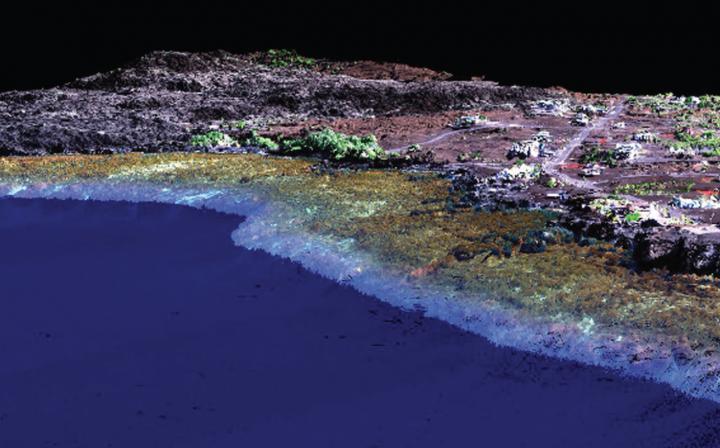
Scientific research into 3D digital applications in ecology has grown in the last decade. Landscape and seascape ecologists can now critically frame 3D ecological questions that have been challenging to answer across broad study areas--until recently. Advances in high-resolution remote sensing systems and data processing are allowing us to model the complex surface of the Earth, both above and below water, with greater detail and accuracy than ever before. 3D seamless land-sea terrain showing lidar-derived ocean floor color (with water removed via models).  CREDIT Greg Asner, Center for Global Discovery and Conservation Science, Arizona State University{module INSIDE STORY}

Future research applications in the marine environment should focus on addressing the challenges associated with integrating dynamic oceanographic information into maps capable of capturing 3D variability in the environment over time.

"3D-capable data sources have wide-ranging ecological applications and help in estimating carbon sequestration, quantifying habitat structure, mapping ecosystem services, and measuring and modeling consequences of climate change," said Asner.

As landscape and seascape ecology looks toward the future, the study notes a need for a continued progression toward a 3D science that will shift the way ecological patterns and processes are conceptualized. The paper provides key examples of 3D data application in terrestrial and marine environments to illustrate how state-of-the-art advances in ecology have been achieved through novel data fusion, spatial analysis, and visualization.

"This article highlights the unprecedented opportunity for understanding 3D ecological dynamics and human impacts on land and in the oceans, with a view to better inform management decisions," said Lisa Wedding, co-author and Associate Professor at the University of Oxford.

As a result of this 3D approach, natural resource management may support the development of conservation and management plans and shift the way that policymakers evaluate current and future regulations in a dynamic environment.

RUB researchers discover high-performance multi-element catalysts by computational prediction

Finding the best material composition among thousands of possibilities is like looking for a needle in a haystack. An international team is combining supercomputer simulations and high-throughput experiments to do this.

Catalysts consisting of at least five chemical elements could be the key to overcoming previous limitations in the production of green hydrogen, fuel cells, batteries, or CO2 reduction. However, finding the optimal composition of these multi-element catalysts is like looking for a needle in a haystack: testing thousands to millions of possible combinations cannot be realized. Therefore, research teams from Ruhr-Universität Bochum (RUB) in Germany and the University of Copenhagen in Denmark have developed an approach that can predict the optimal composition and confirm its accuracy with high-throughput experiments. They report in the journal Angewandte Chemie International Edition of 28. December 2020, DOI: 10.1002/anie.202014374 .

Much less expensive elements than previous catalysts

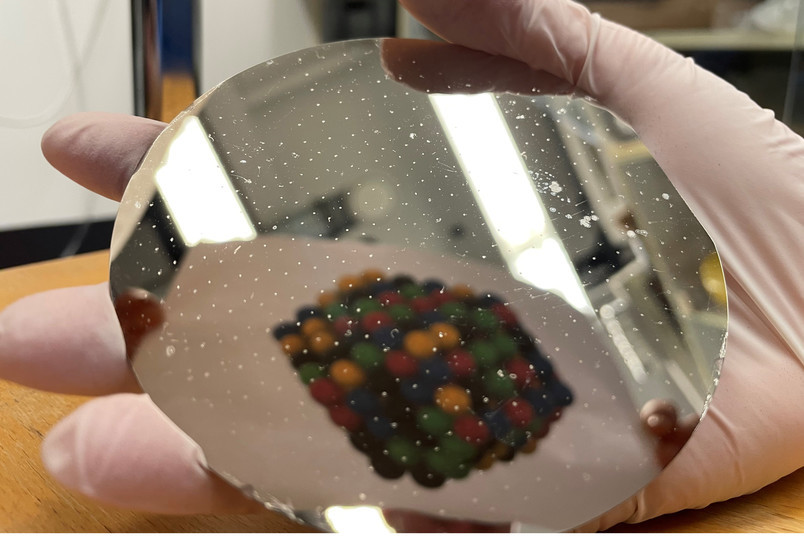
Many electrochemical reactions go through several steps. Each should be optimized on a catalyst surface if possible, but different requirements apply to each step. “Since previous catalysts usually had only one optimized functionality, one could only make the best compromise possible, and energy losses could not be avoided,” explains Professor Wolfgang Schuhmann from the Center for Electrochemistry at RUB. With complex solid solutions, several functionalities can be realized simultaneously on one catalyst surface, overcoming this limitation. However, this only happens when at least five different elements are combined. There are millions of possibilities in which percentage ratios the respective elements can be combined. The previous challenge of searching for a strategy to find optimal properties seems to be answerable with this class of materials. Now the task is to find out which combination fulfills the goal in the best possible way. “Incidentally, this may also be possible with much more favorable elements than with previous catalysts,” Schuhmann emphasizes. Hundreds of possible material combinations can be tested on such a carrier. © Tobias Löffler{module INSIDE STORY}

Make and check predictions

In their work, the research teams present an approach that offers guidance among the countless possibilities. “We have developed a model that can predict the activity for oxygen reduction as a function of composition, thus enabling calculation of the best composition,“ explains Professor Jan Rossmeisl from the Center for High Entropy Alloy Catalysis at the University of Copenhagen.

The team from Bochum provided the verification of the model. “We can use a combinatorial sputtering system to produce material libraries where each point on the surface of the support has a different composition and there are different but well-defined gradients in each direction,” explains Professor Alfred Ludwig from the Chair of New Materials and Interfaces at RUB. Using a scanning droplet cell, the catalytic properties of 342 compositions on a material library are then automatically measured to identify activity trends.

“We found that the original model did not yet do justice to the complexity and still made imprecise predictions. Therefore, we revised it and had it tested again experimentally,” says Dr. Thomas Batchelor from the Copenhagen team, who was a visiting scientist at RUB as part of the collaboration. This time, prediction and experimental measurement showed excellent agreement, which was confirmed by further material libraries.

This strategy allows the complex mechanisms at the surfaces, which consist of five chemical elements, to be identified, leaving most of the screening effort to the computer. “If the model turns out to be universally applicable to all element combinations and also to other reactions, one of the currently biggest challenges of this catalyst class would be realistically met,” the team said.