McMaster, Harvard researchers create 'intelligent' interaction between light, material; establishing a promising new platform for supercomputing

A collaboration between McMaster and Harvard researchers has generated a new platform in which light beams communicate with one another through solid matter, establishing the foundation to explore a new form of supercomputing.

Kalaichelvi Saravanamuttu, an associate professor of Chemistry and Chemical Biology at McMaster, explains that the technology brings together a form of hyrdrogel developed by the Harvard team with light manipulation and measurement techniques performed in her lab, which specializes in the chemistry of materials that respond to light.

The translucent material, which resembles raspberry Jell-O in appearance, incorporates light-responsive molecules whose structure changes in the presence of light, giving the gel special properties both to contain light beams and to transmit information between them. A collaboration between McMaster and Harvard researchers has generated a new platform in which light beams communicate with one another through solid matter, establishing the foundation to explore a new form of supercomputing.{module INSIDE STORY}
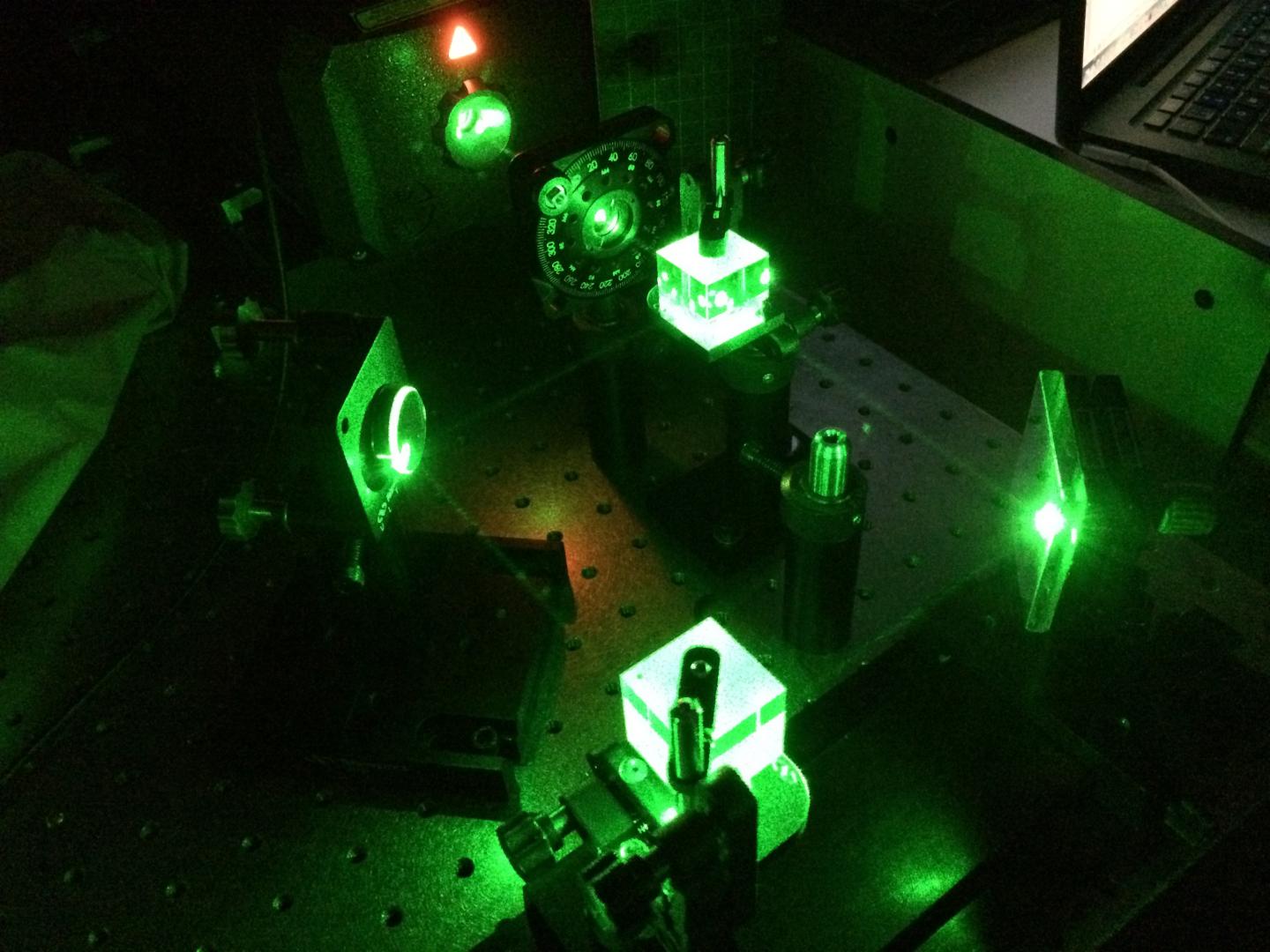
Typically, beams of light broaden as they travel, but the gel is able to contain filaments of laser light along their pathway through the material, as though the light were being channeled through a pipe.

When multiple laser beams, each about half the diameter of a human hair, are shone through the same material, the researchers have established that they affect one another's intensity, even without their optical fields overlapping at all - a fact that proves the gel is "intelligent."

The interaction between those filaments of light can be stopped, started, managed and read, producing a predictable, high-speed output: a form of information that could be developed into a circuit-free form of computing, Saravanamuttu explains.

"Though they are separated, the beams still see each other and change as a result," she says. "We can imagine, in the long term, designing computing operations using this intelligent responsiveness."

While the broader concept of computing with light is a separate and developing field unto itself, this new technology introduces a promising platform, says Derek Morim, a graduate student in Saravanamuttu's lab who is co-first author on the paper. Their work is described in a paper published today in the Proceedings of the National Academy of Sciences.

"Not only can we design photoresponsive materials that reversibly switch their optical, chemical and physical properties in the presence of light, but we can use those changes to create channels of light, or self-trapped beams, that can guide and manipulate light," he says. "Further study may allow us to design even more complex materials to manipulate both light and material in specific ways."

Amos Meeks, a graduate student at Harvard's John A. Paulson School of Engineering and Applied Sciences, said the technology helps to advance the idea of all-optical supercomputing, or computations done solely with beams of light.

"Most computation right now uses hard materials such as metal wires, semiconductors, and photodiodes, to couple electronics to light," said Meeks, who is also co-first author of the research. "The idea behind all-optical computing is to remove those rigid components and control light with light. Imagine, for example, an entirely soft, circuitry-free robot driven by light from the sun."
Dutch researchers produce the first image of hydrogen at the metal-to-metal hydride interface

University of Groningen physicists have visualized hydrogen at the titanium/titanium hydride interface using a transmission electron microscope. Using a new technique, they succeeded in visualizing both the metal and the hydrogen atoms in a single image, allowing them to test different theoretical models that describe the interface structure. The results were published on 31 January in the journal Science Advances.

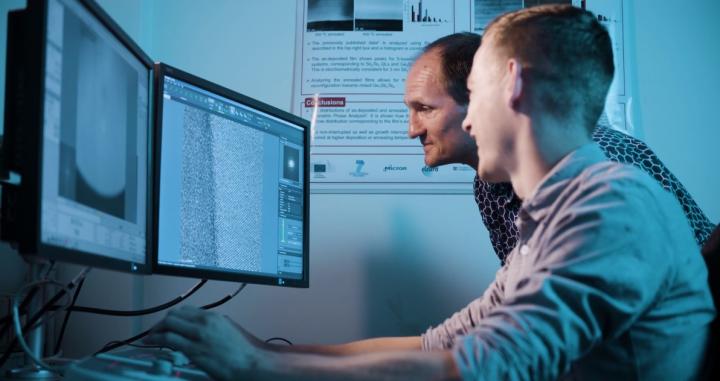
To understand the properties of materials, it is often vital to observe their structure at an atomic resolution. Visualizing atoms using a transmission electron microscope (TEM) is possible; however, so far, no one has succeeded in producing proper images of both heavy atoms and the lightest one of all (hydrogen) together. This is exactly what the University of Groningen Professor of Nanostructured Materials Bart Kooi and his colleagues have done. They used a new TEM with capabilities that made it possible to produce images of both titanium and hydrogen atoms at the titanium/titanium hydride interface. This is a picture from the control room of the new TEM by Thermo Fisher Scientific at the University of Groningen, with Prof. Dr. Bart Kooi in the background.{module INSIDE STORY}

Hydrogen atoms

The resulting pictures show how columns of hydrogen atoms fill spaces between the titanium atoms, distorting the crystal structure. They occupy half of the spaces, something which was predicted earlier. 'In the 1980s, three different models were proposed for the position of hydrogen at the metal/metal hydride interface,' says Kooi. 'We were now able to see for ourselves which model was correct.'

To create the metal/metal hydride interface, Kooi and his colleagues started out with titanium crystals. Atomic hydrogen was then infused and penetrated the titanium in very thin wedges, forming tiny metal hydride crystals. 'In these wedges, the numbers of hydrogen and titanium atoms are the same,' Kooi explains. 'The penetration of hydrogen creates a high pressure inside the crystal. The very thin hydride plates cause hydrogen embrittlement in metals, for example inside nuclear reactors.' The pressure at the interface prevents the hydrogen from escaping.

Innovations

Producing images of the heavy titanium and the light hydrogen atoms at the interface was quite a challenge. First, the sample was loaded with hydrogen. It should subsequently be viewed in a specific orientation along with the interface. This was achieved by cutting properly aligned crystals from titanium using an ion beam and making the samples thinner - to a thickness of no more than 50 nm - again using an ion beam.

The visualization of both titanium and hydrogen atoms was made possible by several innovations that were included in the TEM. Heavy atoms can be visualized by the scattering that they cause of the electrons in the microscope beam. Scattered electrons are preferably detected using high-angle detectors. 'Hydrogen is too light to cause this scattering, so for these atoms, we have to rely on constructing the image from low-angle scattering, which includes electron waves.' However, the material causes interference of these waves, which has so far made the identification of hydrogen atoms almost impossible.

Supercomputer simulations

The waves are detected by a low-angle bright-field detector. The new microscope has a circular bright-field detector that is divided into four segments. By analyzing differences in the wavefronts detected in opposing segments and looking at the changes that occur when the scanning beam crosses the material, it is possible to filter out the interferences and visualize the very light hydrogen atoms.

'The first requirement is to have a microscope that can scan with an electron beam that is smaller than the distance between the atoms. It is subsequently the combination of the segmented bright-field detector and the analytical software that makes visualization possible,' explains Kooi, who worked in close collaboration with scientists from the microscope's manufacturer, Thermo Fisher Scientific, two of whom are co-authors on the paper. Kooi's group added various noise filters to the software and tested them. They also performed extensive supercomputer simulations, against which they compared the experimental images.

Nanomaterials

The study shows the interaction between the hydrogen and the metal, which is useful knowledge for the study of materials capable of storing hydrogen. 'Metal hydrides can store more hydrogen per volume than liquid hydrogen.' Furthermore, the techniques used to visualize the hydrogen could also be applied to other light atoms, such as oxygen, nitrogen or boron, which are important in many nanomaterials. 'Being able to see light atoms next to heavy ones opens up all kinds of opportunities.'

Ultra-high energy events key to study of ghost particles

With 'Zee burst,' physicists propose new resonance beyond the standard model

Physicists at Washington University in St. Louis have proposed a way to use data from ultra-high energy neutrinos to study interactions beyond the standard model of particle physics. The 'Zee burst' model leverages new data from large neutrino telescopes such as the IceCube Neutrino Observatory in Antarctica and its future extensions.

"Neutrinos continue to intrigue us and stretch our imagination. These 'ghost particles' are the least understood in the standard model, but they hold the key to what lies beyond," said Bhupal Dev, assistant professor of physics in Arts & Sciences and author of a new study in Physical Review Letters.

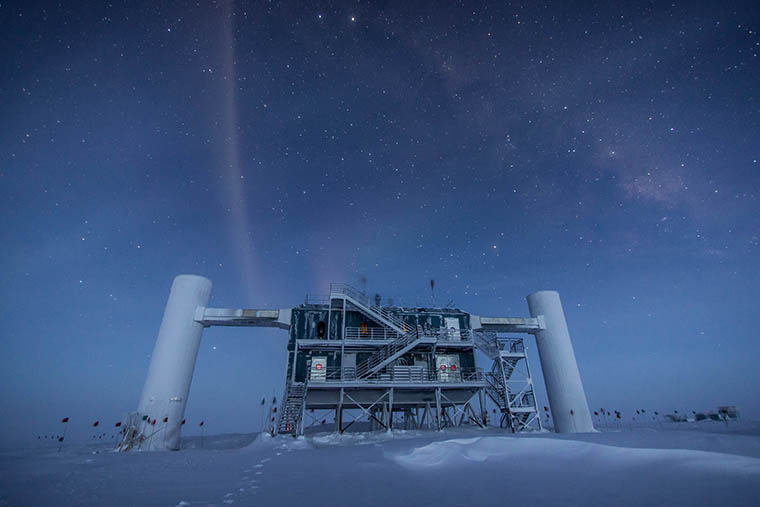
"So far, all nonstandard interaction studies at IceCube have focused only on the low-energy atmospheric neutrino data," said Dev, who is part of Washington University's McDonnell Center for the Space Sciences. "The 'Zee burst' mechanism provides a new tool to probe nonstandard interactions using the ultra-high energy neutrinos at IceCube." {module INSIDE STORY} Physicists in Arts & Sciences have proposed a new way to leverage data from large neutrino telescopes such as the IceCube Neutrino Observatory in Antarctica. (Photo: Felipe Pedreros/IceCube and National Science Foundation)

Ultra-high energy events

Since the discovery of neutrino oscillations two decades ago, which earned the 2015 Nobel Prize in physics, scientists have made significant progress in understanding neutrino properties -- but a lot of questions remain unanswered.

For example, the fact that neutrinos have such a tiny mass already requires scientists to consider theories beyond the standard model. In such theories, "neutrinos could have new nonstandard interactions with the matter as they propagate through it, which will crucially affect their future precision measurements," Dev said.

In 2012, the IceCube collaboration reported the first observation of ultra-high energy neutrinos from extraterrestrial sources, which opened a new window to study neutrino properties at the highest possible energies. Since that discovery, IceCube has reported about 100 such ultra-high energy neutrino events.

"We immediately realized that this could give us a new way to look for exotic particles, like supersymmetric partners and heavy decaying dark matter," Dev said. For the previous several years, he had been looking for ways to find signals of new physics at different energy scales and had co-authored half a dozen papers studying the possibilities.

"The common strategy I followed in all these works was to look for anomalous features in the observed event spectrum, which could then be interpreted as a possible sign of new physics," he said.

The most spectacular feature would be a resonance: what physicists witness as a dramatic enhancement of events in a narrow energy window. Dev devoted his time to think about new scenarios that could give rise to such a resonance feature. That's where the idea for the current work came from.

In the standard model, ultra-high energy neutrinos can produce a W-boson at resonance. This process, known as the Glashow resonance, has already been seen at IceCube, according to preliminary results presented at the Neutrino 2018 conference.

"We propose that similar resonance features can be induced due to new light, charged particles, which provides a new way to probe nonstandard neutrino interactions," Dev said.

Bursting onto the neutrino scene

Dev and his co-author Kaladi Babu at Oklahoma State University considered the Zee model, a popular model of radiative neutrino mass generation, as a prototype for their study. This model allows for charged scalars to be as light as 100 times the proton mass.

"These light charged Zee-scalars could give rise to a Glashow-like resonance feature in the ultra-high energy neutrino event spectrum at the IceCube Neutrino Observatory," Dev said.

Because the new resonance involves charged scalars in the Zee model, they decided to call it the 'Zee burst.'

Yicong Sui at Washington University and Sudip Jana at Oklahoma State, both graduate students in physics and co-authors of this study, did extensive event simulations and data analysis shows that it is possible to detect such a new resonance using IceCube data.

"We need an effective exposure time of at least four times the current exposure to be sensitive enough to detect the new resonance -- so that would be about 30 years with the current IceCube design, but only three years of IceCube-Gen 2," Dev said, referring to the proposed next-generation extension of IceCube with 10 km3 detector volume.

"This is an effective way to look for the newly charged scalars at IceCube, complementary to direct searches for these particles at the Large Hadron Collider."