FSU researchers use engineering, supercomputing, forestry to understand prescribed burns

In the effort to mitigate destructive wildfires, wildland managers often fight those uncontrolled fires with prescribed fire -- carefully controlled burns to safely eliminate the vegetation that piles up on forest floors and adds to potential fuel.

Prescribed fires are an important tool for managing fire-prone landscapes, but they come with a cost. Fire makes smoke, which carries tiny, unburnt particles through the air, lowering air quality and making breathing more difficult.

A $2.2 million Department of Defense grant will fund an FSU investigation into the dynamics of smoke from prescribed burns, giving land managers a better understanding of when and how to best use the technique.

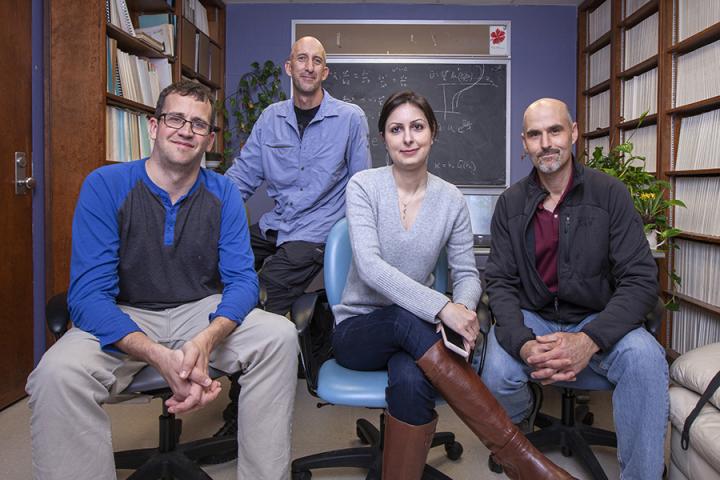
"When we understand how plumes are affected by key controls, such as the ignition pattern, this is one way that fire managers will be able to engineer plumes that have a less significant impact on communities," said Assistant Professor of Scientific Computing Bryan Quaife. CAPTION From left, Bryan Quaife, assistant professor of scientific computing, Rod Linn, of Los Alamos National Laboratory, Neda Yaghoobian, assistant professor of mechanical engineering at FAMU-FSU College of Engineering and Kevin Hiers, of the Tall Timbers Research Station & Land Conservancy, won a $2.2 million grant from the U.S. Department of Defense to study smoke plumes from prescribed fire.  CREDIT Mark Wallheiser / FAMU-FSU College of Engineering{module INSIDE STORY}
Understanding how smoke plumes develop and travel is an interdisciplinary problem. FSU researchers from the Department of Scientific Computing, the FAMU-FSU College of Engineering's Department of Mechanical Engineering and the Geophysical Fluid Dynamics Institute are partnering with the forest research station Tall Timbers, Los Alamos National Laboratory and others to understand the complexities of wildland fires.

Partnering with investigators who have fire management experience helps researchers take what they discover at an academic level and transition it to a practical application. Existing knowledge about how fires burn informs their model. They refine that with new parameters, such as the topography and distribution of vegetation that acts as fuel in a burn plot, the way wind moves through the plot, the fuel moisture and the heat radiated from the fire -- then collect data from an actual fire to make a more accurate model of how smoke plumes rise from a prescribed burn.

"We want our models to capture the true physics and our simulations to be as close to what really happens in the field as possible," said Neda Yaghoobian, an assistant professor of mechanical engineering at the FAMU-FSU College of Engineering. "This requires parameters that can take input from fire managers and other researchers to refine our model."

Fire managers using prescribed burning must balance competing interests when they decide when and where to use the tool. Smoke from fires lowers air quality. When a prescribed fire burns, managers must sometimes field complaints from people downwind, and they must be careful to ensure that smoke plumes don't carry embers that can create undesired spot fires.

But these deliberately set fires have benefits, including making uncontrolled wildfires less likely and removing invasive species. A small prescribed fire that creates little smoke is less likely to bother nearby residents, but it leaves a plot with a greater risk of wildfire in the future.

As more people live closer to woodlands, the stakes for controlling fires rise, and it becomes more challenging for fire managers to find a window to run a prescribed burn, Quaife said.

Many aspects of the procedure are out of the control of land managers, but one thing they can control is how they light the fire. For example, they can light a fire in a long line, or they can create several spot fires that burn toward each other. Researchers will examine how the different patterns of burning affect the smoke plume that is created, giving land managers a better understanding of where smoke might go.

One of the big challenges for this research is that a lot of the physics happens at very small scales. Researchers may be interested in how fire moves around a tree that is only a few inches across in a much larger plot of land. Multiply that by the many parameters they track, and the task becomes very complex. The most advanced fire simulations run on thousands of computer processors for several hours to predict a few minutes of a fire's behavior.

"From an operational point of view, that doesn't make sense," Quaife said. "Part of the work we are doing is hopefully to be able to not only develop better models but also to develop simplified models that can run in more of an operational setting, rather than something that requires a supercomputer. Obviously, when you're a prescribed fire manager, you cannot remotely log into the Los Alamos supercomputer to run a simulation and wait around for a half hour to figure out what's going to happen in the next 30 seconds."

Kevin Speer, director of the Geophysical Fluid Dynamics Institute at FSU, is contributing to this research.
UC engineering prof. John 'Marty' Emmert leads new research center for hardware security risks

Six American universities will work with government and industry to thwart efforts by hackers, counterfeiters, and terrorists to exploit security weaknesses in computer chips and other electronics.

The University of Cincinnati will lead a new National Science Foundation research center to protect electronics and networked systems from sabotage, hacking or spying.

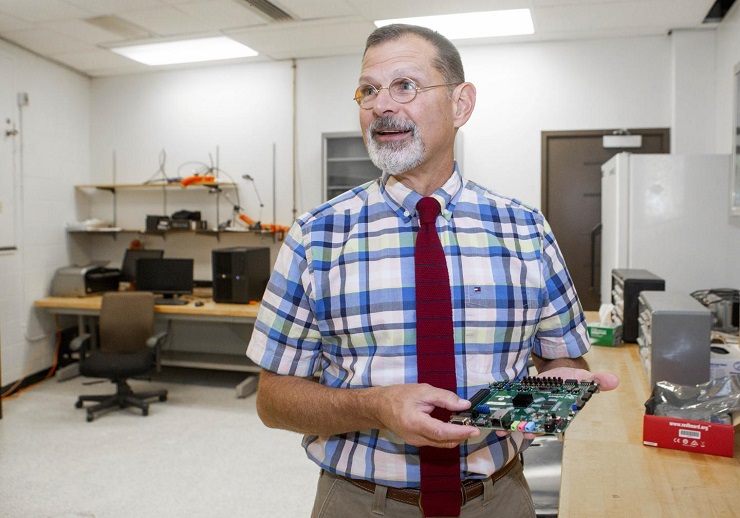
The Center for Hardware and Embedded Systems Security and Trust will be UC's latest industry-university Cooperative Research Center. The center will work with the National Science Foundation, the U.S. Department of Defense and industry leaders to conduct research designed to thwart outside attack, UC engineering professor John "Marty" Emmert said. CAPTION UC engineering professor John 'Marty' Emmert is director of a new national research center sponsored by the National Science Foundation.  CREDIT Joseph Fuqua II/UC Creative Services{module In-article}

"Building consumer trust in technology is central to our work," said Emmert, who will serve as director of the new center and principal investigator of the project.

The National Science Foundation will fund the center with an initial $4.5 million grant for UC and its academic partners: the University of Virginia, the University of Connecticut, Northeastern University, the University of Texas at Dallas and the University of California, Davis.

The center will work with private companies, government agencies, and nonprofits that will contribute annual membership fees of as much as $50,000 to investigate their unique vulnerabilities. The private members include companies such as financial consultants Booz Allen Hamilton and publisher Wiley.

UC's new center will have its own lab space in UC's College of Engineering and Applied Science. Emmert said the center will be able to harness UC's collective expertise across disciplines in collaboration with the other universities.

Emmert said one pressing problem is finding a way to ensure the authenticity of computer chips. The use of flawed counterfeit circuits could lead to catastrophic failures in aviation, communications or weapons systems. 

"The issue most important to industry is IT protection. Part of our mission will be to develop techniques to avoid circuit counterfeiting," Emmert said.

UC professor Marc Cahay, head of UC's Department of Electrical Engineering and Computer Science, said the center's research focus is likely to attract widespread interest.

"The research is very relevant now and of great interest to government and industry. So far, at least 70 companies have expressed interest in participating," Cahay said.

University of Virginia professor James Lambert said the center will work with its industry partners to address security risks.

"Vulnerabilities to cyberattacks can be introduced during design, manufacturing or any stage of the product lifecycle," Lambert said. "By working with industry and government partners to understand what the real issues are and to ask the right questions, we are helping to address security, assurance, and trust across all stages."

Mason Engineering's Wei aims to fine-tune supercomputer model to help others see better

When Mason Engineering's Qi Wei sees people with vision troubles, she knows there is more to the problem than meets the eye.

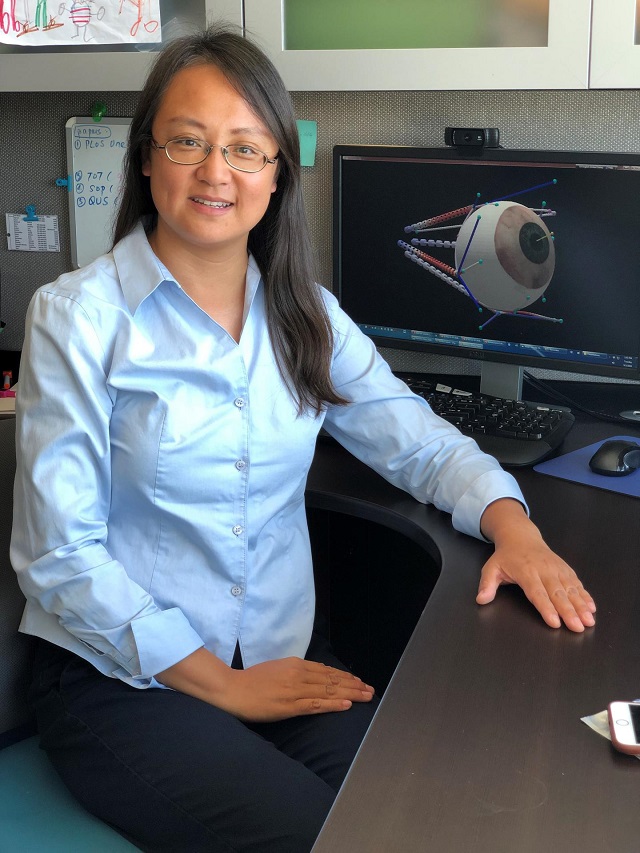
She researches strabismus, which is misaligned crossed eyes. "When people have strabismus, their eyes don't line up to look at the same place at the same time," says Wei, an associate professor in the Department of Bioengineering. Qi Wei, an associate professor in the bioengineering department, is fine-tuning a supercomputer model that will help with the diagnosis and treatment of crossed eyes. Mason Engineering's Qi Wei is studying strabismus.{module In-article}

One or both eyes may turn in, out, up or down. It's a prevalent problem, especially with children. It affects 18 million people in the United States. "Strabismus can be debilitating because people with the condition develop double vision, blurred vision, eyestrain, or other symptoms impairing daily activities."

Wei and three other principal investigators from different universities are creating a data-driven supercomputer model of the eye for diagnosing and treating strabismus with almost $1.8 million in funding from the National Institutes of Health. "We hope the neuro-biomedical model we are developing will help doctors better determine how best to treat strabismus," she says.

Each eye has six extraocular muscles that control eye position and movement. Strabismus occurs when these muscles don't function properly due to complex neurological, anatomical, or perceptual abnormalities, she says.

Some people are born with the condition, while others develop it later due to medical conditions or other reasons, Wei says.

It's complicated and hard to diagnose and treat effectively, she says. Typically, the condition is treated with surgery that manipulates one or more extraocular muscles. Generally, surgeons rely on experience and intuition to decide the best surgical treatment, she says.

Although a few computer models for the treatment of the condition exist, Wei and colleagues are fine-tuning their model, which will overcome others' critical limitations. Using clinical data from 50 strabismic patients who've been operated on, the team will test hypotheses that they hope will advance the knowledge on treating two common types of strabismus.

The model will include clinical information from patients' MRIs, the surgical procedures used to correct the condition, and surgical outcomes. Co-investigator Joseph Demer, an ophthalmologist and biomedical engineer with the Stein Eye Institute at UCLA, operates on patients with strabismus. He provides the data and assists with clinical interpretations of the model.

Mike Buschmann, chair of Mason's bioengineering department says, "Dr. Wei uses a sophisticated approach to modeling eye movements and worked closely with the clinical community to get one step closer to solving some very significant problems in human vision. The future of her research holds great promise and is a shining example of collaboration between a bioengineer and a clinician."

Wei, a computer scientist by training, says the biomedical field "lets you work on a real problem and make it better."

She understands the fear and frustration of having eye issues. "I don't have strabismus, but I'm very nearsighted. Without glasses, I can't walk outside. I've had glasses since I was seven years old.

"I am still nervous when I am tested on the vision chart," she says. "I hope that one-day people can be treated more effectively taking advantage of scientific tools.

"Strabismus is complicated, and computer models might be flawed, but someone has to come up with a breakthrough," she says.