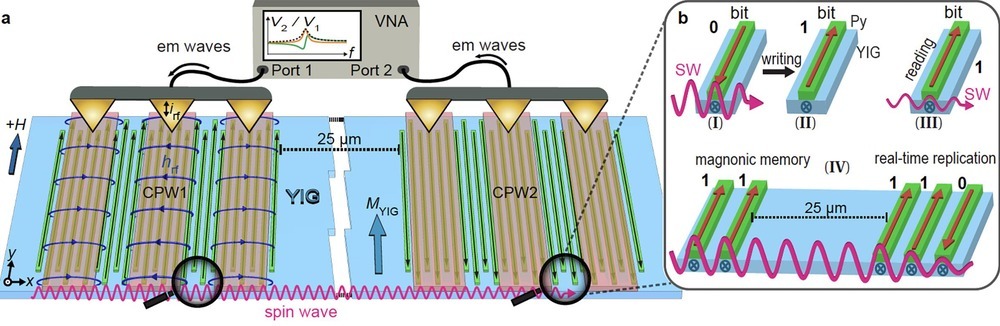
An “SIS amplifier” using two SIS mixers, one at each ends. (Credit: NAOJ)

Japanese prof Kojima builds small but mighty superconducting amplifiers that deliver high performance at lower power consumption

Researchers have devised a new concept of superconducting microwave low-noise amplifiers for use in radio wave detectors for radio astronomy observations and successfully demonstrated a high-performance cooled amplifier with power consumption three orders of magnitude lower than that of conventional cooled semiconductor amplifiers. This result is expected to contribute to the realization of large-scale multi-element radio cameras and error-tolerant quantum supercomputers, both of which require a large number of low-noise microwave amplifiers.

The device they used is called an SIS mixer. The SIS mixer is named after its structure, a skinny film of insulator material sandwiched between two layers of superconductors (S-I-S). In a radio telescope, cosmic radio waves collected by an antenna are fed into an SIS mixer, and the output signal is amplified by low-noise semiconductor amplifiers. An SIS mixer operates in a very low-temperature environment, as low as 4 Kelvin (-269 degrees Celsius), and the amplifiers are also used at that temperature.

To improve the performance of radio telescopes, researchers are developing a large-format radio camera equipped with 2D arrays of SIS mixers and amplifiers. However, power consumption is a limiting factor. The typical power consumption of a semiconductor amplifier is about 10 mW, and by assembling 100 sets of detectors, the total power consumption reaches the maximum cooling capacity of a 4 Kelvin refrigerator.

The research team led by Takafumi Kojima, an associate professor at the National Astronomical Observatory of Japan (NAOJ), has come up with a simple but innovative idea to realize a superconductor amplifier by connecting two SIS mixers. The team exploits the basic functions of the SIS mixer: frequency conversion and signal amplification. “The most important point is that the power consumption of an SIS mixer is, in principle, as low as microwatts,” says Kojima. “This is three orders of magnitude less than that of a cooled semiconductor amplifier.”

After obtaining successful preliminary results in 2018, the team advanced both the theoretical studies of the system and the physical implementation of its various components. In the end, the research team optimized the system and realized an “SIS amplifier” with 5 - 8 dB (three to six times) gain below the frequency of 5 GHz and a typical noise temperature of 10 K, which is comparable to the current cooled semiconductor amplifiers such as HEMT and HBT, but with much lower power consumption.

“By changing the configuration of the components, we can further improve the gain and low-noise performance of an SIS amplifier,” explains Kojima. “The idea of connecting two SIS mixers has broader applications for making various electronics that have functions other than amplification.”

Interestingly, this low-noise, low-power-consumption amplifier is also highly anticipated for large-scale error-tolerant quantum computers. Currently available quantum computers are small-scale with less than 100 qubits, but larger-scale, error-tolerant general-purpose quantum computers will require more than 1 million qubits. To handle a large number of qubits, a large number of amplifiers must also be installed, and dramatic reductions in amplifier power consumption are needed.

NAOJ has experience in the development of superconducting receivers for a number of radio telescopes, including NAOJ’s Nobeyama 45-meter Radio Telescope, which started operation in 1982. NAOJ is also currently working to upgrade the superconducting receivers to improve the performance of the Atacama Large Millimeter/submillimeter Array (ALMA), which is operated in the Republic of Chile in cooperation with East Asia, Europe, and North America. Of the 10 types of receivers (corresponding to 10 different frequency bands) currently installed on ALMA, three were developed by NAOJ, and the SIS chips at the heart of these receivers were also developed and produced in the cleanroom of the NAOJ Advanced Technology Center (ATC). The NAOJ ATC continues to promote research on the miniaturization and integration of superconducting circuits, not only for realizing more powerful radio telescopes but also for their potential as the basis of various technologies that will support society in the new era, such as quantum supercomputing.


Sam Harris update on dangers of AI | Lex Fridman Podcast Clips

Sam Harris update on dangers of AI | Lex Fridman Podcast Clips

Lex Fridman Podcast full episode: https://www.youtube.com/watch?v=Qyrjgf-_Vdk Please support this podcast by checking out our sponsors: - Notion: https://notion.com - Indeed: https://indeed.com/lex to get $75 credit - MasterClass: https://masterclass.com/lex to get 15% off GUEST BIO: Sam Harris is an author, podcaster, and philosopher. PODCAST INFO: Podcast website: https://lexfridman.com/podcast...

Read more

Leeds geophysicists show how activity deep in Earth affects the global magnetic field

Compass readings that do not show the direction of true north and interference with the operations of satellites are a few of the problems caused by peculiarities of the Earth’s magnetic field. 

The magnetic field radiates worldwide and far into space, but it is set by processes that happen deep within the Earth’s core, where temperatures exceed 5,000 degrees C. 

New research from geophysicists at the University of Leeds suggests that the way this super-hot core is cooled is critical to understanding the causes of the peculiarities - or anomalies, as scientists call them - of the Earth’s magnetic field. 

Dynamo at the center of the Earth 

In the extremely hot temperatures found deep in the Earth, the core is a mass of swirling, molten iron which acts as a dynamo. As the molten iron moves, it generates the Earth’s global magnetic field. 

Convective currents keep the dynamo turning as heat flows out of the core and into the mantle, a rock layer that extends 2900 kilometers up to the Earth’s crust.  

Research by Dr. Jonathan Mound and Professor Christopher Davies, from the School of Earth and Environment at Leeds, has found that this cooling process does not happen in a uniform way across the Earth - and these variations cause anomalies in the Earth’s magnetic field.  

Seismic analysis has identified that regions of the mantle, under Africa and the Pacific for instance, are particularly hot. Supercomputer simulations by the researchers have revealed that these hot zones reduce the cooling effect on the core – and this causes regional or localized changes to the properties of the magnetic field. 

For example, where the mantle is hotter, the magnetic field at the top of the core is likely to be weaker.  

And this results in a weaker magnetic field which is projected into space above the South Atlantic, which causes problems for orbiting satellites. 

Interference with space technology 

Dr. Mound, who led the study, said: “One of the things that the magnetic field in space does is deflect charged particles emitted from the sun. When the magnetic field is weaker, this protective shield is not so effective.  

“So, when satellites pass over that area, these charged particles can disrupt and interfere with their operations.” 

Scientists have known about the anomaly over the South Atlantic since they started monitoring and observing the magnetic field, but it is not known if it is a long-lived feature or something that has happened more recently in the history of the Earth.  

As the study at Leeds has revealed, the anomalies are likely to be caused by differences in the rate at which heat is flowing from the Earth’s core into the mantle. Whereabouts in the Earth’s inner structure these heat flow differences happen is likely to dictate how long they could last. 

Dr. Mound added: “Processes in the mantle happen very slowly, so we can expect the temperature anomalies in the lower mantle will have stayed the same for tens of millions of years. Therefore, we would expect the properties of the magnetic field they create also to have been similar over tens of millions of years.  

“But the hotter, the outer core is quite a dynamic fluid region. So, the heat flow and the magnetic field properties they cause will probably fluctuate on shorter time scales, perhaps for 100's to thousands of years.” 

NASA's Fermi animates the dynamic gamma-ray sky which required about three months of processing time

Cosmic fireworks, invisible to our eyes, fill the night sky. We can get a glimpse of this elusive light show thanks to the Large Area Telescope (LAT) aboard NASA’s Fermi Gamma-ray Space Telescope, which observes the sky in gamma rays, the highest-energy form of light. Watch a cosmic gamma-ray fireworks show in this animation using just a year of data from the Large Area Telescope (LAT) aboard NASA’s Fermi Gamma-ray Space Telescope. Each object’s magenta circle grows as it brightens and shrinks as it dims. The yellow circle represents the Sun following its apparent annual path across the sky. The animation shows a subset of the LAT gamma-ray records now available for more than 1,500 objects in a new, continually updated repository. Over 90% of these sources are a type of galaxy called a blazar, powered by the activity of a supermassive black hole. Credits: NASA's Marshall Space Flight Center/Daniel Kocevski

This animation shows the gamma-ray sky’s frenzied activity during a year of observations from February 2022 to February 2023. The pulsing circles represent just a subset of more than 1,500 light curves – records of how sources change in brightness over time – collected by the LAT over nearly 15 years in space.

Thanks to the work of an international team of astronomers, this data is now publicly available in a continually updated interactive library. A paper about the repository was published on March 15, 2023, in The Astrophysical Journal Supplement Series.

“We were inspired to put this database together by astronomers who study galaxies and wanted to compare visible and gamma-ray light curves over long time scales,” said Daniel Kocevski, a repository co-author and an astrophysicist at NASA’s Marshall Space Flight Center in Huntsville, Alabama. “We were getting requests to process one object at a time. Now the scientific community has access to all the analyzed data for the whole catalog.”

Over 90% of the sources in the dataset are blazars, central regions of galaxies hosting active supermassive black holes that produce powerful particle jets pointed almost directly at Earth. Ground-based observatories, like the National Science Foundation’s IceCube Neutrino Observatory in Antarctica, can sometimes detect high-energy particles produced in these jets. Blazars are important sources for multimessenger astronomy, where scientists use combinations of light, particles, and space-time ripples to study the cosmos.

“In 2018, astronomers announced a candidate joint detection of gamma rays and a high-energy particle called a neutrino from a blazar for the first time, thanks to Fermi LAT and IceCube,” said co-author Michela Negro, an astrophysicist at the University of Maryland, Baltimore County, and NASA’s Goddard Space Flight Center in Greenbelt, Maryland. “Having the historical light curve database could lead to new multimessenger insights into past events.”

In the animation, each frame represents three days of observations. Each object's magenta circle grows as it brightens and shrinks as it dims. Some objects fluctuate throughout the entire year. The reddish-orange band running across the middle of the sky is the central plane of our Milky Way galaxy, a consistent gamma-ray producer. Lighter colors there indicate a brighter glow. The yellow circle shows the Sun’s apparent annual trajectory across the sky.

Processing the full catalog required about three months, or more than 400 computer years of processing time distributed over 1,000 nodes on a supercomputer cluster located at the SLAC National Accelerator Laboratory in Menlo Park, California.

The LAT, Fermi’s primary instrument, scans the entire sky every three hours. It detects gamma rays with energies ranging from 20 million to over 300 billion electron volts. For comparison, the energy of visible light mostly falls between 2 to 3 electron volts.

The Fermi Gamma-ray Space Telescope is an astrophysics and particle physics partnership managed by Goddard. Fermi was developed in collaboration with the U.S. Department of Energy, with important contributions from academic institutions and partners in France, Germany, Italy, Japan, Sweden, and the United States.

This view of Jupiter’s icy moon Europa was captured by the JunoCam imager aboard NASA’s Juno spacecraft during the mission’s close flyby on Sept. 29, 2022. The agency’s Europa Clipper spacecraft will explore the moon when it reaches orbit around Jupiter in 2030. Credit: Image data: NASA/JPL-Caltech/SwRI/MSSSImage processing: Kevin M. Gill CC BY 3.0

NASA supercomputing shows ocean currents may affect the rotation of Europa’s icy crust

Research reveals a new explanation for how the icy shell of Jupiter’s moon Europa rotates at a different rate than its interior. NASA’s Europa Clipper will take a closer look.

NASA scientists have strong evidence that Jupiter’s moon Europa has an internal ocean under its icy outer shell – an enormous body of salty water swirling around the moon’s rocky interior. New supercomputer modeling suggests the water may be pushing the ice shell along, possibly speeding up and slowing down the rotation of the moon’s icy shell over time.

Scientists have known that Europa’s shell is probably free-floating, rotating at a different rate than the ocean below and the rocky interior. The new modeling is the first to show that Europa’s ocean currents could be contributing to the rotation of its icy shell.

A key element of the study involved calculating drag – the horizontal force that the moon’s ocean exerts on the ice above it. The research hints at how the power of the ocean flow and its drag against the ice layer could even account for some of the geology seen on Europa’s surface. Cracks and ridges could result from the icy shell slowly stretching and collapsing over time as it is pushed and tugged by the ocean currents.

“Before this, it was known through laboratory experiments and modeling that heating and cooling of Europa’s ocean may drive currents,” said Hamish Hay, a researcher at the University of Oxford and lead author of the study published in JGR: Planets. Hay performed the research while a postdoctoral research associate at NASA’s Jet Propulsion Laboratory in Southern California. “Now our results highlight a coupling between the ocean and the rotation of the icy shell that was never previously considered.”

It might even be possible, using measurements gathered by NASA’s upcoming Europa Clipper mission, to determine with precision how fast the icy shell rotates. When scientists compare images gathered by Europa Clipper with those captured in the past by NASA’s Galileo and Voyager missions, they will be able to examine locations of ice surface features and potentially determine if the position of the moon’s icy shell has changed over time.

For decades, planetary scientists have debated whether Europa’s icy shell might be rotating faster than the deep interior. But rather than tying it to the ocean’s movement, scientists focused on an outside force: Jupiter. They theorized that as the gas giant’s gravity pulls on Europa, it also tugs on the moon’s shell and causes it to spin slightly faster.

“To me, it was completely unexpected that what happens in the ocean’s circulation could be enough to affect the icy shell. That was a huge surprise,” said co-author and Europa Clipper Project Scientist Robert Pappalardo of JPL. “And the idea that the cracks and ridges we see on Europa’s surface could be tied to the circulation of the ocean below – geologists don’t usually think, ‘Maybe it’s the ocean doing that.’”

Europa Clipper, now in its assembly, test, and launch operations phase at JPL, is set to launch in 2024. The spacecraft will begin orbiting Jupiter in 2030 and will use its suite of sophisticated instruments to gather science data as it flies by the moon about 50 times. The mission aims to determine if Europa, with its deep internal ocean, has conditions that could be suitable for life.

Like a Pot of Water

Using techniques developed to study Earth’s oceans, the paper’s authors relied on NASA supercomputers to make large-scale models of Europa’s oceans. They explored the complexities of how the water circulates, and how heating and cooling affect that movement.

Scientists believe that Europa’s internal ocean is heated from below, due to radioactive decay and tidal heating within the moon’s rocky core. Like water heating in a pot on a stove, Europa’s warm water rises to the top of the ocean.

In the simulations, the circulation initially moved vertically, but the rotation of the moon as a whole caused the flowing water to veer in a more horizontal direction – in east-west and west-east currents. The researchers, by including drag in their simulations, were able to determine that if the currents are fast enough, there could be an adequate drag on the ice above to speed up or slow down the shell’s rotation speed. The amount of interior heating – and thus, circulation patterns in the ocean – may change over time, potentially speeding up or slowing the rotation of the icy shell above.

“The work could be important in understanding how other ocean worlds’ rotation speeds may have changed over time,” Hay said. “And now that we know about the potential coupling of interior oceans with the surfaces of these bodies, we may learn more about their geological histories as well as Europa’s.”